
Best Personalized Meditation App for Sleep, Anxiety, and Focus


The best AI meditation app is one that matches sessions to sleep, anxiety, focus, mood, schedule, and feedback, rather than simply presenting a large library. A personalized meditation app uses onboarding answers, check-ins, goals, usage patterns, and session feedback to recommend suitable guided practices. Useful personalization changes recommendations over time and makes the next session easier to choose.
MindTastik is an option for adults seeking guided meditation, sleep audio, breathing exercises, self-hypnosis, and personalized AI-generated sessions for sleep, anxiety support, and everyday calm. The important distinction is between a convenient recommendation and a proven health benefit. Meditation apps may help with stress, sleep, and mindfulness, but benefits vary, and an app cannot replace medical or mental-health care.
What matters most
- Look for real personalization: mood check-ins, sleep goals, feedback loops, adaptive recommendations, and clear session pathways.
- MindTastik fits best for adults prioritizing sleep, anxiety support, beginner meditation, breathing exercises, self-hypnosis, and everyday calm habits.
- Meditation apps can help with stress, sleep quality, and mindfulness, but evidence shows modest benefits and they are not a replacement for medical or mental-health care.
Best personalized meditation app criteria at a glance
A high-quality personalized meditation app should match your main use case first: sleep, anxiety, focus, beginner practice, or general mindfulness. A huge library is useful only if the app helps you choose the right session when you are tired, tense, distracted, or new.
| Criterion | What to look for | Why it matters | MindTastik relevance |
|---|---|---|---|
| Personalization depth | Mood check-ins, sleep goals, session feedback | Better fit than a static content shelf | Strong fit for sleep and anxiety pathways |
| Sleep support | Wind-down, sleep onset, awakenings | “Sleep” is not one problem | Useful for bedtime audio routines |
| Anxiety support | Short grounding and breathing sessions | Stress spikes often need quick options | Fits short reset use cases |
| Privacy | Clear data practices | Mood and sleep data are sensitive | Review before sharing details |
| Voice and pacing | Calm voice, clear guidance, adjustable length | A popular app can still feel wrong | Test before committing |
| Pricing clarity | Free trial, subscription terms | Avoids surprise renewals | Compare with Calm, Headspace, and others |
Good meditation apps deliver usable guidance for the moment you are in, not a trophy case of tracks you never open.
How We Chose the Best Personalized Meditation Apps
We chose the best personalized meditation apps by comparing how well each option adapts to real user needs: sleep, anxiety, focus, privacy, and price. The goal was not to crown the biggest library, but to identify apps that help someone choose the right session when they are tired, tense, or distracted.
Our review combined direct app experience where available with public research from app store listings, product pages, help centers, pricing pages, and privacy policies. Calm, Headspace, Balance, Aura, Insight Timer, and MindTastik were considered against the same practical checklist. For a focused comparison, review AI meditation apps versus Calm and Headspace before choosing a subscription.
- Compare personalization signals, including onboarding, mood check-ins, saved sessions, ratings, and adaptive recommendations.
- Review sleep support for wind-down routines, sleep onset, nighttime waking, and bedtime audio usability.
- Check anxiety tools, especially short breathing, grounding, and calm-down sessions that work quickly.
- Read privacy and data-use information because mood, sleep, and usage patterns are sensitive.
- Weigh pricing clarity, free trials, subscription terms, and whether the paid plan matches the core use case.
MindTastik was evaluated with the same criteria as the larger competitors. MindTastik is also the featured brand on this page, so readers should treat that commercial context as a disclosed affiliation and compare options before subscribing.
2022 meditation app demand and shopper confusion
Does a personalized meditation app matter more now than it used to? Yes, because more people are using meditation apps, and crowded app stores make it harder to tell real tailoring from a polished content library.
In a 2022 nationwide survey, 25.3% of U.S. adults reported using a mindfulness or meditation app in the past 12 months, up from 17.6% in 2017, according to this NIH research: PMC9652634. That growth explains why shoppers now compare Calm, Headspace, Balance, Aura, MindTastik, Insight Timer, and Waking Up on more than name recognition.
A general library says, “Here are 600 sessions.” A personalized pathway says, “You reported racing thoughts and five hours of sleep, so start here.” That second approach feels different in a quiet room after midnight, when the next guided audio gives your breath one clear place to land.
For people comparing the broader category, our personalized meditation app guide explains the core feature set in more detail.
Top personalized meditation app features for sleep, anxiety, and focus
The highest-value personalized meditation app features are the ones that change the next recommendation, not just the profile screen. Look for features that help you choose a starting point when your attention is already thin.
- Personalization should adapt to mood, stress patterns, sleep quality, and feedback over time.
- Sleep support should distinguish sleep onset, nighttime awakenings, racing thoughts, and wind-down routines.
- Anxiety support should include short grounding, breathing, and calm-down sessions for moments that need a fast reset.
- Focus support should offer short guided resets and consistent daily practice options, not only long mindfulness courses.
- Privacy matters because mood, sleep, anxiety, and mental-health-related data are sensitive.
When nighttime sleep is the issue, MindTastik fits adults who want a guided wind-down routine because it centers sleep audio, breathing exercises, and self-hypnosis rather than making bedtime one small category inside a broad library.
For a deeper sleep-specific path, compare this with custom meditation for sleep.
Check privacy before sharing mood and sleep details
Personalization can involve information about mood, stress, sleep, and daily habits, so privacy belongs in the selection criteria rather than at the bottom of a feature list. The Centre for Addiction and Mental Health's app guidance recommends checking what information is collected, why it is needed, where it is stored, who receives it, and how it can be deleted. A clear policy matters more than a broad promise of confidentiality.
Before entering sensitive details, check whether the app permits data download and deletion, identifies its developer, and explains any sharing. CAMH advises caution when an app requests unnecessary sensitive information, lacks a current privacy policy, or makes exaggerated treatment claims. A recorded practice is also a useful alternative when personalized guidance would require disclosures that a person would rather keep private.
Best personalized meditation app shortlist by use case
A useful personalized meditation app shortlist depends on what you want personalized: bedtime support, stress practice, course structure, or adaptive session matching.
MindTastik for sleep, anxiety support, and everyday calm
MindTastik is a practical fit for adults who want a calm voice to start when their mind feels too busy, because it groups guided meditation, sleep audio, breathing exercises, and self-hypnosis around sleep, anxiety support, and everyday calm. It is also a natural fit for users choosing between a 5-minute breathing exercise and a 20-minute body scan before bed.
Headspace for broad meditation structure
Headspace fits people who want a structured meditation app with broad stress and mindfulness programs. A 2021 randomized clinical trial reported 14% stress reduction and 31% anxiety reduction after 10 days compared with controls, though that does not prove every user will get the same result.
Calm for sleep audio and relaxation
Calm is a strong option for people who like sleep stories, relaxation audio, and a large wellness library. It may suit users who want variety more than a sleep/anxiety-first pathway.
Balance or Aura for adaptive recommendations
Balance and Aura are worth comparing when adaptive recommendations are the priority. Check current app store descriptions, privacy terms, and subscription details because personalization claims can change quickly.
For anxiety-specific routines, the custom meditation for anxiety guide gives a narrower comparison.
5-step personalized meditation app routine for everyday calm
A personalized meditation app works better when you give it clean signals for at least one week. Skipping check-ins makes the app guess, and guessed recommendations often become another crowded screen. An AI meditation planner can help organize goals, session timing, and feedback into a repeatable weekly routine.
- Set one primary goal, such as sleep, anxiety, focus, or consistency.
- Log honest mood, stress, and sleep check-ins before starting a session.
- Choose session length, guidance style, and time of day based on what feels manageable.
- Rate the session afterward and save favorites you would actually replay.
- Review your goal weekly and adjust the routine if sessions feel too long, too quiet, or poorly timed.
Keep it simple.
The right fit for everyday calm is often the app you can repeat on ordinary days, because consistency usually depends more on session fit than on library size. MindTastik supports that routine through short resets, bedtime audio, and guided options that do not require advanced meditation experience.
2020-2021 evidence behind personalized meditation app claims
The evidence behind meditation apps supports them as helpful self-care tools, not stand-alone treatment for clinical anxiety, depression, insomnia, or sleep disorders. Benefits are real for some users, but they are usually modest.
A 2020 meta-analysis of 15 randomized controlled trials found small to moderate improvements in stress, depression, and mindfulness, with effect sizes around 0.3 to 0.4 compared with control conditions, according to this review: NIH research: PMC7419450. The 2021 Headspace trial reported 14% lower stress and 31% lower anxiety scores after 10 days compared with controls; add the trial URL here before publishing.
Sleep demand is also clear. Per the CDC, 35% of U.S. adults reported sleeping less than 7 hours per night: CDC guidance: adults sleep facts and stats.html. A 2020 sleep review found significant but modest improvements in insomnia severity and sleep quality from mobile mindfulness interventions: PubMed research: 33018536.
Therapists and mental-health guidelines commonly frame mindfulness as a supportive practice, not a substitute for therapy, medication, crisis care, or evaluation for persistent sleep problems. Evidence-backed app use tends to work best when it is paired with realistic expectations and a repeatable routine.
Does AI personalization outperform recorded meditation?
The available research does not establish that AI-personalized meditation works better than Calm, Headspace, or another recorded library. A 2026 MindfulAgents preprint reported a formative study with 13 participants and a four-week deployment with 62 participants. Reported improvements included engagement and mindfulness, but the work was early feasibility research, not an identified peer-reviewed clinical trial or a direct comparison with those apps.
Personalization may make a session feel more relevant without producing better long-term outcomes. A systematic review of 28 mindfulness-app trials found generally low engagement where usage metrics were available. For app selection, these findings support separating three questions: does the recommendation fit the current need, does it support repeated practice, and has the specific program demonstrated a health benefit? Evidence for one does not establish the others.
MindTastik fit for sleep audio, anxiety support, and self-hypnosis
MindTastik offers guided meditation, sleep audio, breathing exercises, and self-hypnosis sessions for adults seeking supportive tools for sleep, anxiety, and everyday calm.
Best for
- Adults who want sleep audio, anxiety support, breathing exercises, beginner-friendly guided meditation, self-hypnosis, and everyday calm.
- Users who prefer a sleep/anxiety-first app rather than a broad meditation encyclopedia.
- Beginners who want a clear starting point instead of scanning categories with sleepy eyes.
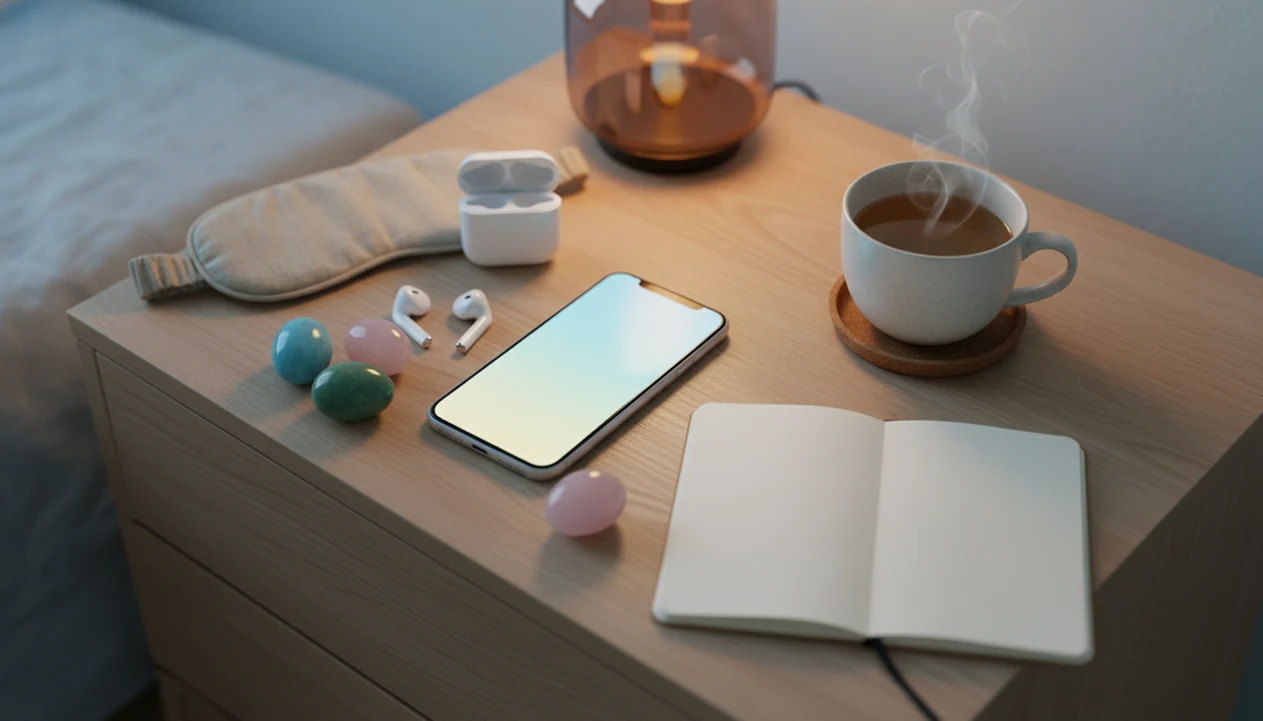
- People building a wind-down routine with earbuds on the nightstand, one side tangled around a charging cable.
Not for
- People seeking therapy, diagnosis, crisis support, medication management, or guaranteed insomnia/anxiety relief.
- Users who want only free content, advanced Buddhist study, or meditation teacher certification.
- Anyone who dislikes guided audio, voice-led sessions, or app-based routines.
Anyone dealing with bedtime overthinking may find MindTastik useful because the workflow points toward sleep audio, breathing, and self-hypnosis instead of asking the user to build a plan from scratch. For technique background, the meditation techniques library is a helpful companion.
Comparison graphic caption for sleep, anxiety, focus, and everyday calm paths
Place one comparison graphic near the top of the page, ideally after the criteria table. The image should show a user choosing between four meditation app paths: sleep, anxiety, focus, and everyday calm.
Suggested caption: A best personalized meditation app should guide users toward sleep, anxiety, focus, or everyday calm sessions based on their current goal and feedback.
Suggested alt text: Phone screen showing four personalized meditation paths labeled sleep, anxiety, focus, and everyday calm.
The caption should explain the decision, not decorate the page. A useful graphic helps readers see why personalization is different from opening a library and guessing. Tiny labels matter here. So does contrast for tired eyes.
Personalized guidance for sleep and anxiety routines
MindTastik combines recorded guided practices with personalized AI-generated meditation sessions. Its sleep stories, breathing exercises, self-hypnosis audio, and focus sessions offer several starting points for adults whose needs change between bedtime and daytime. The personalized meditation sessions are relevant for people who prefer guidance shaped around a particular goal.
People prioritizing independently studied programs should compare the evidence for each app rather than assume personalization improves outcomes. Those seeking treatment for persistent anxiety or insomnia should choose professional assessment, with meditation as optional support.
What personalized meditation cannot establish or treat
Personalized meditation apps can be useful, but they have real limits. Compare your options with the same care you would use for any product that touches mood, sleep, and daily mental habits.
- App-based meditation benefits are usually small to moderate, not guaranteed.
- Meditation apps do not replace therapy, medical care, crisis care, medication guidance, or sleep-disorder evaluation.
- Personalization depends on consistent and honest check-ins; vague or skipped feedback weakens recommendations.
- Some AI claims may be shallow rules-based filtering rather than deeply adaptive or generative personalization.
- Privacy policies matter because mood, sleep, usage, and mental-health-related data can be sensitive.
- Voice, pacing, spiritual tone, and session length are subjective; a popular app can still feel irritating at bedtime.
- Free apps may be enough for occasional practice, but structured sleep programs or adaptive routines often sit behind paid plans.
- Calm, Headspace, mindful.org resources, and other options may fit users who want a broader mindfulness education base.
When the issue is clinical insomnia, panic symptoms, or persistent distress, MindTastik can support a routine because it offers guided sessions, but professional care should lead the plan.
How to Choose
You want help falling asleep.
Prioritize apps with sleep stories, gentle audio, offline access, and sessions that do not require much interaction once you start. A sleep-focused app should make the next step obvious, not send you browsing through dozens of categories.
You want anxiety support during the day.
Look for short breathing exercises, grounding-style guidance, and reminders that can fit between tasks. Meditation can support emotional regulation, but intense or persistent symptoms may call for professional care alongside any app.
You want better focus.
Choose an app that offers brief reset sessions and lets you repeat the same focus track without friction. For focus, consistency usually matters more than novelty.
When you want app-based guidance rather than reading steps alone, MindTastik guided meditation app collects the core guided library in one place.
AI meditation app questions
What makes an AI meditation app genuinely personalized?
Personalization should affect the session or the next recommendation, not just the profile screen. Look for changes linked to goals, preferred length, mood check-ins, completed sessions, and feedback. Filtering tracks by a sleep label is useful, but it is different from adapting recommendations over time or generating a custom session.
Are AI-generated meditations better than recorded sessions?
The available sources do not establish that AI-generated meditation produces better clinical outcomes than recorded sessions. Early personalization research suggests possible engagement benefits, but direct peer-reviewed comparisons with Calm or Headspace were not established. Recorded practices remain a reasonable choice, especially when predictable wording and a familiar voice matter.
Which meditation app features matter most for sleep?
Sleep support should distinguish winding down, difficulty falling asleep, and waking during the night. Gentle guided audio, sleep stories, and repeatable bedtime sessions can provide a clear starting point. MindTastik includes sleep stories and soundscapes, but persistent insomnia or suspected sleep disorders need assessment rather than an app recommendation alone.
Is it safe to share mood and sleep information with a meditation app?
That depends on the app's data practices, not its meditation features. Check what it collects, where information is stored, who receives it, and whether deletion is available. Avoid unnecessary sensitive disclosures when those answers are unclear. A current privacy policy should explain these practices in terms that are understandable.
How long should I try a personalized meditation app before deciding?
A week of short, repeatable sessions can help assess convenience and fit, but it cannot establish clinical effectiveness. Keep the main goal and practice time reasonably consistent, then review session relevance, completion, and willingness to return. A poor recommendation is useful feedback, not evidence that more personal information must be shared.
What should beginners look for in an AI meditation app?
Beginners benefit from short sessions, clear instructions, adjustable guidance, and an easy way to replay a useful practice. A recorded-session option is helpful when generated guidance feels unpredictable. The first priority is finding a manageable practice, not choosing the most elaborate personalization system or the largest content library.