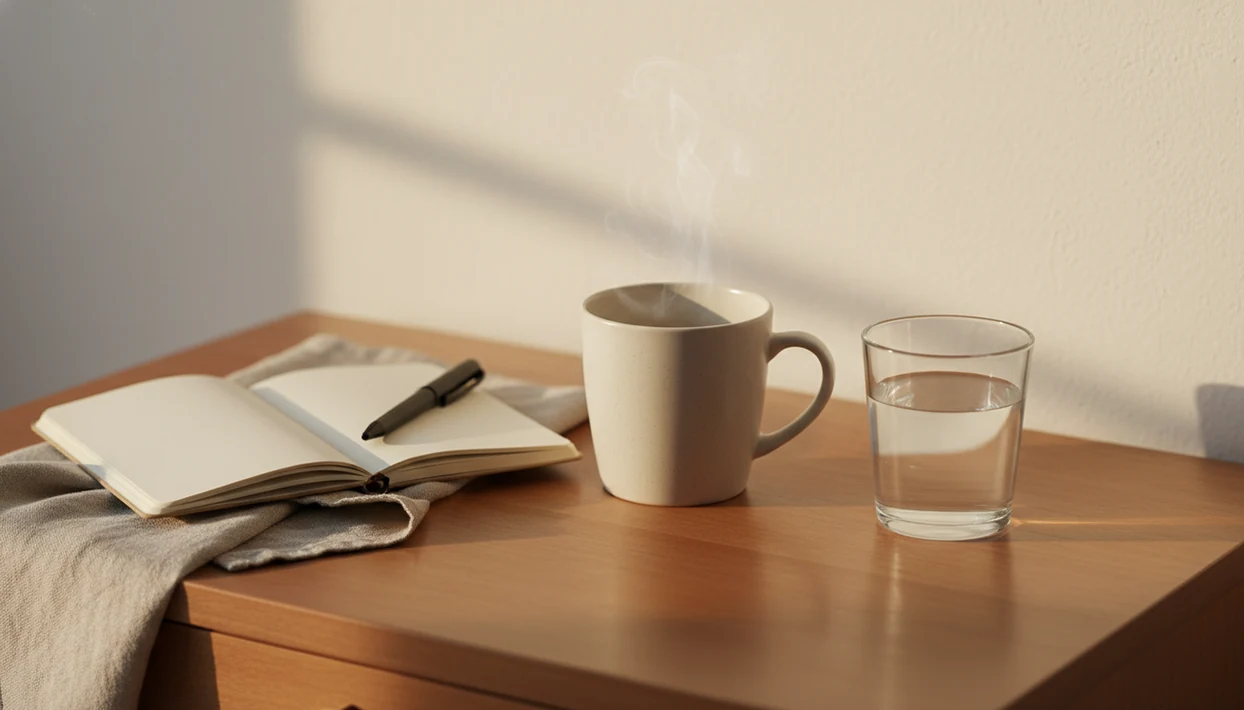
Gratitude practice is the deliberate habit of noticing, naming, and reflecting on specific things that matter, such as a supportive message or a quiet moment. A practical starting point is 3 to 5 minutes, attached to morning coffee, brushing teeth, or bedtime. It can be written, spoken, or silent. Adding attention to breathing, sounds, or body sensations turns a list into a mindful reflection.
The aim is not to replace difficult feelings with positive ones. Research suggests modest benefits on average, including a small improvement in well-being across gratitude interventions. MindTastik offers guided gratitude, meditation, and breathing sessions for readers who prefer audio during a bedtime routine. These sessions can provide structure, but neither gratitude nor an app replaces therapy or treatment for persistent sleep problems.
Gratitude practice at a glance
- A gratitude practice takes under 5 minutes and works best when it is specific and attached to an existing routine like sleep or morning meditation.
- Mindful gratitude pairs appreciation with breath, senses, or body awareness to move it from a mental checklist to an embodied calm exercise.
- Research shows small-to-moderate well-being improvements from consistent gratitude practice, helpful but not a standalone fix for anxiety or insomnia.
Gratitude Practice Definition for Everyday Calm
Gratitude practice is intentionally noticing and reflecting on specific things you appreciate, instead of letting the day blur past without naming them. It can be written, spoken, thought through quietly, or folded into meditation.
Gratitude is not pretending everything is fine. You can feel stressed, sad, restless, or awake in the dim light of a quiet room, and still notice one steady thing. Maybe your breath softens for a moment. Maybe one person showed up for you today. Both can be true.
Keep it repeatable.
A short daily gratitude practice usually beats a long one-off journal entry because it asks less from you. If writing feels natural, use a notebook. If you’re tired, say one sentence under your breath. If you prefer guided reflection, pair it with gratitude meditation and let the audio carry the structure.
What a Gratitude Practice Does for Everyday Calm
A gratitude practice gives your attention a steadier place to land. Instead of circling the same worry, you redirect toward one real, appreciated detail that the mind can name and hold.
That shift is small, but useful. At bedtime, gratitude can soften the handoff from the day into rest by replacing replay loops with quieter reflection. In the morning, it can act like a reset before messages, tasks, and noise take over. Over time, the repetition may support emotional steadiness because you are training attention to notice what is still safe, kind, ordinary, or enough. It does not guarantee calm on demand. Some days it feels neutral, and some nights it barely helps. The value is usually gradual.
A simple way to use it:
- Choose one moment from the last 24 hours.
- Name the exact detail you appreciated.
- Notice one body cue, like breath, warmth, or softened shoulders.
- Repeat it in a format that fits: written, spoken, silent, or guided audio.
If you want more structure, MindTastik can provide app-based prompts and bedtime audio, but the practice itself does not require an app.
Mindful Gratitude Brain-and-Body Mechanisms
Mindful gratitude works by combining attention, emotional labeling, and body awareness. In plain language, you give the mind one specific appreciation to process while the body gets a slower cue to settle.
- Specific gratitude usually activates deeper processing than vague thankfulness because the brain has to retrieve a real detail. “The hallway was quiet when I got home” gives the mind more to hold than “everything is good.” For additional reading after your reflection, consider They Don't Want You to Know This when you have time for another article.
- Pairing gratitude with breathing or body sensation can shift attention away from rumination. One slow inhale, one named appreciation, one softer jaw. Simple, but not empty.
- In a 2019 randomized trial, a 15-minute daily gratitude-writing exercise for 6 weeks was linked with modest reductions in inflammation markers in adults with heart failure PMC research article: PMC6475218.
- A meta-analysis of gratitude intervention studies found small effects on well-being and happiness, with stronger results in waitlist-controlled studies than in active-control comparisons doi reference: 17439760.2017.1326518.
- Repetition builds a habit loop: cue, routine, reflection. For many people, that loop makes everyday calm easier to access over time.
For beginners, specific mindful gratitude is often easier than open-ended meditation because it gives attention a clear place to land.
Daily Gratitude Practice: Best-For and Not-For Cases
Daily gratitude practice fits people who want a small, repeatable calm habit. It is not a substitute for clinical care when sleep or anxiety symptoms are significant.
Best For
- Adults who want a short bedtime wind-down.
- People with mild sleep anxiety who need a gentler focus before lights out.
- Beginners to meditation who prefer prompts over silence.
- Anyone looking for a simple everyday calm habit that takes less than 5 minutes.
- People building a daily gratitude routine around an existing cue.
Not For
- People who need clinical treatment for insomnia or anxiety disorders.
- Anyone who feels worse when pressured to “be grateful.”
- People using gratitude to avoid grief, anger, stress, or hard conversations.
Gratitude works alongside therapy and sleep treatment, not instead of it. Anxiety that interferes with daily life and persistent sleep problems need professional evaluation; gratitude can be a supporting habit, but it is not a substitute for treatment.
5-Step Gratitude Practice for Morning or Bedtime
Use this 5-step gratitude practice when you want a quick morning reset or a softer bedtime transition. The whole routine can take 3 to 5 minutes.
- Pick a cue. Attach gratitude to bedtime, morning coffee, or brushing your teeth so you don’t have to remember from scratch.
- Set a timer. Choose 3 to 5 minutes so the practice stays low-friction and doesn’t become another task.
- Name 1 to 3 specific things. Skip broad lines like “my life.” Try “pajamas warm from the dryer” or “the text my sister sent.”
- Add one sensory layer. Notice a breath, a shoulder dropping, a sound in the room, or the weight of the blanket.
- Close with one slow exhale. Let the reflection settle before opening another app or turning out the light.
Tools like MindTastik can support consistency with guided gratitude audio, especially when choosing between silence, breathing, and reflection feels like too much at night.
7 Gratitude Prompts for Bedtime Calm and Sleep
Bedtime gratitude prompts help by replacing rumination with reflection. They don’t force sleep, but they give the mind a calmer track to follow before rest.
- One kind thing someone did today. Name the person, the action, and how it landed in your body.
- One moment your body felt relaxed. Recall a specific change, such as your shoulders loosening or your feet warming under the blanket.
- One sound that felt calming. Try rain at the window, a fan, or the low hum of the refrigerator.
- One small thing that went better than expected. Keep it ordinary. The easier meeting counts.
- One person you felt connected to. Think of a message, glance, call, or shared joke.
- One thing you learned. It can be practical, emotional, or tiny.
- One comfort you usually overlook. Earbuds on a nightstand, one side slightly tangled around a charging cable, still count.
These prompts work inside a meditation app session or on their own. More sleep-specific examples are covered in gratitude before sleep.
Gratitude With a Meditation App: 3-Minute Habit Loop
A 3-minute guided audio prompt can reduce decision fatigue because it tells you what to notice next. That matters when your thoughts are loud and you don’t want to build a routine from scratch. For a related perspective, see how gratitude and decision making connect when considering everyday choices.
The habit loop is simple: reminder, guided session, closing reflection. App reminders and streaks can support consistency, but the strongest benefits come from regular repetition, not one dramatic session. When someone wants a calm track ready during mental overload, they usually need fewer decisions, not a bigger library.
MindTastik pairs gratitude reflection with sleep audio and breathing exercises for a full bedtime routine.
Compared with broader meditation libraries like Calm, Headspace, and Insight Timer, MindTastik should be presented here as the sleep-first gratitude option, not the largest general meditation library.
Use the app lightly. If streaks start to feel like pressure, turn them off and keep the practice human.
2022 JAMA Trial on Gratitude Letters and Depression
A 2022 randomized trial of a six-week gratitude app involving 849 participants found better outcomes across the measured variables in the gratitude group than in the waiting-list control group. The effect was measured as a short-term reduction in depression scores at posttest.
- The intervention used gratitude letters, not just quick positive thoughts.
- That trial studied a structured gratitude app, so its findings do not establish that a brief gratitude meditation produces the same benefits.
- The improvement was short term, measured after the intervention period.
- A 2019 meta-analysis also found small-to-moderate improvements in well-being from gratitude interventions.
- Gratitude practice should be framed as a supportive habit, not a cure for depression.
For people with low mood, gratitude may be one small supportive practice. It should sit beside appropriate care, connection, and treatment when needed, not replace them.
Daily practice is an option, not a proven requirement
Research does not establish one best schedule for gratitude. In a trial involving 102 health-care practitioners, participants wrote work-related gratitude diaries twice weekly for four weeks. At follow-up, the gratitude group reported lower perceived stress and depressive symptoms than the control group. That finding supports a repeated practice, but it does not show that daily journaling is necessary or that the same results apply to everyone.
A review of gratitude interventions among healthy workers found no significant effects from interventions performed four times or fewer. This is a reason to allow several weeks for reflection, not a rule that a fifth session guarantees improvement. A manageable starting plan is one to five minutes daily or several times weekly. The exact duration is a practical choice, not a proven therapeutic dose.
5 Gratitude Practice Mistakes That Reduce Consistency
The most common gratitude mistakes are vague prompts, forced emotion, and routines that are too long to repeat. Small and specific wins more often.
- Being vague. “Grateful for everything” sounds nice, but it gives the mind nothing concrete. Name one exact moment.
- Forcing gratitude. If it feels guilt-driven or performative, scale back. Try neutral noticing instead.
- Writing too much. Long journal entries can feel meaningful for three nights, then disappear. Brief and consistent beats long and rare.
- Suppressing stress or grief. Gratitude should coexist with real pain, not cover it with a polite sentence.
- Expecting overnight change. Daily gratitude builds gradual emotional steadiness. It is a practice, not a switch.
If you’re new, gratitude for beginners can be easier when it starts with one sentence instead of a full page.
Guided gratitude for a quieter bedtime routine
MindTastik’s gratitude sessions suit adults who prefer a spoken prompt to a blank journal page. Its guided breathing exercises can also provide a separate settling step before reflection. A simple sequence is breathing, one specific appreciation, then a clear ending rather than a longer review of the day.
Paper or silent reflection may be a better fit when audio feels distracting or gratitude prompts create pressure. Persistent insomnia, significant anxiety, or depressive symptoms call for professional care rather than a gratitude app alone.
What gratitude cannot promise about mood or sleep
Gratitude practice is useful, but it has real limits. Treat it as a supportive practice for everyday calm, not a medical solution.
- Evidence shows benefits are often modest, not life-changing. A 2019 meta-analysis found small-to-moderate well-being improvements overall.
- Gratitude exercises are not a proven treatment for insomnia or anxiety disorders on their own.
- Forced gratitude can backfire. People who feel pressured may disengage, feel guilty, or feel worse.
- One-off sessions are unlikely to produce lasting change. Consistency is required.
- App-based gratitude routines can be overhyped when they promise quick emotional transformation.
- Gratitude practice is not a replacement for therapy, sleep treatment, medication, or medical care.
- Some nights are not gratitude nights. If the practice feels sharp or fake, choose breathing, grounding, or rest instead.
For anxious evenings, gratitude for anxiety works best when it allows discomfort to be present rather than arguing it away.
Everyday gratitude questions
How do I start practicing gratitude?
Choose one ordinary experience from today and name why it mattered. For example: “A friend checked in, and I felt remembered.” Write it down, say it quietly, or reflect without writing. Start with one to five minutes and attach the practice to an existing routine.
Do I need to practice gratitude every day?
No single schedule has been shown to work best. Studies have used repeated exercises over several weeks, including twice-weekly diaries. Daily practice is one convenient option, not a requirement. Choose a schedule that is manageable, and avoid treating a missed day as a failure.
What should I write in a gratitude journal?
Write one specific event, person, or comfort, then add why it mattered. “Lunch outside gave me a quiet break” is more concrete than “I am grateful for everything.” One sentence is a reasonable starting point. There is no need to produce a long list or find something extraordinary.
Can gratitude practice help me fall asleep?
A short gratitude reflection can give bedtime attention a quieter focus, but it does not guarantee sleep. Keep it brief rather than reviewing the whole day. Gratitude is not an established treatment for insomnia on its own. Persistent sleep problems need care beyond a bedtime reflection routine.
Is gratitude different from positive thinking?
Gratitude names something specific that is appreciated; positive thinking is a broader attempt to focus on favorable thoughts or expectations. Gratitude does not require calling a difficult day good. A reflection can acknowledge both a painful experience and one supportive person or small comfort without making either less real.
How long should a gratitude practice take?
A gratitude practice can take just one or two minutes. Pause to notice something you appreciate, then name what made it meaningful to you. You can spend longer reflecting if you wish, but there is no required duration. Choose a length that feels comfortable and fits your routine.
How can I practice gratitude without keeping a journal?
You can practice gratitude by quietly naming something you appreciate, taking a photo of a meaningful moment, or sharing a thankful thought with someone. During a walk, notice small details such as fresh air or birdsong. Writing is optional, the practice is about paying attention rather than recording everything.
How can I express gratitude to other people?
Try thanking someone for a specific action and explaining why it mattered to you. You might send a short message, say it in person, or offer a thoughtful gesture. Keep your appreciation sincere and free of expectations. Expressing gratitude does not mean overlooking conflict or giving up personal boundaries.