
Gratitude Meditation for Sleep and Everyday Calm



Gratitude meditation for sleep is a gentle mindfulness practice that uses breath, attention, and reflection prompts to focus on people, moments, and small details that feel appreciated rather than replaying bedtime stress. It can fit into a short evening routine or an everyday calm break. Its role is sleep preparation, not a guaranteed fix for sleep or mood.
The practice works best with specific, believable details: a helpful message, a small comfort, or something completed during a difficult day. There is no need to produce a strong feeling of gratitude or pretend that problems have disappeared. Guided prompts can provide structure when silent reflection feels too open-ended, while ongoing sleep difficulties deserve attention beyond a bedtime exercise.
The essentials
- Use gratitude meditation at bedtime to gently shift attention from worry loops toward calmer pre-sleep thoughts.
- A guided gratitude meditation can be easier than silent practice when your mind feels busy or anxious.
- The evidence is promising but modest, so use gratitude practice as one supportive habit alongside sleep hygiene and professional care when needed.
What gratitude meditation means in a sleep routine
Gratitude meditation is a structured mindfulness practice where you use breath, attention, and reflection prompts to notice what you appreciate in your life, your day, or the present moment. In a sleep routine, that usually means slowing down, breathing steadily, and naming a few specific things that felt steady, kind, useful, or okay.
It is not the same as telling yourself, “Be grateful” when you feel awful. That can sound like pressure. A better prompt is quieter: What was one moment today that did not need fixing?
Hard days still count.
A bedtime gratitude meditation can include sadness, stress, or irritation without pretending everything is fine. You might notice tense shoulders against the mattress, then bring attention to one safe detail: the room is dark, the blanket is warm, the day is over. That shift is small, but small is often enough for a wind-down routine.
Five facts about gratitude meditation for sleep and calm
- Gratitude practices are associated with better sleep quality and more positive pre-sleep thoughts, especially when practiced regularly rather than once.
- In a 401-adult study, higher trait gratitude was linked with better subjective sleep quality, lower sleep latency, and fewer daytime problems through more positive pre-sleep cognitions (Wood et al., 2009: PubMed research: 19073292).
- In a randomized trial of adults with neuromuscular disease, a 21-day gratitude intervention was associated with better sleep duration and sleep quality, with benefits still seen at follow-up (Emmons and McCullough gratitude-intervention research summary: PubMed research: 12585811).
- A JAMA Internal Medicine review of meditation programs found small to moderate evidence for improvements in anxiety, depression, and pain, though effects on sleep were less certain (Goyal et al., 2014: JAMA Internal Medicine study: 1809754).
- Benefits usually build gradually. One calm session may feel pleasant, but a repeated gratitude meditation practice is more likely to shape bedtime habits.
For most beginners, gratitude meditation works better as a repeatable cue than as a test of whether sleep arrives right away. If you wake in the dark and feel tempted to measure your progress, let the practice be a gentle return instead of a performance. Try not to grade it.
How gratitude meditation works before bedtime
Gratitude meditation works by redirecting attention from rumination toward specific appreciated moments. Rumination is the loop of replaying worries, mistakes, or unfinished tasks. Gratitude prompts give the mind a different object to hold.
Pre-sleep cognitions matter. That phrase simply means the thoughts and images running through your mind before sleep. If those thoughts are mostly threat-focused, your body may stay more alert. If the practice turns attention toward a completed task, a kind message, or a safe room, the bedtime transition can feel less charged.
Slow breathing adds another cue. A guided voice through cheap earbuds can set a slower pace when your own thoughts are jumping ahead. Repeated practice may train the mind to notice safe, steady, or positive cues more easily.
For anxious bedtime thinking, a specific gratitude prompt is often easier than “clear your mind” because it gives attention somewhere concrete to land. For additional support during bedtime worry, try mindfulness exercises for anxious moments that keep attention on simple, manageable cues.
Five steps for a bedtime gratitude meditation practice
Use this 5 to 10 minute routine when you want a low-pressure bedtime gratitude meditation. Silent reflection, guided gratitude meditation, and app-based audio can all work.
- Set a small time window, usually 5 to 10 minutes, so the practice does not become another bedtime task.
- Sit or lie down in a position you can keep without fussing, then dim the phone screen if you are using audio.
- Breathe slowly for three to five rounds, noticing the exhale without trying to force relaxation.
- Name three specific appreciations: one person, one small comfort, and one thing you completed or survived today.
- Close by letting the list be enough, then turn toward sleep without checking whether the meditation “worked.”
If your mind blanks, choose ordinary details. A clean pillowcase. A text you did answer. The door locked. You are building a cue, not writing a speech.
For more bedtime options, our guide to mindfulness exercises before bed covers other short wind-down practices.
When worries return during gratitude meditation
A worry returning during gratitude practice does not mean the exercise has failed. An evidence-informed mindfulness approach is to label the thought briefly, such as “planning,” “worrying,” or “remembering,” then return attention to breathing or a bodily sensation. Repeating that sequence is enough. The aim is less involvement in the thought, not a blank mind or a forced return to appreciation. To reconnect with your surroundings, try a 5 senses grounding exercise using sights, sounds, textures, scents, and tastes.
For recurring next-day concerns, a separate note before bed can hold worries and tasks, with a specific later time assigned to each task. If wakefulness becomes increasingly frustrating, CBT-I principles favor a quiet, dim-light activity out of bed until drowsiness returns. These are broader sleep-management strategies, not proven effects of gratitude meditation. A review comparing CBT-I and mindfulness for sleep problems supports CBT-I as the better-supported behavioral treatment for chronic insomnia.
Guided gratitude meditation versus journaling and silent reflection
Guided gratitude meditation, journaling, and silent reflection can all support a gratitude routine, but they fit different minds at night. The right choice is the one that feels least activating before bed.
| Method | Best fit | Possible drawback |
|---|---|---|
| Guided meditation | Busy, anxious, or wired minds that need prompts and pacing | Audio choice can become another decision if the library feels crowded |
| Journaling | People who like visible structure and want to record patterns | Writing may feel too mentally active right before sleep |
| Silent reflection | People who prefer no devices, lights, or narration | Rumination can take over when attention has no guide |
Guided audio is often easier at night because the voice carries the next step for you. Tools like MindTastik, Calm, and Headspace offer guided meditation, sleep audio, breathing exercises, and related sessions for people who want structure. When comparing sleep meditation apps, look for bedtime-specific gratitude sessions, low-stimulation audio controls, and clear language that avoids cure claims.
Best-fit scenarios and cautions for gratitude meditation practice
Gratitude meditation fits best when the goal is gentle attention training, not emotional forcing. Use it as one supportive practice among other mindfulness exercises and techniques, especially if bedtime stress is only one part of your day.
Best for
- Bedtime wind-down: when you want to shift from planning mode into rest mode.
- Beginner meditation: when breath-only practice feels too vague.
- Everyday calm breaks: when you need a short reset between work and home.
- Gentle reflection: when appreciation feels easier than deep analysis.
Not ideal for
- Emergency mental health support: use urgent or crisis care instead.
- Untreated chronic insomnia: ongoing sleep trouble deserves evaluation.
- Suspected sleep apnea: loud snoring, choking, or gasping needs medical guidance.
- Replacing therapy or medical care: meditation can support care, not stand in for it.
People with trauma histories, severe depression, or high self-criticism may need gentler prompts. “Name one neutral thing that helped you get through today” may be kinder than “list blessings.” When appreciation feels difficult, mental health exercises for stress support can offer other gentle ways to respond to tension.
Everyday calm micro-practices for gratitude meditation
Daytime micro-practices make bedtime gratitude feel less like a brand-new habit. If the mind has practiced noticing one okay moment at noon, it is less strange to do it under the blanket at night.
- After waking: name one support already present, such as warm socks or a quiet room. A short morning meditation for focus and calm can also help you begin the day with steady attention.
- After work: pause before opening the next app and name one task that is finished.
- Before a meal: notice one person, ingredient, or effort behind the food.
- During a walk: pick one steady detail, such as a tree, a window light, or your own pace.
- Before bed: choose one small comfort before starting audio.
In a 10-week undergraduate study, people asked to count blessings once a week reported higher optimism and fewer physical symptoms than those focused on hassles or neutral events. The pocket check is real. A one-minute pause can still count; our one minute mindfulness exercises page gives more short options.
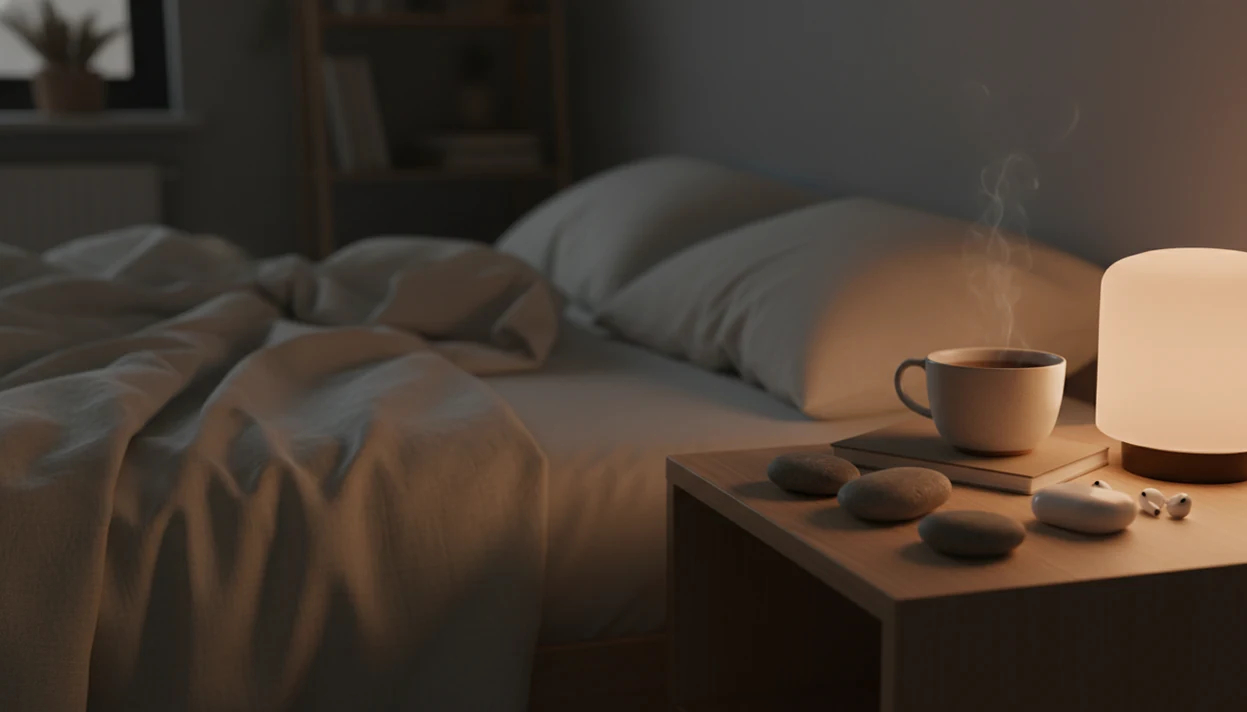
Suggested image caption: a quiet bedside gratitude meditation routine with soft light, headphones, and a phone set to sleep audio
Image caption guidance: show a calm bedside gratitude meditation scene with soft light, headphones, and a phone set to sleep audio.
Three common questions about bedtime gratitude meditation
Can gratitude meditation help you sleep? It may help some people prepare for sleep by changing pre-sleep focus from worry loops toward steadier thoughts. It does not guarantee sleep, and it should not be used to ignore ongoing sleep problems.
Can gratitude meditation help you sleep?
Gratitude meditation for sleep may support the wind-down period by giving the mind a calm, specific focus. Think of it as sleep preparation, not a switch.
How long should gratitude meditation be?
Most beginners can start with 5 to 10 minutes. If you are exhausted, two minutes of naming one person, one comfort, and one safe moment is enough.
What should I think about?
Choose concrete prompts: a person who helped, a small comfort, a completed task, or a safe moment. If “gratitude” feels too bright, try “something that was okay.” For writing-based practice, mindfulness journal prompts can help you choose simpler wording.
Guided gratitude when bedtime reflection needs structure
MindTastik’s gratitude sessions and guided meditation library offer spoken prompts for people who find silent reflection too open-ended at bedtime. Choosing a session before the evening routine can keep audio selection from becoming another task. A breathing exercise may suit nights when appreciation feels forced. People who prefer silence or find narration distracting may be better served by simple reflection without an app. Persistent insomnia needs assessment and appropriate treatment, not a larger audio library.
What gratitude meditation cannot treat
Gratitude meditation is promising, but the evidence specific to gratitude meditation is more limited than the evidence for broader gratitude exercises, journaling, and mindfulness programs. Clinicians typically recommend evaluating persistent insomnia, breathing-related sleep symptoms, severe mood symptoms, panic, or trauma distress rather than relying on self-guided practices alone.
Key limitations:
- Gratitude meditation does not replace evaluation for chronic insomnia, suspected sleep apnea, panic symptoms, severe depression, trauma, or other health concerns.
- Some people feel guilt, pressure, or self-criticism when asked to list gratitude.
- Benefits are usually modest and gradual, not instant.
- A single bedtime gratitude meditation may feel pleasant without changing sleep that night.
- The practice may need softer prompts for people with grief, trauma, or high self-blame.
- Stop or modify the practice if it increases distress.
- MindTastik supports sleep, anxiety, beginner meditation, and everyday calm routines, but it is not a therapy replacement.
If gratitude feels loaded, try emotional awareness exercises first and come back later.
Matching bedtime gratitude to racing thoughts or body tension
| If you... | Try | Why | Note |
|---|---|---|---|
| Your mind keeps replaying the day once the dim lamp is on | A short guided gratitude meditation with a slow exhale cue | Spoken prompts reduce the number of choices you have to make when you are already tired. | Keep the topic simple; forcing a big emotional shift can make the practice feel strained. |
| You feel physically tense even though you want to reflect on gratitude | Gratitude paired with a gentle body scan | Starting with the shoulders, jaw, and hands can make appreciation feel more grounded than abstract. | If scanning the body feels uncomfortable, return to noticing the breath or the room. |
| You like bedtime audio but do not want a long session | A brief sleep story with one gratitude prompt near the end | Narrative can give the mind a soft landing without turning gratitude into a task. | Choose offline audio when possible so the routine does not become a browsing session. |
Nighttime Reset
Gratitude meditation may support bedtime calm by shifting attention toward specific, low-pressure memories rather than unfinished problems. It is best understood as a wind-down cue, not a promise that sleep will arrive on command. The most useful gratitude prompt is usually concrete enough to picture and gentle enough to release. A small remembered detail, like a kind message or warm cup in your hands, often works better than trying to feel deeply grateful on demand.
Bedtime gratitude questions
Does gratitude meditation help with falling asleep?
It may make the wind-down period feel calmer by shifting attention from worries toward specific appreciated moments. Evidence for mindfulness and broader gratitude practices does not establish a reliable sleep-onset benefit from gratitude meditation alone. Treat it as optional sleep preparation, not a method that must produce sleep.
How long should a bedtime gratitude meditation last?
A practical starting point is 5 to 10 minutes, with a clear ending so reflection does not become another bedtime task. On an exhausting night, two minutes and one small appreciation may be enough. These are suggested practice lengths, not durations proven to treat insomnia.
What can I focus on when nothing good happened today?
The prompt can be smaller than a good event: a warm drink, a helpful action, or one moment that did not need fixing. Sadness and frustration do not have to disappear first. If appreciation still feels dishonest, neutral noticing of the room or breathing is a reasonable alternative.
Can gratitude meditation make anxiety or guilt worse?
Gratitude can feel like pressure when the task becomes producing a positive emotion or dismissing a difficult experience. There is no need to continue that version of the exercise. Switch to a neutral focus or stop. Persistent panic, severe mood symptoms, or trauma distress warrant professional support.
Is guided gratitude meditation better than silent reflection?
Neither is established as the better sleep method for everyone. Guided audio supplies prompts and pacing, which may suit a busy mind. Silent reflection avoids screens and narration, but can leave more room for rumination. The practical choice is the format that feels least activating before bed.
Should I write a gratitude journal or meditate before bed?
Journaling suits people who like a visible record and clear structure. Meditation keeps the practice in attention and reflection without writing. If writing feels mentally activating near bedtime, move it earlier or choose silent reflection. Neither format should become a requirement that delays the rest of the sleep routine.
What if I am still awake after gratitude meditation?
Finishing the practice without falling asleep is not a failure. Avoid extending the gratitude list to chase sleep. If wakefulness becomes frustrating, a quiet activity in dim light outside bed until drowsy follows CBT-I principles. Repeated sleep difficulty deserves assessment rather than reliance on longer meditation sessions.