
Mindfulness Journal Prompts for Calm
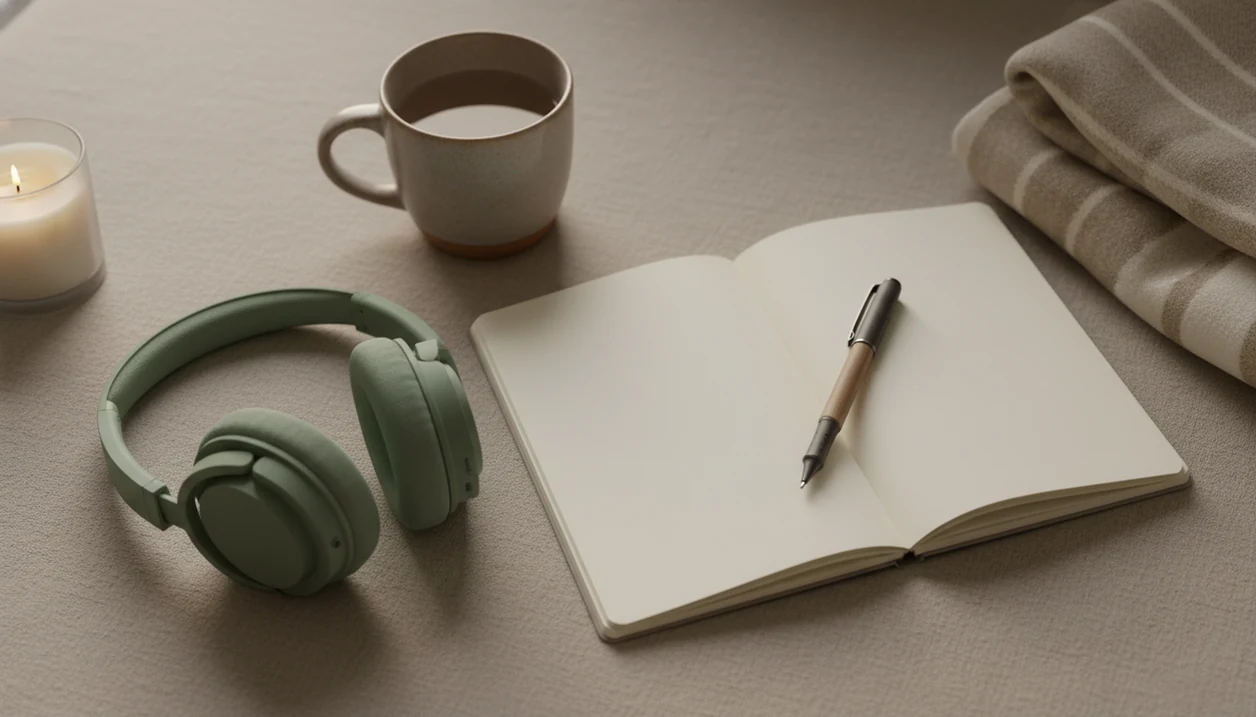


Mindfulness journal prompts are short reflection questions used before or after meditation to notice thoughts, label feelings, and support everyday calm. Mindful journaling means writing brief, nonjudgmental observations about the breath, body, emotions, and present-moment experience. An entry can be a few plain sentences rather than a detailed account of the day.
A manageable starting point is two or three prompts after a guided meditation, with one honest sentence for each. Match the questions to the session: sleep, anxiety support, breathing, gratitude, or body awareness. The aim is to record what is present, not explain every feeling or produce a positive answer. Journaling can support reflection and habit-building, but it does not replace therapy or medical care.
The essentials
- Use 2-3 calm journal prompts after a guided meditation, not a long writing session.
- Match the prompt to the meditation type: sleep, anxiety, breathing, gratitude, or body awareness.
- Journaling can support reflection and habit-building, but it is not a replacement for therapy or medical care.
18 mindfulness journal prompts for calm after meditation
Use these mindfulness journal prompts by choosing one to three questions after your meditation, then writing one honest sentence for each. Longer is not better if it turns reflection into another task.
Breath prompts 1. What did I notice about my breath today? 2. Where did breathing feel easiest? 3. Did my breath change during the guided session? Try a three-minute breathing space before writing to notice your breath, bodily sensations, and what feels present.
Body prompts 4. What body sensation is most noticeable right now? 5. Where do I feel tension, warmth, heaviness, or ease? 6. What is my body asking for next?
Emotion prompts 7. What feeling is present, even if it is small? 8. Can I name this feeling without fixing it? 9. What softened slightly during practice?
Thought prompts 10. What thought kept returning? 11. Was this thought a fact, a worry, or a memory? 12. What would I say to myself kindly?
Gratitude and next-step prompts 13. What ordinary thing supported me today? 14. What can I release for now? 15. What is one calm action I can take next? 16. What did journaling after meditation help me notice? 17. Which mindful journaling prompts felt manageable? 18. Which calm journal prompts should I repeat tomorrow?
One sentence counts.
What makes a good mindfulness journal prompt?
A good mindfulness journal prompt is specific, short, present-focused, and nonjudgmental. It gives the mind one clear place to look without asking for a perfect answer.
The strongest prompts usually point to the body, breath, emotion, or one next action. That focus helps reduce rumination because attention moves from abstract looping into something observable: a tight jaw, a slower exhale, a named feeling, or the next small step. Choose the prompt based on the goal. Sleep prompts should help you set things down. Anxiety support prompts should name sensations and safety cues. Gratitude prompts should stay concrete. Body awareness prompts should notice what is here without forcing change.
- Choose one question that fits the session you just finished.
- Keep the answer to one or two honest sentences.
- Notice whether the prompt leaves you clearer, softer, or more grounded.
- Avoid prompts that demand deep analysis, forced positivity, or the “right” insight.
Strong examples: “Where do I feel ease in my body right now?” and “What is one kind next action I can take?” Weak examples: “Why am I like this?” and “How can I make myself feel grateful immediately?”
Mindfulness journal prompts in a 3-step calm habit loop
Mindfulness journal prompts work by turning a brief meditation into a cue-routine-reward loop: the guided session settles attention, the writing captures what you noticed, and repetition makes the calm habit easier to restart.
In plain terms, mindfulness journal prompts work by giving your attention a specific object after meditation: breath, body sensation, emotion, thought, or one next action. That makes the practice easier to repeat than open-ended journaling.
The sequence is simple. First, a guided meditation gives the mind one place to rest. Then a prompt reduces decision fatigue by asking one focused question. Finally, a short reward appears, such as feeling clearer, naming an emotion, or knowing what to do next. That pattern matters on nights when the heartbeat feels loud under the blanket and the mind wants another problem to solve.
Nonjudgmental labeling is the center of the practice. Instead of “I should not feel anxious,” you write, “Anxiety is here, and my chest feels tight.” Research on mindfulness-based interventions suggests benefits for anxiety, mood, and stress, and expressive writing studies suggest structured reflection may support emotional processing. The combined meditation-plus-journaling protocol has less direct evidence. RAIN mindfulness practice offers a structured way to recognize and allow feelings before writing a brief, nonjudgmental observation.
MindTastik can fit this routine when you want to end your bedtime meditation with one or two calm journal prompts instead of a long entry.
MindTastik meditation routine for mindfulness journal prompts
Use mindfulness journal prompts before meditation when your mind is too crowded to settle, and after meditation when you want to record what changed. Most people can keep the writing to 2-3 minutes.
- Choose one session goal, such as sleep, anxiety support, breathing, or self-compassion.
- Set one prompt before you press play, especially if your thoughts feel scattered. A mindfulness bell practice can provide a gentle cue to pause, notice your breathing, and begin your reflection.
- Listen to the guided session without trying to remember every insight.
- Write for 2-3 minutes afterward using one body prompt, one emotion prompt, and one next-step prompt.
- Review the entry once, then stop before it becomes analysis.
- Repeat the same prompt set for several days so patterns become easier to see. Mindfulness cards for everyday calm can offer a repeatable question when choosing a journal prompt feels difficult.
For a sleep meditation, try, “What can wait until tomorrow?” For an anxiety support meditation, try, “What sensation tells me my body is asking for care?” A good meditation app for sleep anxiety and everyday calm gives you repeatable sessions and simple prompts, not a promise that every hard night disappears.
Meditation journal prompts for 6 session types
Matching meditation journal prompts to the session type is more useful than picking random questions because the prompt reinforces the reason you practiced. Journaling after meditation then becomes a feedback loop for noticing patterns over time.
| Session type | Prompts to use afterward |
|---|---|
| Sleep meditations | What can I set down tonight? What felt softer after the session? What is one small bedtime cue I can repeat? |
| Anxiety support meditations | What feeling is present? Where do I feel it in the body? What is one safe next step? |
| Breathing exercises | What did I notice on the inhale? What changed on the exhale? Did counting help or distract me? |
| Body scan meditations | Which area felt tense? Which area felt neutral? What did I learn by moving slowly? |
| Self-compassion meditations | What tone did I use with myself? What kind sentence felt believable? What pressure can I lower today? |
| Morning calm sessions | What matters most this morning? What can stay simple? What is one steady action for the next hour? |
If you want more body-based options, emotional awareness exercises pair well with this table. Prompt matching usually works best when the question reflects the session goal, while random prompts fit people who prefer open-ended reflection.
Five research facts about mindful journaling prompts and calm
Research supports the parts of this practice more strongly than the exact combined routine. That means mindful journaling prompts are reasonable support tools, but the evidence should be read with care.
- Fact 1: Prompts work best when attached to a specific moment, such as immediately after meditation, because the cue is clear and repeatable.
- Fact 2: Mindful journaling is not about perfect writing. Plain language often works better than polished paragraphs.
- Fact 3: Repeating a few prompts can be better than constantly switching, because the mind learns what to look for.
- Fact 4: Research on mindfulness and expressive writing suggests possible benefits for stress, anxiety, mood, and sleep, but evidence is indirect for combined protocols. A JAMA Internal Medicine meta-analysis found moderate evidence that mindfulness meditation programs can improve anxiety, depression, and pain (JAMA Internal Medicine study: 1809754), and early expressive-writing research found that structured emotional disclosure can affect health-related outcomes (doi reference: 0022 006X.54.6.875).
- Fact 5: Prompts are supportive tools, not stand-alone treatment for anxiety disorders, insomnia, trauma, or depression.
Clinicians typically recommend professional support when anxiety, sleep loss, or low mood interferes with safety, work, relationships, or daily functioning. If you feel at risk of harming yourself or cannot stay safe, seek urgent local help; in the U.S., call or text 988 for the Suicide & Crisis Lifeline (988lifeline reference). For shorter resets, one minute mindfulness exercises can be easier than writing.
What the research measures, and what it does not
A 2022 review of mindfulness-based interventions included 19 studies involving 1,138 people with depression. It found a moderate reduction in rumination, with a standardized mean difference of -0.46. That finding supports the rationale for noticing a current sensation or feeling instead of repeatedly analyzing a worry. It does not establish that a two-minute journal entry after meditation produces the same result, because the review examined mindfulness-based interventions rather than this particular writing routine.
Gratitude research offers a separate, narrower reason to include an occasional concrete gratitude question. A 2021 review of nine studies involving workers found that gratitude-list interventions generally improved perceived stress and depression, while well-being results were inconsistent. Interventions completed four times or fewer did not show significant changes in that review. Repetition may matter, but these findings do not establish an ideal journaling schedule or justify requiring a grateful answer when someone feels distressed.
Best-fit users and safety limits for calm journal prompts
Calm journal prompts fit adults who want structure around meditation, not people who need urgent mental health care. The practice can support anxiety and insomnia routines, but it should stay gentle.
| Best for | Not ideal for |
|---|---|
| Adults building a meditation habit | Crisis support or immediate safety needs |
| Beginners who need a clear starting point | Replacing therapy, medication, or medical advice |
| People processing mild daily stress | Processing severe trauma alone |
| Users tracking sleep or anxiety patterns | Forcing long writing sessions at bedtime |
| Anyone who wants a short reset after practice | People who feel more distressed after writing |
Distressing emotions can surface during journaling. If that happens, stop, orient to the room, and choose a grounding action. A hallway wall against your back can be enough for the first reset.
For sleep, prompts should lower mental load. If writing wakes you up, switch to a single line or try mindfulness exercises before bed without journaling.
Two-minute mindful journaling prompt template
A two-minute template keeps mindful journaling low-friction, especially after a guided session. Use the same five lines often, rather than building a long entry you will avoid tomorrow.
Fill-in template
- Body: Right now, I notice ______.
- Emotion: The feeling I can name is ______.
- Thought: The thought passing through is ______.
- Need: What I may need is ______.
- Next calm action: For the next few minutes, I will ______.
Completed example after a guided anxiety meditation can start with a body sensation, a named feeling, and one small next action.
- Body: Right now, I notice tightness across my ribs.
- Emotion: The feeling I can name is worry.
- Thought: The thought passing through is, “I forgot something important.”
- Need: What I may need is reassurance and a slower pace.
- Next calm action: For the next few minutes, I will drink water and leave the phone locked.
Small is sustainable.
Tools such as MindTastik, Calm, and Headspace can help if you prefer an audio cue before writing. For gratitude-focused entries, mindful gratitude can keep the prompt tied to present-moment detail.
Image caption: a calm journal beside a meditation app
Image caption: A calm journal beside a phone with a meditation app open, showing how mindfulness journal prompts can follow a short guided session.
Pair a short guided session with one clear prompt
MindTastik’s guided meditation library, breathing exercises, and gratitude sessions offer starting points for a brief journal entry. A breathing session pairs with a question about the inhale or exhale; a gratitude session pairs with a concrete note about something helpful. Adults who prefer quiet can use the prompts without audio. Anyone seeking treatment for persistent anxiety, insomnia, or trauma should choose professional care rather than rely on an app and notebook.
When calm journal prompts are not enough
Mindfulness journal prompts are helpful for many calm routines, but they have real limits. Keep the practice supportive, not pressured.
- Evidence for a specific combined meditation-plus-journaling protocol is limited.
- Most research comes from separate mindfulness, expressive writing, and positive psychology studies.
- Journaling can temporarily intensify distressing emotions, especially when memories or worries surface.
- Prompts do not replace therapy, crisis care, sleep medicine, medication guidance, or medical advice.
- App-based routines depend on user consistency. A saved session does not help much if it never gets played.
- Bedtime journaling may be too activating for some people, especially at 2:13 a.m. when the lock screen keeps getting checked.
- Long entries can become rumination if they turn into problem-solving without a stopping point.
- People with trauma histories may need professional support before using reflective writing.
If a prompt makes you feel less safe, stop using it. Choose grounding first.
Mindfulness journaling questions
How is mindful journaling different from keeping a diary?
A diary can recount events or explore a story at length. Mindful journaling focuses on what is noticeable now: a body sensation, a feeling, a thought, or a need. The distinction is the focus, not the notebook format. A single sentence can be a complete mindful entry.
What should I write after meditation if nothing changed?
Record the lack of change plainly: “My shoulders still feel tense,” or “I did not notice much today.” Then name one current feeling or next action. A journal entry does not need to show improvement. Its purpose is observation, not proof that the meditation worked.
How long should a mindfulness journal entry take?
Two or three minutes is a practical starting point, not a research-established dose. Choose one to three prompts and write one sentence for each. Stop when the observations are recorded. Longer writing is optional, but it is not necessary for this brief post-meditation routine.
What are good mindfulness journal prompts for anxiety?
Try “What feeling is present?”, “Where do I notice it in my body?”, and “What would make the next ten minutes more manageable?” These questions allow worry to be acknowledged without demanding a solution. Keep answers brief, and stop if writing increases distress. Prompts are support tools, not anxiety treatment.
What should I do if journaling turns into overthinking?
Switch from explaining causes to recording one observable detail, such as a tight jaw or a named feeling. Add one small next action, then close the notebook. If writing repeatedly increases distress, pause the practice rather than force it. Persistent or severe distress calls for professional support.
Are gratitude prompts suitable when I feel upset?
They can be optional, but they should not require a positive answer. A neutral question such as “What helped even a little today?” leaves more room than a demand to feel grateful. If nothing comes to mind, describe what is difficult and what might make the next few minutes more manageable.
Is it a good idea to journal before bed?
A brief entry can fit a bedtime routine if it helps set concerns aside. Choose a closing question such as “What can wait until tomorrow?” rather than a long analysis of the day. If writing leaves thoughts more active or increases distress, shorten it or move it earlier.