
Mindfulness Prompts for Everyday Calm: 40 Gentle Cues for Stress, Sleep, and Grounding
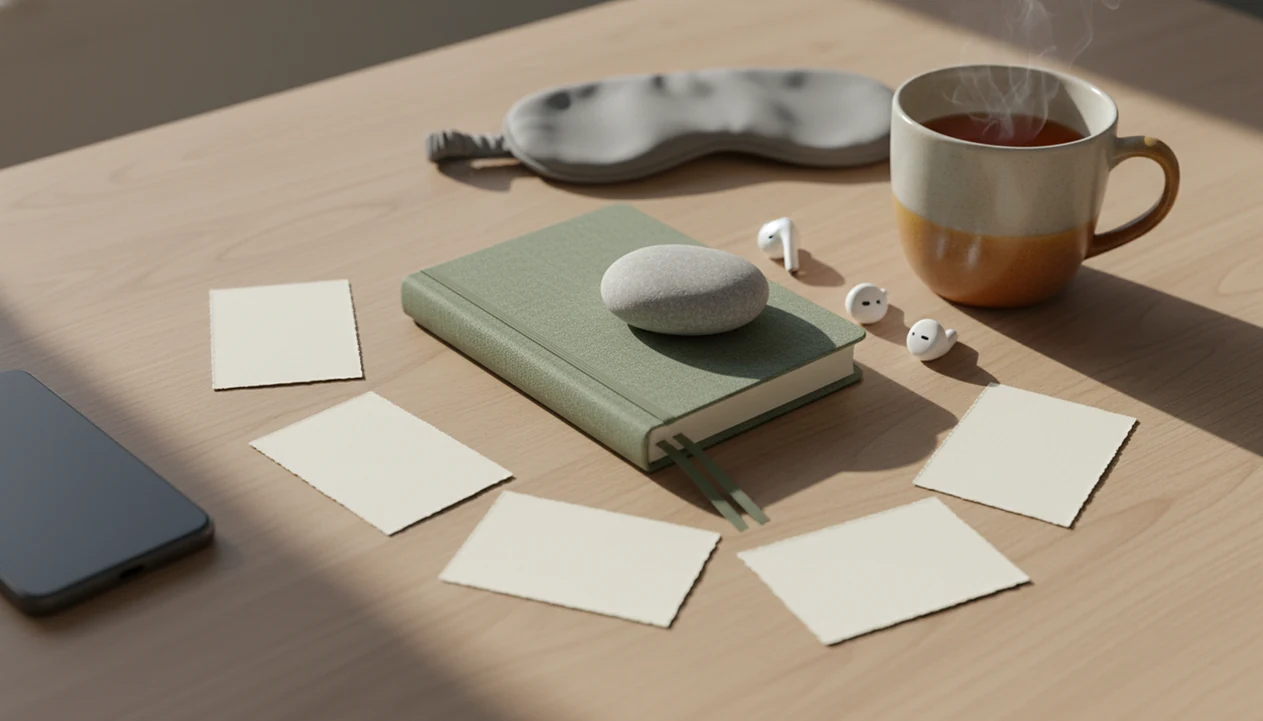


Mindfulness prompts are short reflection cues that help bring attention to the breath, body, thoughts, or emotions and point toward a calming next step. A prompt can fit into five minutes of journaling, a guided meditation, a breathing exercise, or bedtime audio. The aim is not to produce a thoughtful answer every time. One clear observation, such as noticing a tight jaw or naming a worry, is enough to begin.
Choose one prompt that matches the moment: a morning intention, a workday reset, anxiety grounding, or bedtime worry release. A brief daily check-in can be easier to maintain than an occasional long writing session. MindTastik offers guided meditations, breathing practices, sleep audio, and self-hypnosis sessions that can follow a prompt. These tools support everyday calm, not replace professional care.
The essentials
- Use one prompt at a time; a short daily check-in is easier to sustain than a long occasional journaling session.
- Match the prompt to the moment: morning intention, midday stress reset, anxiety grounding, or bedtime worry release.
- Prompts are not a replacement for care, but they can make guided meditation, breathing, and sleep audio feel more personal and timely.
Best mindfulness prompts for everyday calm by moment
The most useful mindfulness prompts are organized by the moment you need them, not dumped into one giant list. Start with the category that matches your day, then pair the answer with a guided session, breath practice, or sleep track. For ready-made cues you can keep nearby, try mindfulness cards for everyday calm and choose one that matches your moment.
Morning check-in prompts
Try: “What does my body need before I rush?” “What tone do I want to carry into the next hour?” “What is one thing I can do gently today?” Pair these with a short guided meditation in MindTastik.
Body-scan prompts
Try: “Where am I holding tension?” “What area feels neutral?” “Can I soften one muscle group?” A breathing exercise or body relaxation track fits well here.
Worry-release prompts
Try: “What is fact, and what is forecast?” “What can wait until tomorrow?” Use anxiety support audio or self-hypnosis when thoughts loop.
Bedtime wind-down prompts
Try: “What can I put down for tonight?” “Where does the pillow meet my body?” A sleep-audio routine works here because it gives the mind something steady to follow after the prompt.
How we picked everyday calm mindfulness prompts
These prompts were chosen for real-life use, not for polished notebook pages. A useful cue should still work when your phone is at 3% and your attention is thin.
- Short prompts are easier to repeat than long reflection exercises.
- Open-ended wording helps you answer honestly, even with one sentence.
- Present-moment cues point toward breath, body sensation, emotion, or immediate need.
- Each prompt connects naturally to guided meditation, breathing, relaxation music, sleep hypnosis, or self-hypnosis.
- Research evidence is stronger for broader mindfulness and meditation programs than for prompts alone.
If you want a wider practice library, our guide to mindfulness exercises and techniques gives more options beyond prompts.
Good meditation app routines deliver a next calming action, not a demand to analyze every feeling.
How mindfulness prompts for everyday calm work
Mindfulness prompts work as attention cues: they interrupt autopilot and redirect awareness toward breath, body sensations, emotions, and immediate needs. The basic sequence is notice, name, soften, then choose a next action.
A prompt like “Where is my body asking for less effort?” moves attention away from mental replay. That shift does not erase stress, but it can create a small gap before reacting. In habit terms, the prompt becomes a cue that leads into a calmer response.
The pocket check is real.
MindTastik fits this sequence when a prompt leads into a guided meditation, breathing exercise, or sleep audio track. In a large U.S. survey, 14.2% of adults reported using mindfulness or meditation in the past year, up from 4.1% in 2012, per the CDC CDC guidance: db325.htm. App-based mindfulness research also suggests consistent practice over weeks can support stress and well-being, though prompt-only studies are less established.
When reflection turns into repeated worry
A prompt becomes less useful when the answer keeps circling the same failure, fear, or unanswered question. A 2022 review of mindfulness-based interventions included 19 studies and 1,138 people with depression. It found a moderate reduction in rumination, meaning repetitive thinking about distress. The research examined broader interventions, not this list of prompts, so it supports a direction for practice rather than proving that one question will stop worry.
When an answer starts repeating, switch from explanation to observation. Instead of asking “Why do I always feel this way?”, try “What am I noticing right now?” Then name one feeling or sensation and ask “What would make the next ten minutes slightly more manageable?” A neutral or difficult answer is allowed. The purpose is to identify a workable next step, not require gratitude, solve the whole problem, or keep writing until the feeling disappears. When difficult feelings persist, RAIN mindfulness practice offers a structured way to recognize them and respond with kindness.
How to use mindfulness prompts in a everyday calm routine
Use mindfulness prompts in a 5-10 minute routine that ends with one concrete calming choice. Consistency over several weeks usually matters more than one intense session on a difficult day.
- Choose one steady time, such as after waking, before lunch, or during your wind-down routine. If you prefer a sound cue, mindfulness bell practice can remind you to pause and notice the present.
- Select one prompt that matches the moment instead of scanning a long list.
- Answer briefly in a note, journal, or silently in your head.
- Match your answer to an audio choice, such as breathing, guided meditation, relaxation music, or sleep audio.
- Review weekly patterns, noticing which prompts actually helped you settle.
On days your thoughts feel scattered before you even stand up, MindTastik fits a simple morning routine because a prompt can lead straight into a 5-minute guided session. No big setup. Just choose a starting point.
For more writing-based practice, mindfulness journal prompts can help if you like seeing patterns on the page.
Morning mindfulness prompts for steady everyday calm
What mindfulness prompt should I use in the morning? Use a prompt that names your body state, energy level, and one doable intention before the day starts moving too fast.
Try these:
- “What is the first sensation I notice in my body?”
- “How much energy do I have, from low to full?”
- “What emotion is already here?”
- “What do I want to do slowly today?”
- “What is one task that truly matters?”
- “What can I leave unforced this morning?”
- “What would support me before I check messages?”
Pair these with a short guided meditation or breathing exercise when your mind jumps ahead. The chair cushion beneath a stiff back can tell you more than your calendar does.
Best for scattered mornings. Not ideal for solving the whole day before it starts.
Midday mindfulness prompts for stress resets
What mindfulness prompt helps during a stressful workday? Use a prompt that slows the reaction loop and points you toward one next step.
Try these:
- “Where did my breath go shallow?”
- “What tension can I unclench right now?”
- “What am I reacting to?”
- “What is the next useful action?”
- “What can wait ten minutes?”
- “What do I need less of in this moment?”
- “What would make this transition easier?”
A brief pause before replying, driving, or opening another tab can reduce the feeling of being pulled around by the day. Clinical evidence is stronger for structured mindfulness programs than for single prompts; a JAMA Internal Medicine review found mindfulness meditation programs can produce small-to-moderate improvements in anxiety, depression, and pain NIH research: PMC4142584.
If your priority is a fast reset between meetings, MindTastik covers the handoff from prompt to 1-3 minute breathing track. Slack pings muted for a reset counts as practice too. For a structured pause between meetings, try the three-minute breathing space to notice your state and return to breathing.
Anxiety grounding prompts for everyday calm support
Can mindfulness prompts help when anxiety feels loud? Grounding prompts may help you reconnect with senses, body contact, and present facts. Persistent, worsening, or disruptive anxiety calls for professional evaluation and appropriate treatment; mindfulness prompts should complement care rather than replace it, and research on mindfulness-based interventions does not establish standalone prompts as a substitute.
Try these:
- “Name five things I can see.”
- “Where do my feet touch the floor?”
- “What emotion can I name without arguing with it?”
- “What is a fact, and what is a worry?”
- “What sound is closest to me?”
- “Where does my body feel supported?”
- “What would be kind and practical right now?”
Therapists and mental-health guidelines commonly recommend grounding and present-moment skills as supportive tools for anxiety, especially when paired with appropriate professional care. A meta-analysis found mindfulness-based interventions had medium effects for anxiety symptoms, but that does not mean a single prompt treats anxiety.
Anyone dealing with racing worry can use MindTastik after the prompt because breathing exercises, guided anxiety meditation, and grounding audio offer a structured next step. For related practices, try emotional awareness exercises.
Bedtime mindfulness prompts for sleep and worry release
What mindfulness prompts help before sleep? Bedtime prompts work best when they are short, body-based, and focused on letting the day settle instead of trying to fix it late at night.
Try these:
- “What unfinished task can I write down for tomorrow?”
- “Where is my jaw holding the day?”
- “What worry is asking for attention, not an answer?”
- “What would rest look like for the next ten minutes?”
- “What part of my body feels heaviest?”
- “What can I stop rehearsing tonight?”
- “Can I let the bed hold more of my weight?”
The dim lamp beside wrinkled pillows is not the time for a full life audit. Move from one answer into sleep audio, relaxation music, or sleep hypnosis. A randomized trial found short daily app-based mindfulness practices improved sleep quality and reduced pre-sleep arousal in adults with sleep difficulties NIH research: PMC6402258.
People looking for a bedtime cue can use MindTastik because reflection can lead into guided sleep audio without scrolling through unrelated content. You may also like gratitude meditation for a softer evening close.
Mindfulness prompt matching table for guided audio choices
A prompt is most useful when it tells you what kind of support to choose next. Use the answer as a simple signal, then pick the audio type that matches your state.
| If your prompt reveals | Try this audio type | Best time | Why it helps |
|---|---|---|---|
| Racing thoughts | Guided meditation | Morning or evening | Gives attention a steady track to follow |
| Tight body | Breathing exercise | Midday or pre-sleep | Supports slower pacing and muscle softening |
| Low mood | Gentle self-hypnosis | Afternoon | Offers supportive language without forcing positivity |
| Scattered focus | Short focus meditation | Before work blocks | Narrows attention to one next task |
| Bedtime worry | Sleep audio or sleep hypnosis | In bed | Moves reflection into a wind-down routine |
| General restlessness | Relaxation music | Transitions | Reduces the need to choose words |
MindTastik can bridge the prompt and the next guided session. If silent reflection tends to spiral, prompt-plus-audio is often easier because the audio carries the practice after the first honest answer.
When to seek professional support
Seek professional support when emotional distress feels bigger than a prompt, breath exercise, or sleep track can hold. Mindfulness prompts are self-support tools; they are not a diagnosis, treatment plan, or substitute for licensed mental health care.
This matters especially with severe anxiety, depression, PTSD symptoms, ongoing insomnia, panic attacks, or thoughts of self-harm. A grounding question may help you get through the next few minutes, but persistent or worsening symptoms deserve real support from a therapist, physician, psychiatrist, or another qualified clinician.
- Notice whether symptoms are lasting for days or weeks, intensifying, or showing up more often.
- Check whether they are disrupting work, school, relationships, sleep, eating, parenting, or basic daily tasks.
- Contact a licensed professional for assessment and treatment options if the pattern is not easing.
- Use prompts and calming audio as add-ons while you follow the care plan you receive.
- Get urgent help immediately if you might harm yourself or someone else, feel unable to stay safe, or are in immediate danger. In the U.S., call or text 988, contact emergency services, or go to the nearest emergency room.
Pair a prompt with a guided next step
MindTastik’s guided meditation library suits prompts that reveal scattered attention or a need for spoken direction. Breathing exercises offer another option after noticing physical tension, while sleep stories and soundscapes can follow a brief bedtime check-in. An app is optional: people who prefer silence can answer a prompt mentally or on paper. Persistent anxiety or sleep problems need more than an audio choice, and MindTastik is not a medical treatment.
What mindfulness prompts cannot do
Mindfulness prompts can support everyday calm, but they have real limits. Keep these boundaries clear.
- Prompts are not a replacement for professional mental health care, especially for severe anxiety, depression, PTSD, insomnia, panic, or thoughts of self-harm.
- Evidence is stronger for mindfulness programs and app-based practices than for standalone prompts.
- Turning inward can feel uncomfortable for some trauma survivors; sensory grounding or eyes-open practices may feel safer.
- Notification fatigue is real, so reminders should be limited and easy to turn off.
- Benefits usually require consistent use over weeks, not one late-night session.
- Free apps or sites such as calm.com, headspace.com, and mindful.org may offer useful content, but ads or trial reminders can interrupt calm for some users.
- Prompts can become overthinking if you keep answering more questions instead of moving into rest, breath, or action.
If stress feels constant, mental health exercises may offer more structure alongside professional support.
Avoid turning a calming prompt into another task
- Mistake: choosing a deep emotional prompt when you need a quick reset. Fix: use a grounding cue first, then save longer reflection for a calmer window.
- Mistake: treating every prompt like a journal assignment. Fix: answer some prompts silently while walking, waiting, or taking three slower breaths.
- Mistake: switching prompts every few seconds. Fix: give one cue a full minute, because calm often needs repetition more than novelty.
- Mistake: judging the session by whether your mind went blank. Fix: measure whether you noticed the drift and returned, even once.
- The better comparison is not which prompt sounds most meaningful, but which prompt you can repeat when life is ordinary and slightly messy.
Mindfulness prompt questions
What is a simple mindfulness prompt for beginners?
Start with “What sensation do I notice right now?” An answer might be warm hands, pressure from a chair, or a tense jaw. Name one thing without explaining it. Then choose a small next action, such as adjusting posture or pausing before returning to a task.
How often should I use mindfulness prompts?
A brief check-in at one regular point in the day is a practical starting routine, not a proven ideal frequency. Choose a cue such as finishing breakfast or closing a work task. Repeated practice is more commonly studied than isolated prompts, but research does not establish one schedule that suits everyone.
Do mindfulness prompts have to be written down?
No. A prompt can be answered silently, spoken aloud, or written in a short note. Writing helps when there is something concrete to remember, such as a task for tomorrow. For a quick grounding pause, noticing the feet on the floor may be enough without creating a journal entry.
What mindfulness prompt can I use during work stress?
Try “What is the next useful action?” after naming one physical sign of stress, such as tight shoulders. Keep the answer small: finish one sentence, delay a reply, or take a brief pause. Save questions about broader life problems for a time when reflection will not compete with an immediate task.
Can mindfulness prompts help with anxiety?
A concrete sensory prompt, such as “What sound is closest to me?”, may provide a grounding step during an anxious moment. It is not treatment for an anxiety disorder. Persistent, worsening, or disruptive symptoms deserve professional support. If inward attention feels uncomfortable, an eyes-open prompt about the surroundings is an alternative.
What is a good mindfulness prompt before sleep?
Try “What unfinished task can I write down for tomorrow?” or “Where can I soften a little?” Keep the answer brief rather than starting a detailed review of the day. Move on to quiet rest or sleep audio afterward. Ongoing insomnia needs assessment, not simply a longer list of bedtime prompts.
What if a mindfulness prompt makes me overthink?
Stop expanding the answer and switch to something observable: a sound, the chair beneath the body, or one area of tension. A prompt does not need a complete explanation. If reflection repeatedly increases distress, leave that prompt aside and consider professional guidance rather than pushing through or demanding a positive answer.