
Mindfulness Exercises for Overthinking: 5 Guided Practices for a Busy Mind
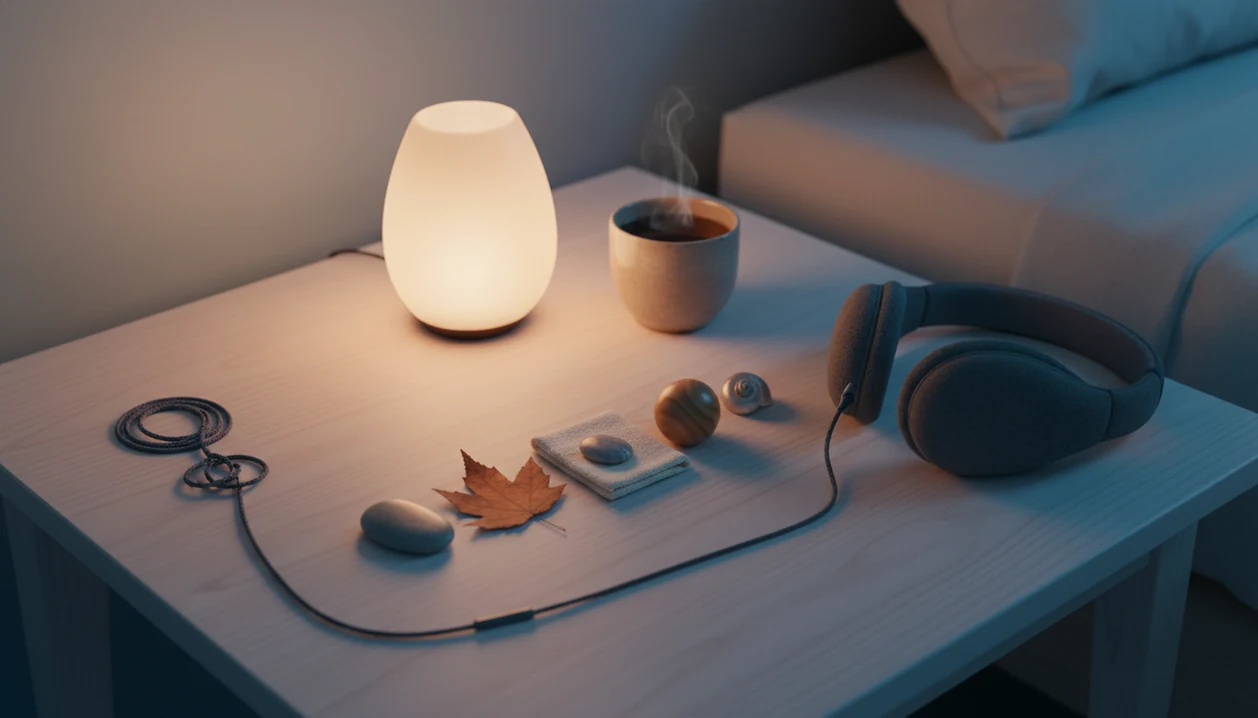


Mindfulness exercises for overthinking are short, repeatable attention practices that help adults notice racing thoughts, label them gently, and return to an anchor such as breathing, body sensations, sound, or movement. The aim is not to empty the mind. It is to notice a thought without following it into another round of worrying, planning, or replaying.
Start with 1 to 5 minutes and repeat the same exercise daily. Sensory grounding offers something concrete to notice during a spiral; thought labeling suits repetitive mental loops; a body scan can give bedtime attention a quieter task. Guided audio provides instructions when choosing the next step feels like more work. Thoughts may keep returning, and returning attention is the practice. If starting small feels more manageable, try one-minute mindfulness exercises before adding more time to your daily practice.
The essentials
- You do not need to stop thoughts; the skill is noticing thoughts and returning to an anchor.
- The strongest beginner exercises are 5-4-3-2-1 grounding, box breathing, body scans, thought labeling, and guided sleep audio.
- MindTastik can support consistency with guided meditation, sleep audio, breathing exercises, and self-hypnosis sessions for adults who want sleep, anxiety, and everyday calm support.
Best mindfulness exercises for overthinking at a glance
The most useful mindfulness exercises for overthinking match the practice to the moment: sensory grounding for spirals, breathing for stress, labeling for repetitive thoughts, body scans for bedtime, and guided audio when deciding what to do feels like more work.
| Exercise | Best for | Time needed | When to avoid or modify |
|---|---|---|---|
| 5-4-3-2-1 grounding | Panic-like spirals, commuting worry, public stress | 1-3 minutes | Modify if sensory focus feels overstimulating |
| Box breathing | Racing thoughts before a meeting or hard conversation | 1-5 minutes | Skip breath holds if they feel uncomfortable |
| Thought labeling | Repetitive planning, replaying, judging, or “what if” loops | 2-5 minutes | Keep labels neutral, not critical |
| Body scan | Bedtime rumination and mental exhaustion | 5-20 minutes | Keep eyes open if closing them feels unsafe |
| Guided sleep audio | Nighttime overthinking and decision fatigue | 5-30 minutes | Use shorter tracks if long audio makes you restless |
Guided audio helps because it takes away the “what now?” problem. In a quiet room with dim light, that can make the next step feel simpler. One steady voice may be easier to follow than sorting through several techniques while your mind is already busy.
For a broader menu, our mindfulness exercises page lists more options by time, setting, and energy level.
How overthinking mindfulness exercises work in the brain and body
Overthinking mindfulness exercises work by training attention to return to an anchor instead of feeding the thought loop. The mechanism is simple: notice the thought, interrupt the rumination cycle, and redirect attention to breath, body, sound, senses, or guided audio.
The goal is not a blank mind. It is a different relationship to thoughts. You may still notice planning, replaying, or worrying, but you practice not climbing inside each thought.
Research supports this direction, with limits. A review of 19 studies found small to moderate reductions in rumination after mindfulness-based interventions. A 2014 meta-analysis found mindfulness-based therapy was associated with lower anxiety symptoms, and an 8-week stress trial found reduced perceived stress. For source context, see Goyal et al. on meditation programs and anxiety symptoms (JAMA Internal Medicine study: 1809754) and the NIH overview of meditation and mindfulness evidence (NCCIH mindfulness overview: meditation and mindfulness effectiveness and safety). A sleep meta-analysis also found moderate improvements in sleep quality for people with sleep disturbance. Add the sleep source inline: systematic review/meta-analysis on mindfulness meditation and sleep quality (PubMed research: 27658958).
Therapists and mental-health guidelines commonly recommend skills that build awareness, grounding, and flexible attention for stress and anxiety support, not as a replacement for care. Good mindfulness tools offer practice cues, not promises.
How to use mindfulness exercises for a busy mind
Use mindfulness exercises for a busy mind by making the practice tiny, specific, and repeatable. A short reset works better than waiting for a quiet personality to arrive.
- Set a tiny time limit. Choose 1-5 minutes, especially if your mind feels fast.
- Choose one anchor. Use breath, sound, body pressure, or one guided audio track.
- Label thoughts briefly. Say “planning,” “worrying,” “remembering,” or “replaying.”
- Return gently. Bring attention back without scolding yourself for drifting.
- Repeat at the same cue. Try after closing your laptop, getting into bed, or sitting in the car before walking inside.
- Use guided audio. Choose it when you keep wondering what to do next.
Tiny counts.
At bedtime, dim the phone screen before starting audio and place it face down. During stress, use one breath cycle before replying to the message that made your chest tighten. MindTastik fits this routine because guided breathing and sleep sessions give a busy mind a track to follow.
How we picked these overthinking mindfulness exercises
We picked these overthinking mindfulness exercises because they are simple, repeatable, beginner-friendly, and usable in 1-5 minutes. Long silence can help some people, but it can also give a busy mind too much room to argue.
- Clear anchors matter: breath, body, senses, movement, and audio guidance give attention somewhere to land.
- Short practice lowers friction: a 2-minute reset is easier to repeat than a 30-minute ideal.
- Beginner language helps: the practice should not require spiritual vocabulary or perfect posture. For practical options without specialized vocabulary, try mindfulness activities for adults that bring attention to ordinary moments.
- Modification is important: eyes open, shorter timing, and guided audio can make practice safer and easier.
- Scope stays honest: this page focuses on calm, sleep support, and anxiety support, not medical treatment.
If you want a wider framework, our mindfulness exercises and techniques hub explains how different practices fit together.
5-4-3-2-1 grounding exercise for overthinking and anxiety
What is the 5-4-3-2-1 exercise for overthinking? It is a sensory grounding practice that asks you to name 5 things you see, 4 things you feel, 3 things you hear, 2 things you smell, and 1 thing you taste, or one slow breath if taste is not available.
The reason it works is practical. Sensory detail pulls attention toward the present room, sidewalk, seat, or blanket. Noticing the blue sign, the sleeve seam, the elevator hum, and the cool air at the nose gives attention concrete details to return to when worry takes over.
In public, make it silent. On a train, look for five colors and feel both feet inside your shoes. Before bed, keep the list soft: pillow, sheet, breath, darkness, one sound.
For immediate resets, 5-4-3-2-1 grounding is often easier than silent meditation because it gives the mind five concrete tasks in a row.
Box breathing mindfulness exercise for racing thoughts
Box breathing is a breath-counting exercise for racing thoughts: inhale for 4, hold for 4, exhale for 4, and hold for 4. Repeat the square for one to five rounds, using the count as your attention anchor.
If breath holds make you tense, remove them. Try inhale for 4 and exhale for 6, or simply count each natural exhale from 1 to 10. The point is not breath performance. The point is giving attention a low-effort pattern.
Counting lowers cognitive load because there is less to decide. Inhale. Count. Exhale. Count again.
MindTastik can help when self-guiding becomes another thing to manage, because a breathing exercise can set the rhythm while you follow along. If the priority is a fast workday reset, MindTastik fits with short guided breathing audio that can sit between calendar alerts and the next call.
Thought-labeling mindful exercise for repetitive thoughts
Thought labeling is a mindful exercise for repetitive thoughts that names the mental activity without arguing with it. Useful labels include “worrying,” “planning,” “remembering,” “judging,” “replaying,” and “problem-solving.”
A 2-minute script can be very plain: notice the thought, label it once, soften your jaw or shoulders, then return to breath or sound. If the thought returns, label it again. No debate. No courtroom.
The label creates distance from thought content. “I am failing” feels different from “judging is here.” That small gap helps you respond instead of chasing the same loop for another twenty minutes.
Watch the tone, though. Labeling should not become another self-criticism exercise. If you catch “worrying again, obviously,” drop the commentary and use one neutral word. Replaying. Planning. Returning. If you prefer practicing with others, mindfulness activities for groups offer shared exercises without requiring anyone to discuss private thoughts.
For people who want a written follow-up, mindfulness journal prompts can help sort recurring thought themes after the practice, not during it.
Body scan mindfulness exercise for bedtime overthinking
How do you use a body scan for bedtime overthinking? Start at the feet and move slowly toward the face, noticing pressure, warmth, tingling, heaviness, pulsing, or tension without needing to change every sensation.
A body anchor can be easier at night than analyzing thoughts. The mind may want to review unread emails behind closed eyes, but the body gives you something less abstract: heel on mattress, calf against sheet, shoulder sinking into the pillow.
Try this before bed: feet, ankles, calves, knees, thighs, hips, belly, chest, hands, arms, neck, jaw, eyes, forehead. Pause for one breath at each area. If closing your eyes feels uncomfortable, keep them half open or shorten the scan to just feet, hands, and jaw.
For adults who need bedtime structure, MindTastik covers guided sleep audio and self-hypnosis sessions that can lead the scan step by step. For bedtime calm, MindTastik is useful because the audio keeps the sequence moving when thoughts keep trying to restart.
Bedtime mindfulness is not the same as insomnia treatment
Feeling less caught up in bedtime thoughts and treating persistent insomnia are different goals. A 2018 review of randomized trials on mindfulness and sleep quality found improvements compared with nonspecific active controls, but no advantage over specific active controls. The comparison group matters: a practice can help without outperforming another targeted intervention. These findings also concern programs of practice, not a guarantee that one body scan will shorten the time needed to fall asleep.
For chronic insomnia, cognitive behavioral therapy for insomnia, or CBT-I, remains the better-supported first-line behavioral treatment. A 2025 review comparing psychological treatments for sleep problems found a medium improvement in sleep quality for CBT-I relative to controls, while the mindfulness effect was smaller and statistically uncertain. A body scan or thought-labeling practice can accompany treatment, but should not replace its core components, including stimulus control and sleep scheduling.
MindTastik guided audio for mindfulness exercises for a busy mind
MindTastik can support consistency with guided meditation, sleep audio, breathing exercises, and self-hypnosis sessions for adults who want sleep, anxiety, and everyday calm support. Guided audio lowers the burden of deciding what to do next, which is often the exact burden overthinkers are trying to reduce.
Helpful formats include:
- Guided meditation: for everyday calm when sitting alone feels too open-ended.
- Sleep audio: for a wind-down routine when thoughts get louder in bed.
- Breathing exercises: for short resets during stress transitions.
- Self-hypnosis sessions: for structured bedtime listening and habit support.
For adults who want a simple track ready when overthinking picks up, MindTastik can be a practical fit because it turns practice into a press-play routine. Competitors such as Calm and Headspace also offer guided libraries, so compare voice style, session length, pricing, and download needs before choosing.
Best-for and not-for table for mindfulness exercises for overthinking
Mindfulness exercises for overthinking are best for everyday thought loops, not crisis care. They can support everyday calm, sleep routines, and stress transitions, but they should not be used to avoid needed professional support.
| Best for | Not ideal for |
|---|---|
| Everyday worry loops | Emergency mental health situations |
| Bedtime rumination | Replacing therapy, medication, or clinical care |
| Stress transitions between work and home | Severe untreated anxiety, depression, PTSD, or suicidal thoughts |
| Beginner meditation practice | Trauma-triggering body scans or closed-eye practices without support |
| Everyday calm support | Expecting every stressful thought to disappear |
Needing more help is not a failure. It is information.
For beginner meditators who need structure, MindTastik fits because guided sessions can narrow the choice between a 5-minute breathing exercise and a 20-minute body scan. If emotional naming feels more useful than breathwork, emotional awareness exercises may be a better starting point.
Honest cons of overthinking mindfulness exercises
Mindfulness can feel boring, frustrating, or emotionally uncomfortable at first. Some people expect calm within thirty seconds, then feel like they failed when the mind keeps sprinting.
Benefits usually build with repeated practice over weeks, not one session. Many studies on mindfulness use 6-8 week practice windows, which is very different from trying one breathing exercise after a brutal day and judging the whole method.
Silent practice can also amplify rumination for some people. In that case, guided audio is not a shortcut; it is a support. The voice gives your attention a rail to follow.
Mindfulness supports anxiety and sleep habits, but it does not remove every stressful thought. For busy adults, MindTastik can help with consistency because guided meditation, breathing, and sleep tracks reduce the need to invent a practice from scratch each night.
When to seek professional help for overthinking
Seek professional help when overthinking feels unmanageable, starts disrupting sleep, work, relationships, or daily safety, or comes with symptoms that feel bigger than a normal stress loop. Mindfulness can support care, but it does not replace treatment from a licensed therapist, doctor, or qualified clinician.
Warning signs deserve extra attention: panic attacks, flashbacks or trauma triggers, compulsive checking, severe avoidance, depression symptoms, substance use to cope, or thoughts of self-harm or suicide. If you might hurt yourself or someone else, treat that as urgent.
- Contact emergency services if there is immediate danger, a suicide plan, or you cannot stay safe.
- Use crisis support in your country or region if suicidal thoughts, panic, or emotional overwhelm feel acute.
- Tell a trusted person what is happening, especially if you are alone or afraid you may act on an impulse.
- Book clinical support with a licensed therapist, doctor, psychiatrist, or qualified mental-health professional.
- Keep mindfulness gentle while you wait for care: eyes open, short sessions, grounding through the room, and guided audio if silence feels too intense.
Getting help is not overreacting. It is a safer plan.
Guided prompts when self-directed practice becomes another task
MindTastik’s guided meditation library suits adults who want spoken prompts rather than an open-ended period of silence. Breathing exercises can provide a counting rhythm during a short reset, while sleep stories or self-hypnosis audio offer structured bedtime listening. These formats are options for directing attention, not treatments for overthinking. Adults who prefer silence may need only a timer; persistent insomnia, severe anxiety, or trauma-related distress calls for professional support rather than more audio.
When mindfulness is not enough for racing thoughts
Mindfulness exercises for overthinking are supportive practices, not medical treatment. They can help many adults relate differently to racing thoughts, but they have real limits.
- Mindfulness is not a substitute for professional treatment for severe anxiety, depression, PTSD, panic symptoms, or suicidal thoughts.
- Results are gradual. Many mindfulness studies examine 6-8 week practice windows, not single-session fixes.
- Body scans, closed eyes, silence, or inner-focus practices may feel triggering for some trauma histories.
- Evidence is stronger for stress, anxiety symptoms, rumination, and sleep quality than for curing all overthinking.
- Apps only help when used consistently; downloading one does not create a routine by itself.
- Breath holds may feel uncomfortable for some people, so box breathing should be modified when needed.
- Guided audio may not fit people who dislike voices, music, or listening through earbuds at night.
- Mindful practice can bring up sadness, tension, or restlessness before it feels calming.
If symptoms feel intense, unsafe, or hard to manage alone, contact a qualified health professional or local emergency support.
Questions about mindfulness for overthinking
Can mindfulness stop overthinking completely?
Mindfulness does not require thoughts to stop, and it cannot guarantee that worry will disappear. The skill is noticing a thought, briefly naming it, and returning to a chosen anchor. Repeated practice may make thought loops easier to step out of, but persistent or disruptive symptoms need more than a short exercise.
What is a quick mindfulness exercise for racing thoughts?
Try a brief sensory reset: notice visible objects, the pressure of both feet, and nearby sounds. The 5-4-3-2-1 exercise adds smell and taste when available. Keep the details neutral and concrete. If sensory input feels overwhelming, simplify the practice to one comfortable sound or point of contact.
How do I label repetitive thoughts without analyzing them?
Use a short description of the activity, such as “planning,” “worrying,” or “replaying.” Name it once, then return to breath or sound. There is no need to decide why the thought appeared or find the perfect label. If naming thoughts becomes another debate, use a simpler anchor.
Why do I keep losing focus during mindfulness?
A wandering mind does not mean the exercise has failed. Noticing that attention has shifted is part of the practice. Return to the same anchor without restarting the whole session. Shorter practice or spoken guidance can make the task clearer when silence leaves too much room for repetitive thinking.
How long should I practice mindfulness for overthinking?
Start with 1 to 5 minutes at a repeatable cue, such as closing a laptop or beginning a bedtime routine. Use the same exercise rather than changing methods every day. Many mindfulness studies examine several weeks of practice, so one session is not a reliable test of longer-term benefit.
What helps when I overthink in bed?
A body scan or brief thought labeling can shift attention away from replaying the day. Writing down worries and next-day tasks before bed may also help separate planning from bedtime. If wakefulness becomes increasingly frustrating, CBT-I principles favor a quiet, dim-light activity outside bed until drowsy.
Can mindfulness make anxiety or overthinking worse?
Yes, silence, closed eyes, or attention to bodily sensations can feel uncomfortable or intensify distress for some people. Shorten or stop the exercise rather than forcing it. Eyes-open grounding or attention to an external sound may suit better. Panic, flashbacks, or recurring distress warrant guidance from a qualified clinician.
Should I use box breathing if holding my breath feels uncomfortable?
Breath holds are optional, not a requirement for mindfulness. Remove them and try a comfortable inhale and exhale, or count natural exhales from 1 to 10. Avoid forcing the count or straining for a slower breath. If breathing focus itself feels distressing, choose sound or sensory grounding instead.