
Mental Health Exercises for Everyday Stress Support
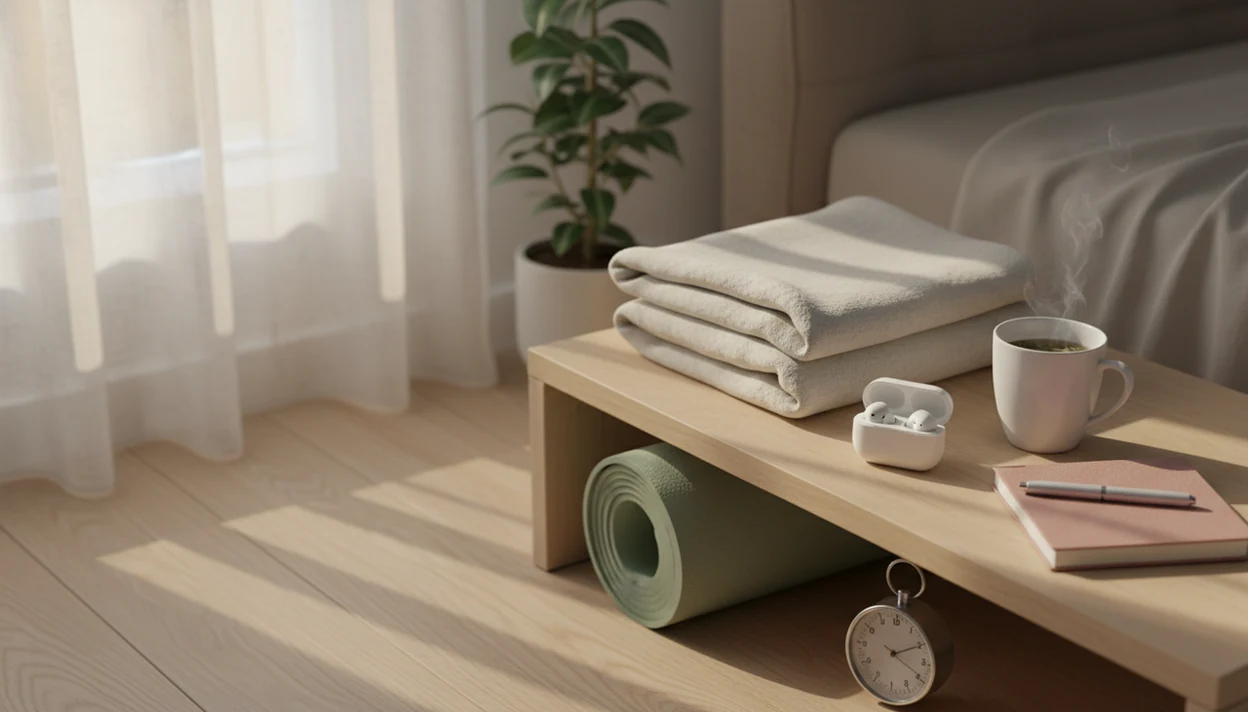


Mental health exercises for stress are simple, repeatable practices, such as breathing, grounding, mindfulness, gentle movement, and guided meditation, that support everyday calm. These non-clinical, self-guided activities can help with stress regulation, emotional awareness, and sleep readiness. They are wellness tools, not emergency care or replacements for therapy, medication, or a clinician’s guidance.
A useful starting point is a short practice matched to the problem: grounding for racing thoughts, gentle movement for muscle tension, or guided meditation before bed. Two to ten minutes is enough to begin without making calm another task to complete. Severe, persistent, or unsafe symptoms need professional support. Suicidal thoughts, self-harm urges, unmanageable panic, psychosis, or difficulty meeting basic needs call for prompt assessment or urgent care.
Stress support at a glance
- Use short practices first: 2-10 minutes of breathing, grounding, body scanning, or guided meditation is enough to start.
- Match the exercise to the moment: calming breathwork for acute stress, movement for tension, and sleep meditation for nighttime rumination.
- Escalate to professional or urgent care if stress includes suicidal thoughts, self-harm urges, panic that feels unmanageable, psychosis, or inability to function.
Mental health exercises for adults: quick exercise table
| Exercise | Best for | Not for | Time needed | How to do it safely |
|---|---|---|---|---|
| Breathing | Fast stress downshift | Dizziness, breath panic | 1-3 min | Keep the inhale easy; never force breath holds. |
| 5-4-3-2-1 grounding | Racing thoughts | Severe dissociation alone | 2-5 min | Name real sights, sounds, textures, smells, and tastes. |
| Body scan | Tension awareness | Trauma flashbacks | 3-10 min | Notice sensations without trying to fix them. |
| Progressive muscle relaxation | Tight jaw, shoulders, legs | Pain flares | 5-12 min | Tense lightly, then release. Skip painful areas. |
| Guided meditation | Beginners, focus | Crisis care | 5-20 min | Choose a calm voice and stop if distress rises. |
| Journaling | Emotional sorting | Rumination spirals | 5-10 min | Use prompts and set a timer. |
| Mindful walking | Restlessness | Unsafe walking areas | 5-15 min | Walk slowly and keep awareness of surroundings. |
| Sleep audio | Bedtime rumination | Severe insomnia alone | 10-30 min | Dim the screen and keep volume low. |
These exercises support stress and calm, but they do not treat crises, trauma flashbacks, severe depression, or panic disorder alone. Apps such as MindTastik can offer guided meditation, sleep audio, breathing exercises, and self-hypnosis sessions for adults seeking sleep, anxiety, and everyday calm support. For Todd Kennedy’s guest overview of mindfulness meditation and mental health, see his practical guide.
What mental health exercises are and are not
Mental health exercises are simple, repeatable activities that help people practice stress regulation without needing a formal clinical setting. Common examples include breathing techniques, mindfulness, gentle movement, journaling, grounding, and relaxation practices.
They can support everyday stress, emotional awareness, sleep routines, and focus. Someone may use a two-minute grounding exercise after a tense message, then choose a longer body scan later that night. Small is allowed.
These practices are not diagnosis, psychotherapy, crisis intervention, or a substitute for prescribed treatment. About 1 in 5 U.S. adults, or 22.8%, lived with a mental illness in 2021, according to the National Institute of Mental Health nimh reference: mental illness, which helps explain why accessible support tools matter. Still, accessible does not mean sufficient for every situation.
For a broader library of related practices, our mindfulness exercises and techniques guide maps breathing, grounding, and meditation options by use case.
How mental health exercises work in the nervous system
Mental health exercises work by shifting attention, slowing breathing, reducing muscle tension, increasing interoceptive awareness, and creating a pause between a trigger and a response. Interoception means noticing internal body signals, such as a tight chest or clenched stomach, before stress takes over.
- Attention shift: Grounding gives the mind a concrete task, like counting five blue objects in the room.
- Breathing rhythm: A steady exhale can cue the body toward a calmer state without claiming to cure anxiety or depression.
- Muscle release: Progressive relaxation teaches the difference between held tension and softening.
- Body scanning: Short scans help adults notice stress earlier, not perfectly.
- Habit loop: Repeated short practices make it easier to pause before reacting.
A 2014 JAMA Internal Medicine meta-analysis of 47 randomized controlled trials found mindfulness-based stress reduction produced moderate improvements in anxiety and depression and small improvements in stress and quality of life JAMA Internal Medicine study: 1809754.
For everyday stress, a short repeated practice is often more useful than a long occasional session because it becomes easier to remember under pressure.
How to use mental health exercises at home
If you are looking for mental health exercises I can do at home, start with brief, low-pressure practice. The goal is not to become calm on command. The goal is to choose a starting point you can repeat. Choose morning meditation that works for your routine, keeping the practice brief and comfortable rather than forcing stillness.
- Pick one exercise that matches the moment, such as grounding for racing thoughts or stretching for tension.
- Set a short timer for 2-5 minutes instead of forcing a long session.
- Practice after one daily anchor, such as waking, lunch break, after work, or before bed. For a focused start, try morning meditation for focus and calm before checking messages or beginning work.
- Notice what changes in your breath, shoulders, thoughts, or urge to scroll. Try six questions for your daily ledger to record your observations and keep daily reflections simple and consistent.
- Repeat the same practice for several days before judging whether it fits. A 7 day mindfulness challenge can help you repeat manageable practices and notice which ones fit your everyday needs.
Stop or switch exercises if a practice increases distress, dizziness, panic, numbness, or trauma activation. Feet on the carpet. One real object named out loud. That can be enough for today.
Best stress support exercises for specific moments
Different stress moments need different exercises, so avoid treating one method as universally right. The most useful choice is the one that fits your body, setting, and safety needs.
- Before a stressful meeting: box breathing or extended exhale. Best for pre-meeting nerves; not for anyone who feels dizzy with breath control. Try three quiet rounds before opening your notes.
- During an anxiety spike: 5-4-3-2-1 grounding. Best for reconnecting with the room; not enough for panic that feels unmanageable. Name what you can see, hear, and touch.
- After conflict: progressive muscle relaxation. Best for clenched muscles; not for painful areas. Release the jaw, shoulders, and hands gently.
- During work fatigue: mindful walking. Best for restless stress; not for unsafe spaces. Walk one hallway without checking your phone.
- Before sleep: guided sleep meditation. Best for nighttime rumination; not a replacement for sleep disorder care.
Many adults are looking for a calm voice to help them pause, breathe, and steady themselves when worry starts to build. That is a fair starting point.
Calm exercises for breathing, grounding, and body awareness
Which calm exercises can I do quickly during the day? Breathing, grounding, and body scanning are practical first choices because they need little space, no special gear, and only a few minutes.
Extended-exhale breathing
Inhale gently through the nose or mouth, then exhale slightly longer than the inhale. Repeat for 1-3 minutes. Do not strain. If a four-count inhale feels tight, use two counts in and three counts out.
5-4-3-2-1 grounding
Name five things you see, four things you feel, three things you hear, two things you smell, and one thing you taste. This brings attention back to the present environment, especially when thoughts are speeding ahead.
Two-minute body scan
Move attention from forehead to feet, noticing tension without forcing relaxation. If breathwork makes you dizzy, breathe normally and choose grounding instead.
For very short options, one minute mindfulness exercises can help when the day is already crowded.
Wellness exercises for movement, sleep, and daily routines
Wellness exercises include movement, relaxation, and sleep-support practices that make stress care less dependent on sitting still. For many adults, movement-based exercises are easier than seated meditation because the body has somewhere to put its energy.
- Mindful walking: Walk slowly and notice foot pressure, pace, and surroundings.
- Gentle stretching: Use small movements for the neck, shoulders, hips, or back.
- Progressive muscle relaxation: Lightly tense and release muscle groups from face to feet.
- Sleep-focused guided meditation: Use a calm voice to follow a wind-down routine.
- Daily physical activity: The U.S. Physical Activity Guidelines recommend 150-300 minutes of moderate-intensity aerobic activity per week for adults and note that regular physical activity is associated with mental health benefits health reference: Physical Activity Guidelines 2nd edition.pdf.
Picture a short reset beside the bed: feet on the floor, one hand on the blanket, the room dim, and a guided voice kept low enough not to jolt you awake.
Sleep audio and guided sessions, including those in MindTastik, can help adults build a consistent wind-down routine, but they are not medical treatment.
App-based mental health exercises and guided meditation evidence
App-based mental health exercises can make short practices easier to access, repeat, and fit into ordinary routines. That matters when the choice is between a five-minute breathing exercise and a 20-minute body scan in an app library at 10:46 p.m.
- App-based mindfulness can reduce friction by putting guided sessions on a phone adults already use.
- A 2017 PLOS ONE systematic review and meta-analysis found small-to-moderate reductions in stress, anxiety, and depression from app-based mindfulness interventions compared with controls journals reference: article.
- Results vary by user, session quality, practice consistency, and symptom severity.
- Short guided sessions may help beginners who do not know what to do in silence.
- Apps cannot replace personalized assessment when symptoms are severe.
MindTastik provides structured guided meditation, bedtime audio, breathing cues, and self-hypnosis sessions aimed at sleep support, anxiety relief, and everyday calm.
App-based practice usually works best when it reduces the effort to begin, while in-person care fits people who need assessment, risk support, or a treatment plan.
What mindfulness research says about responding to stress
A 2026 systematic review and meta-analysis of mindfulness-based strategies included 110 studies and 8,105 participants. It found a small, statistically significant effect on emotional reactivity and the use of emotion-regulation strategies, with an effect size of g = 0.28. Results varied substantially between studies. This supports mindfulness as a modest aid for noticing emotions and responding less automatically, not a guaranteed way to stop stress quickly.
The comparison group also matters. A 2019 review of 51 randomized trials in university students found small-to-moderate short-term improvements in several outcomes, including distress, anxiety, and rumination, compared with passive controls. Benefits were less consistent against active treatments. Neither review establishes that a particular two-minute exercise will work immediately, and findings from structured mindfulness programs should not be treated as proof for every self-guided technique.
When stress support exercises are not enough
When are stress support exercises not enough? Self-guided exercises should not delay professional help when symptoms are severe, persistent, unsafe, or affecting basic functioning.
Escalation signs include suicidal thoughts, self-harm urges, feeling unsafe, hallucinations or delusions, panic attacks that feel unmanageable, inability to work, inability to care for basic needs, substance misuse, or prolonged low mood. If any of these are present, contact a licensed mental health professional, primary care clinician, local emergency number, or crisis service based on urgency.
Clinicians typically recommend matching support to risk: self-guided tools for mild everyday stress, professional care for persistent or impairing symptoms, and urgent help when safety is at risk.
During the COVID-19 pandemic, about 30% of U.S. adults reported anxiety and/or depressive disorder symptoms in KFF survey reporting kff reference: the implications of covid 19 for mental health and substance use. That demand is real. However, common stress does not make unsafe symptoms something to manage alone.
For people who want to name feelings more clearly before a therapy visit, emotional awareness exercises can be a gentle bridge.
How This Guide Was Reviewed for Safety
This guide was editorially reviewed for safety and source quality, not clinically reviewed as individualized medical advice. Its exercises are presented as wellness support for everyday stress, not treatment for a specific diagnosis or crisis.
The review process used a cautious mental-health source order and checked language that could affect reader safety:
- Prioritize government and public-health sources first, then peer-reviewed research, clinical guidance, and finally consumer-facing education.
- Check crisis language for clear escalation: suicidal thoughts, self-harm urges, psychosis, feeling unsafe, unmanageable panic, or inability to meet basic needs should point toward urgent or professional support.
- Screen contraindications so practices do not imply that breathwork, meditation, sleep audio, or app-based tools are safe for everyone in every state.
- Review wording around stopping, switching, or seeking care when an exercise increases dizziness, panic, dissociation, trauma activation, or distress.
- Refresh mental-health statistics and source links on a regular editorial cycle, with closer review when major public-health data or guidance changes.
The aim is steady, practical support with clear boundaries: small exercises can help, but they should never delay needed care.
Guided sessions for short stress breaks
MindTastik’s guided meditation library suits adults who prefer spoken instructions to practicing alone. Breathing sessions offer another option for a brief daytime pause, while sleep stories and soundscapes may suit a bedtime wind-down. People who find breath focus or inward attention distressing should choose external grounding or gentle movement instead. Persistent symptoms, severe panic, or safety concerns need professional care, not a longer app session. MindTastik is not a medical treatment.
When self-guided stress exercises are not enough
Mental health exercises can be useful, but the boundaries matter. A calm routine should never become a reason to postpone needed care.
- These exercises are not emergency interventions for suicidal thoughts, self-harm urges, psychosis, severe panic, or unsafe situations.
- They do not replace therapy, medication, medical evaluation, or a treatment plan for diagnosed mental health conditions.
- Mindfulness can feel uncomfortable for some people, especially those with trauma histories. Movement or grounding may be safer starting points.
- Breathwork can cause dizziness, air hunger, or distress in some people. Modify it, breathe normally, or stop.
- Evidence is stronger for structured mindfulness, physical activity, and relaxation than for unsupported wellness hacks, affirmation-only routines, or untested audio frequency claims.
- Apps can support practice consistency, but they cannot diagnose conditions, monitor risk fully, or provide individualized crisis care.
- Sleep audio may support a wind-down routine, but ongoing insomnia or major daytime impairment deserves clinical evaluation.
At 2:13 a.m., checking the lock screen and realizing you are still awake feels lonely. It is also a signal to use more support if the pattern keeps repeating.
For bedtime-specific routines, mindfulness exercises before bed may help you choose a gentler starting point.
Questions about stress support exercises
Which mental health exercise should I try first for stress?
Start with the clearest stress signal. Racing thoughts may suit sensory grounding, tense muscles may suit gentle movement or progressive relaxation, and a need for structure may suit guided meditation. There is no single best exercise for everyone. Choose a brief practice and stop or switch if distress increases.
How long should a stress exercise last?
Two to five minutes is a practical starting point at home or during a break. A longer body scan or guided meditation is optional, not a requirement. Repeat a manageable practice for several days and notice changes in tension, attention, or breathing rather than expecting complete calm after every session.
Does 5-4-3-2-1 grounding actually help with stress?
Grounding gives attention a concrete task: naming things seen, felt, heard, smelled, and tasted. It may help shift focus from distressing thoughts to the immediate surroundings. Direct controlled evidence for the exact 5-4-3-2-1 sequence is limited, so it is best understood as a coping option, not a proven treatment for anxiety or trauma.
What should I do if breathing exercises make me dizzy or anxious?
Stop the counted breathing and let the breath return to its usual rhythm. Avoid forced inhalations or breath holds. An external task, such as naming objects in the room, may be a better fit than watching the breath. Persistent or worsening panic needs professional assessment rather than repeated attempts to force relaxation.
Can meditation make stress or trauma symptoms worse?
Yes. Inward attention, closed eyes, breath focus, or body scans can sometimes increase panic, intrusive memories, or dissociation, especially with a trauma history. Keeping eyes open, noticing the room, moving gently, or shortening the practice may help. Stop if symptoms escalate, and seek a clinician’s guidance for persistent trauma-related distress.
What exercises can help with stress before sleep?
Gentle stretching, light progressive muscle relaxation, or a calm guided meditation can provide a simple wind-down routine. Skip painful muscle groups and avoid breath control that causes discomfort. These practices support sleep readiness, but they do not treat every cause of sleep disruption. Persistent or worsening sleep problems deserve professional attention.
Can stress exercises replace therapy or anxiety medication?
No. Self-guided exercises can support everyday coping, but they do not replace assessment, psychotherapy, prescribed medication, or a treatment plan. Research on structured mindfulness interventions does not mean a brief home exercise is equivalent to treatment. Persistent anxiety, panic, or difficulty functioning is a reason to discuss care with a licensed professional.
When should I get help instead of doing a stress exercise?
Seek professional support when stress, low mood, panic, sleep disruption, or substance use persists, worsens, or interferes with basic functioning. Suicidal thoughts, self-harm urges, risk of harming someone, psychosis, severe dissociation, or inability to stay safe need immediate help from a crisis service or local emergency service. Exercises should not delay that contact.