
Mindfulness Books for Kids: A Practical Parent Guide


Mindfulness books for kids are stories, picture books, and activity guides that teach present-moment awareness through simple language, illustrations, and exercises such as belly breathing, naming feelings, or noticing the five senses. The most useful choices pair a story with one concrete practice a child can try immediately. A book about feeling calm is less practical than one that shows what to do when worry or frustration appears.
Choose by age, attention span, and the situation the book needs to support. Younger children often need pictures and movement; older children may prefer drawing prompts, journals, or more precise emotion words. Read together, model the exercise, and return to the same short practice at bedtime, before school, or during anxious moments rather than introducing a new technique every time.
Choosing and using a book
- The best mindfulness books combine story, pictures, and a short practice instead of only talking about calm.
- Match the book to your child’s age: concrete picture books for younger kids, journals and deeper emotion language for older children.
- Books work best when adults model the same skills and reinforce them with short audio practices, sleep routines, or breathing exercises.
Best mindfulness books for kids by age and need
This is a selection framework, not a ranked commercial book list. The right choice depends on your child’s age, reading stamina, and the moment you want to support.
| Child’s stage or need | Book type to choose | What to look for |
|---|---|---|
| Toddlers and preschoolers | Picture books or board books | One concrete practice, such as belly breathing, animal breathing, or noticing colors |
| Early elementary | Read-aloud stories | Characters who name feelings, pause, breathe, or use the five senses |
| Ages 8-12 | Activity books, journals, body-awareness guides | Drawing prompts, short reflections, and body clues like tight shoulders or fast breathing |
| Preteens and teens | More reflective mindfulness books | Stress, friendship, sleep, self-talk, and choice-based practices |
For younger kids, one practice per book is enough. For older children, a journal page may work better than another “calm down” story.
Keep the shelf small at first. If you want named starting points, look for titles such as Sitting Still Like a Frog by Eline Snel, Breathe Like a Bear by Kira Willey, I Am Peace by Susan Verde, Anh’s Anger by Gail Silver, and What Does It Mean to Be Present? by Rana DiOrio. Treat those as examples to library-test, not a universal top-five list.
Five recommended mindfulness books for kids
Five strong starting examples are Sitting Still Like a Frog by Eline Snel, Breathe Like a Bear by Kira Willey, I Am Peace by Susan Verde, Anh’s Anger by Gail Silver, and What Does It Mean to Be Present? by Rana DiOrio. They are not medical or therapeutic prescriptions; they are books to try, adapt, or skip depending on your child.
- Start with Breathe Like a Bear by Kira Willey for preschool and early elementary children who like quick prompts. It teaches breath awareness and works well before bed with one “bear breath” under the blanket.
- Try I Am Peace by Susan Verde for ages 4-8 when worry feels busy. Its core skill is noticing thoughts and returning to the present.
- Use Anh’s Anger by Gail Silver for ages 5-9 when big emotions need a name. It helps children picture anger without shame.
- Choose What Does It Mean to Be Present? by Rana DiOrio for ages 5-10 to practice attention, kindness, and everyday noticing.
- Save Sitting Still Like a Frog by Eline Snel for ages 7-12, especially children ready for short guided practices around focus and body awareness.
Borrow from a library first when your child is picky, easily bored, or sensitive to quiet inward attention. Families may also find mindfulness for parents of autistic children useful when adapting shared practice to sensory preferences.
How mindfulness books for kids teach calm skills
Mindfulness books teach calm skills by turning attention, emotion regulation, and body awareness into repeatable scenes children can understand. A character feels worried, notices a tight belly, takes three breaths, and tries again.
Children learn through repetition, modeling, images, and short embodied practices. “Embodied” just means the skill happens in the body, not only in words. Stories help because abstract ideas become visible: a storm cloud for anger, a buzzing bee for busy thoughts, or a sleepy bear doing slow breaths.
A 2014 systematic review and meta-analysis of school-based mindfulness programs found small-to-moderate improvements in cognitive performance, resilience, and stress measures, but the authors also noted wide variation in program quality and study design (source).
For children, mindfulness usually works best when a caring adult reads, pauses, tries the exercise too, and repeats it across ordinary moments.
Research on programs does not prove a particular book works
The research cited here evaluates mindfulness programs, not the five individual books recommended on this page. A 2019 meta-analysis of 33 randomized controlled studies, involving 3,666 children and adolescents, found small improvements across several outcomes compared with controls. Those findings support cautious interest in structured practice, but they do not establish that reading a particular story produces the same results.
The comparison group also matters. When mindfulness was compared with active controls, significant benefits remained only for mindfulness, depression, and anxiety or stress, rather than across every outcome examined. For families, the practical distinction is between a useful reading activity and a treatment claim. A book can supply language and an exercise to repeat; this research cannot establish that the book itself will improve attention, sleep, or behavior.
Five mindfulness books for kids facts parents should know
- Story plus practice works better than story alone. A book that ends with “take three balloon breaths” gives the child something to do right away.
- Age and developmental stage matter. Preschoolers need pictures and movement; older children can handle journals, body maps, and more specific emotion words.
- Adult modeling improves follow-through. A parent saying, “I’m frustrated, so I’m doing the breathing page too,” teaches more than a lecture. Adults can also practice meditation for parents to model calm responses during shared reading and everyday challenges.
- Regular practice over weeks matters more than one perfect book. In a randomized study of 4th- and 5th-grade children, an 8-week mindful awareness program was associated with improved executive function ratings compared with controls (source).
- Evidence should be used carefully. A 2015 randomized trial of 99 children aged 9-11 found improvements in self-reported well-being, prosocial behavior, and peer-rated social behavior after a school mindfulness program, but the results came from one setting and should not be treated as universal (source).
Small repeats count.
How to use mindfulness books for kids at home
Use mindfulness books as a short routine, not a long lesson. The goal is a repeatable cue your child recognizes when feelings get loud.
1. Set one calm reading moment
- Choose a predictable time, such as bedtime, after school, or before a difficult transition. For tight schedules, mindfulness for busy parents can help adults keep shared practices short and manageable.
- Keep the setting simple, with a dim lamp beside wrinkled pillows or a quiet couch corner.
- Read only enough pages to keep your child engaged, even if that means stopping before the story ends.
2. Read for connection first
- Notice the character together, and ask one plain question: “What do you think they feel?”
- Avoid turning the book into a correction, especially during a meltdown.
3. Practice one exercise together
- Pause for one practice, such as belly breathing, five senses, or feeling feet on the floor.
4. Repeat the same cue daily
- Name the skill clearly, such as “slow breath,” “body check,” or “worry name.”
- Repeat it for several days before adding another practice.
5. Add guided audio when helpful
- Bridge to short audio when your child likes listening more than talking. Tools like MindTastik can reinforce sleep, anxiety, breathing, and everyday calm routines; a meditation for kids app can also help families keep the cue consistent.
Mindfulness books for kids tips for sleep, anxiety, and focus
Which mindfulness book exercise fits sleep, anxiety, focus, or big emotions? Match the practice to the child’s immediate need, then keep the routine short enough to repeat.
For sleep, choose slow breathing, a gentle body scan, or cozy sensory imagery. The small decision of dimming the phone screen before bedtime audio can become part of the cue, especially when paired with bedtime meditation for children.
For anxiety, use books that name the feeling, externalize worry, and offer short breathing practices. One child may say, “I just need something to play when my thoughts get loud.” That’s useful information.
For focus, try a five senses game, mindful listening, or a one-minute attention reset. For big emotions, co-regulation comes before correction.
MindTastik can support a book routine with audio, but the adult relationship still carries the practice.
Best-fit and poor-fit use cases for mindfulness books for kids
Mindfulness books fit best when a family wants gentle language, shared practice, and repeatable calm cues. They are less useful when a child needs clinical, school-based, or crisis support.
| Best for | Not ideal for |
|---|---|
| ✓ Families building a gentle bedtime or after-school routine | ✗ Replacing therapy, medical care, school services, or crisis intervention |
| ✓ Children who respond to stories, visuals, and repetition | ✗ Children who feel worse with quiet inward attention |
| ✓ Teaching emotional vocabulary without shame | ✗ Books that promise to fix anxiety, sleep, or behavior |
| ✓ Classroom-friendly calm skills and short breathing cues | ✗ Situations needing urgent safety planning or specialist care |
Some children do better with movement first. A wall push, stretch, or sensory grounding game can make the book feel safer. For more active resets, families may prefer calm down meditation for kids alongside reading. For a hands-on activity before reading, learn how to make a glitter jar and watch the glitter settle together.
Quality checklist for mindfulness books for kids
Use this checklist before buying, borrowing, or building a routine around a book.
Concrete exercise: Choose books with a real practice, not vague advice to “be calm.” Belly breathing, five senses, and mindful listening are easier to repeat.
Age-fit language: A preschooler needs simple words and pictures. A preteen may need privacy, choice, and less sing-song narration.
Emotion validation: Prefer books that say feelings are allowed. Avoid stories that push forced positivity or make sadness seem like failure.
Relatable representation: Look for diverse illustrations, family structures, school settings, and everyday worries children recognize.
Honest claims: Skip books that promise to cure anxiety, sleep problems, or behavior issues.
Borrow first if you can. A library test prevents the “five new books, none opened twice” problem. For whole-house practice, a family mindfulness routine can help adults and children use the same words.
Image caption for mindfulness books for kids reading routines
Suggested caption: A parent and child sit together in a quiet bedtime corner, reading a mindfulness picture book and practicing belly breathing before lights out.
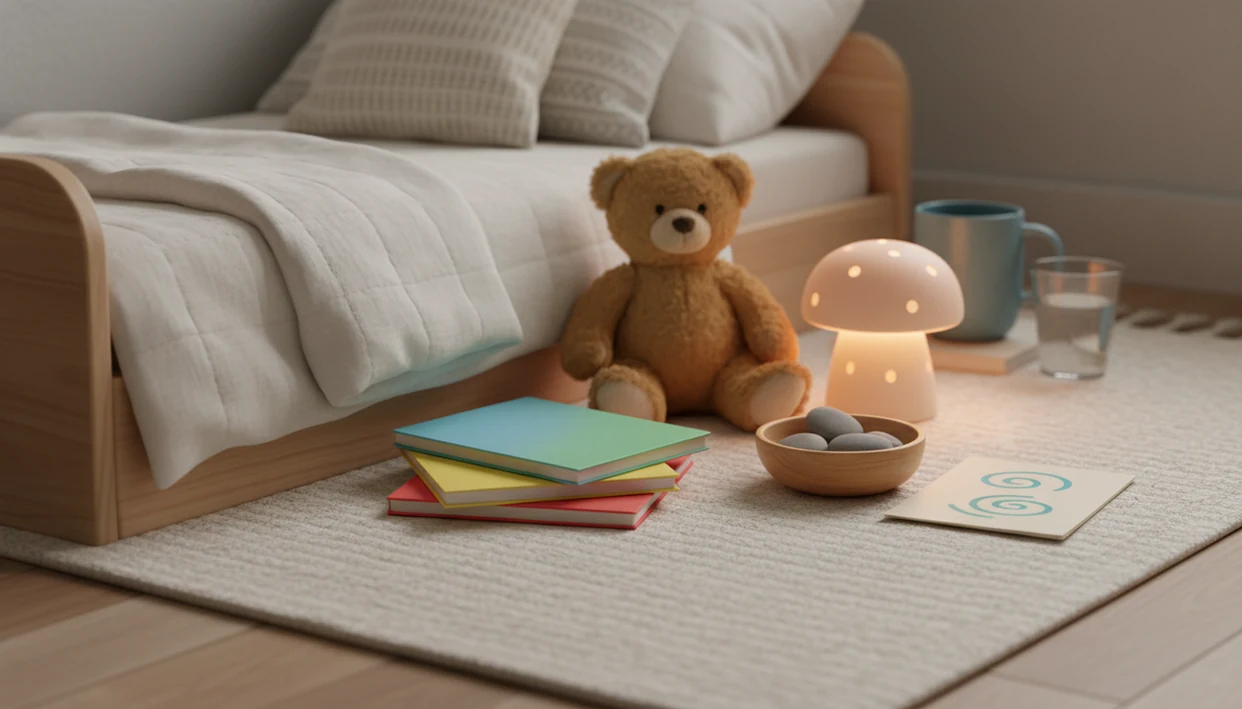
A useful image for mindfulness books for kids should show connection first, not a child sitting perfectly still. Include a familiar setting, such as a rug, bed, book basket, or soft lamp. The practice can be simple: one hand on the belly, noticing five things in the room, or listening for the quietest sound.
The image should feel like a real evening, not a staged wellness poster. One slightly tangled earbud on the nightstand would be believable.
Audio practice after a mindfulness story
MindTastik’s kids sessions and guided breathing exercises can provide an audio cue after a book introduces a calming skill. An adult can choose a session that matches the story’s exercise and listen alongside the child. A child who prefers pictures, movement, or conversation may do better staying with the book rather than adding audio. Children whose distress persists or worsens need appropriate professional support, not a longer meditation routine.
What mindfulness books cannot treat or guarantee
Mindfulness books can support calming habits, but they have clear limits. Parents should treat them as practice tools, not as proof that a child’s needs are solved.
- Books alone do not usually change anxiety, sleep, attention, or behavior without repetition and adult support.
- Mindfulness is not a substitute for professional mental health care, medical care, therapy, school services, or emergency support.
- Some children may find quiet body-focused practices uncomfortable, especially with trauma histories or certain neurodevelopmental needs.
- Some books use mindfulness language loosely or make unrealistic promises.
- Benefits in studies are often modest and depend on program quality, age, setting, and consistency.
- Caregivers should stop or adapt any practice that increases distress.
- Apps and audio supports should be used as gentle practice tools, not diagnosis or treatment.
If a child’s worry, sleep disruption, aggression, withdrawal, or distress persists, ask a qualified professional for guidance.
When to seek professional help
Seek professional help when a child’s worry, sleep trouble, withdrawal, aggression, panic, or distress keeps showing up or starts interfering with daily life. Books and apps can support practice, but they cannot diagnose what is happening or replace care.
A useful first step is to notice patterns, not just one hard night or one difficult morning. If your child avoids school, stops enjoying usual activities, has frequent stomachaches around worry, wakes often, lashes out in ways that feel unsafe, or seems overwhelmed by panic, bring in support.
- Contact your pediatrician to rule out medical contributors and ask what level of care fits the concern.
- Reach out to a therapist or licensed mental health professional if anxiety, sleep disruption, anger, or withdrawal is persistent or escalating.
- Ask the school counselor or support team when worries, attention, peer stress, or behavior changes show up during the school day.
- Use books, breathing, and audio as practice tools while you follow professional guidance, not as tests or treatments.
- Get emergency help immediately if there is talk of self-harm, threats to safety, abuse concerns, or any crisis situation.
Questions about children’s mindfulness books
What should a mindfulness book for kids include?
Look for an understandable story, recognizable feelings, and one concrete exercise, such as noticing sounds or taking gentle belly breaths. Pictures and instructions should fit the child’s developmental stage. Avoid books that treat sadness or anger as failure, demand calm, or promise to fix anxiety or behavior.
Which mindfulness books suit preschoolers?
Picture books with brief prompts and movement are a useful starting point. Breathe Like a Bear by Kira Willey is one option for preschool and early elementary children who enjoy quick exercises. Choose a single prompt rather than completing every activity, and stop when the child loses interest.
Which mindfulness books can help children talk about worry or anger?
I Am Peace by Susan Verde offers a starting point for noticing busy thoughts, while Anh’s Anger by Gail Silver is another book to consider for discussing strong feelings. The best fit depends on the child’s response to the story. Neither book is a treatment for persistent anxiety or unsafe behavior.
How can a mindfulness book become part of bedtime?
Read a short section, then repeat one familiar exercise, such as gentle breathing or noticing how the body rests on the bed. Keep the emphasis on connection rather than completing the book. If inward attention makes the child uncomfortable, return to the story or try noticing sounds in the room.
How often should children practice exercises from mindfulness books?
Use a brief, repeatable moment, such as after school or during bedtime reading, rather than setting a demanding practice target. Repeating one familiar exercise can make the cue easier to recognize. There is no established reading schedule here that guarantees results, and practice should remain optional rather than a test of good behavior.
What if a child dislikes breathing exercises or sitting still?
Sitting still is not required for every mindfulness activity. Try noticing colors, listening for sounds, drawing feelings, or using movement prompts instead. Do not insist on closed eyes or prolonged breath attention. Stop an exercise that increases distress, and involve a trusted adult or clinician if that reaction persists.
Can mindfulness books replace therapy for a child?
No. Books can support shared practice and emotional vocabulary, but they cannot diagnose or treat a child’s difficulties. Persistent worry, disrupted sleep, school avoidance, withdrawal, or unsafe behavior calls for professional support. A pediatrician or qualified mental health professional can help determine what care is appropriate.