
Self-Compassion for Parents of Struggling Kids


Self-compassion for parents of struggling kids means responding to fear, guilt, exhaustion, and mistakes with the steadiness and kindness a parent would offer their child. It involves noticing personal distress, remembering that other parents struggle too, and replacing shame with a more useful response. It is not self-pity, an excuse for harmful behavior, or a reason to lower parenting standards.
This is a learnable skill, not a fixed personality trait. The practical aim is to pause before reacting, respond with more patience, and repair after a mistake. Breathing exercises, body scans, sleep audio, and guided meditation can offer a place to practice that pause. They support the parent’s response; they do not solve the child’s difficulties or replace professional care.
What matters most
- Self-compassion is a learnable parenting skill, not a fixed personality trait.
- Research links higher parent self-compassion with lower stress and more supportive responses to children’s difficult emotions.
- Brief tools like breathing exercises, body scans, sleep audio, and guided meditation can help parents reset before reacting.
Self-Compassion for Parents of Struggling Kids: The Core Definition
Self-compassion for parents of struggling kids has three parts: kindness toward yourself, awareness of what is happening, and the reminder that other parents struggle too. It is not pretending the hard moment went well.
A self-critical parent might think, “I ruined everything again,” after yelling during homework. A self-compassionate parent might think, “That was not how I wanted to respond. I can calm down, apologize, and try the next step.” Same accountability. Less shame.
At 2:13 a.m., when the lock screen glows and you realize you are still awake worrying about your child, self-compassion sounds small. “I am scared, and I am still here.” That pause can make repair easier in the morning.
Self-compassion supports better parenting because it reduces the inner attack that often fuels reactivity. It does not excuse harm, ignore boundaries, or replace the work of changing behavior.
3 Evidence Signals for Parent Self-Compassion Under Stress
Research does not say self-compassion makes parenting easy. It does suggest that parents who relate to themselves with less shame often have more room for steady responses when children are struggling.
Most of this evidence is correlational, so it does not prove that self-compassion alone causes better parenting outcomes. It is best read as support for self-compassion as one regulation skill, not as a stand-alone treatment for child anxiety, trauma, school refusal, or developmental concerns.
- A 2011 meta-analysis of 79 samples and 16,416 participants found that higher self-compassion was strongly associated with lower stress, anxiety, and depression across diverse populations source.
- A 2014 study of parents of children with autism found that higher self-compassion was linked with lower stress and depression source.
- A 2021 study of 189 parents found that higher parent self-compassion was associated with more supportive responses to children’s negative emotions, even after accounting for depressive symptoms source.
- A steadier parent nervous system can help a child feel safer, especially during meltdowns, school refusal, or anxiety spirals. Learning how parental love affects child development can add context to the value of steady, caring responses.
- Brief self-compassion practice may help parents move from punishment or panic toward repair, limits, and problem-solving.
The backpack is still by the door. The morning is still hard. But the parent’s tone can change the room.
Mindful-parenting research does not prove a brief reset changes child outcomes
Much of the intervention research concerns structured mindfulness-based parenting programs, not self-compassion phrases or a single audio session. A 2021 review of 11 studies involving 1,340 parents found no significant overall effect on parenting stress or overall parenting mindfulness. Evidence for changes in parent-child relationships, parental wellbeing, positive parenting, and child behavior was limited or inconsistent. That makes broad promises about calmer families difficult to justify.
The gaps also concern what researchers measure. A 2024 review of 20 randomized trials found that several parent-focused mindfulness interventions reduced parenting stress, but studies measured stress much more often than burnout, relationship quality, or child functioning over time. Feeling less overwhelmed matters, but it is not the same as a child returning to school or receiving effective treatment. Self-compassion is best treated as support for the parent alongside attention to the child’s needs. Research on benefits of mindfulness in schools addresses a different setting and should be considered separately from parent-focused findings.
Parent Nervous System Mechanics Behind Self-Compassion
Self-compassion works by shifting the parent from threat-mode self-criticism toward steadier regulation. In plain language, it helps your body stop treating your own mistake as another emergency.
When a child screams, refuses school, or dissolves at bedtime, your nervous system may jump into fight, flight, or freeze. Mindfulness creates a small pause between trigger and reaction. You notice, “My chest is tight. I want to snap.” That noticing is not passive; it is a brake.
This is why the first useful goal is often not feeling peaceful; it is interrupting the automatic snap, lecture, or shutdown long enough to choose one safer response.
Common humanity reduces isolation. Instead of “I am the only parent who cannot handle this,” you remember, “Many parents have moments like this.” Shame loses some grip.
Self-kindness then supports repair and problem-solving. For overwhelmed parents, naming the feeling is often easier than forcing calm because it gives the brain one clear job before the next parenting choice. Clinicians typically recommend seeking mental health, developmental, medical, or school support when a child’s distress is severe, unsafe, persistent, or beyond what the family can manage alone.
5 Self-Compassion Steps for Parents During Hard Moments
Use self-compassion during the hard moment, not only after everyone is asleep. The goal is not a flawless response; it is one steadier next move.
- Pause for one breath before speaking, even if the room is loud.
- Name your feeling silently: “I am overwhelmed,” “I feel helpless,” or “I am scared.”
- Offer one compassionate phrase: “This is hard, and I can stay steady for one minute.”
- Choose the next small action, such as lowering your voice, moving closer, or giving one clear limit.
- Repair afterward with a short apology, a reset, or a practical plan.
Pause before the reaction
A pause may be one quiet exhale before opening messages from school. That counts.
Name the parent emotion
Naming the feeling keeps you from becoming the feeling. “Guilt is here” lands differently than “I am failing.”
Choose the next kind action
Kind does not mean permissive. It might mean, “I won’t yell, and the tablet is still off.”
Self-Compassion Scripts for Meltdowns, Anxiety, and School Stress
Self-compassion becomes useful when it has words ready before the next storm. Scripts keep the parent from having to invent calm while flooded.
- Child meltdown: A self-critical thought says, “Everyone thinks I am a bad parent.” A self-compassionate response says, “This is hard, and I can stay steady for one minute.”
- Child anxiety: Instead of “I should know how to fix this,” try, “My job is to be present, not to remove every fear.”
- School refusal: Instead of “We are falling apart,” try, “We need support and one next step.” For child-focused support ideas, meditation for anxious kids may fit some families as a gentle add-on. For families with teenagers, teaching mindfulness in high school may offer school-based practice, without replacing support for persistent school refusal.
- Sibling conflict: Try, “I can hold the boundary without shaming either child.”
- Bedtime distress: Try, “Tonight is messy. Repair can still happen.”
Boundaries still matter. Self-compassion helps you set them with less panic and less blame.
Best-Fit Table for Parent Self-Compassion Practices
Self-compassion practices are a good fit when a parent needs steadier reactions, less shame, and repeatable ways to reset. They are not a substitute for care when safety, diagnosis, trauma, or severe distress is involved.
| Parent situation | Best for | Not for |
|---|---|---|
| Overwhelmed after conflicts | A short reset before re-engaging | Crisis care or emergency support |
| Carrying guilt after yelling | Repair, apology, and self-talk | Excusing harmful behavior |
| Wanting calmer reactions | Breathing, body scans, and mindful pauses | Replacing therapy or parent coaching |
| Needing brief daily practices | Two to five minutes before school or bed | Untreated severe child symptoms |
| Building family routines | Modeling calm language at home | Ignoring safety or developmental concerns |
Tools like MindTastik can support everyday calm, but they do not replace professional care. Meditation apps for sleep, anxiety, and everyday calm offer guided practice and repeatable routines, not diagnosis, crisis treatment, or guaranteed behavior change.
When Parents Should Seek Professional Help
Parents should seek professional help when a child’s distress is unsafe, persistent, or interfering with daily life. Self-compassion and meditation can support regulation, but they are not diagnostic tools, treatment plans, or crisis care.
Some hard seasons are ordinary stress: rough mornings, tears after school, sibling blowups, or a parent needing a reset. The threshold changes when a child cannot sleep, eat, attend school, separate, communicate, or recover in a typical way for days or weeks; when aggression, self-harm talk, running away, substance use, abuse concerns, or threats appear; or when a parent feels unable to keep everyone safe.
- Call emergency services or a local crisis line now if there is immediate danger, suicidal behavior, serious self-harm risk, violence, or a child who cannot be safely supervised.
- Contact the pediatrician when symptoms are intense, new, physical, or affecting sleep, eating, school, or development.
- Ask the school counselor or teacher what they are seeing and what supports or accommodations may help. Families can ask about mindfulness in schools as one possible classroom support alongside appropriate accommodations and professional care.
- Seek a therapist, parent coach, or developmental evaluation when patterns persist or feel beyond home strategies.
- Choose one calm next step if unsure: write down what changed, when it happens, and who you can call today.
MindTastik Support for Self-Compassion, Sleep, Anxiety, and Everyday Calm
For a parent, that support may look like a three-minute reset after a conflict, bedtime audio when worrying starts, or morning grounding before school stress. For mothers seeking a short reset, meditation for moms can provide practice options that fit around daily caregiving.
For context, consumer meditation apps such as Calm, Headspace, and Insight Timer offer overlapping guided-audio libraries; parents should compare session length, sleep support, child-adjacent content, and whether the routine is realistic on hard nights.
A parent might choose between a 5-minute breathing exercise and a 20-minute body scan in an app library. On rough nights, the smaller choice often wins. Keep it simple.
Guided sessions can also sit beside family practices, such as parent and child breathing exercises or a family mindfulness routine. MindTastik can help make practice easier to access. It should not be used as a replacement for therapy, medical care, school support, or emergency help.
Hero Image Caption for Parent Self-Compassion
Caption: A parent takes one slow breath beside an upset child, practicing self-compassion for parents of struggling kids by pausing, softening their tone, and choosing the next kind action.
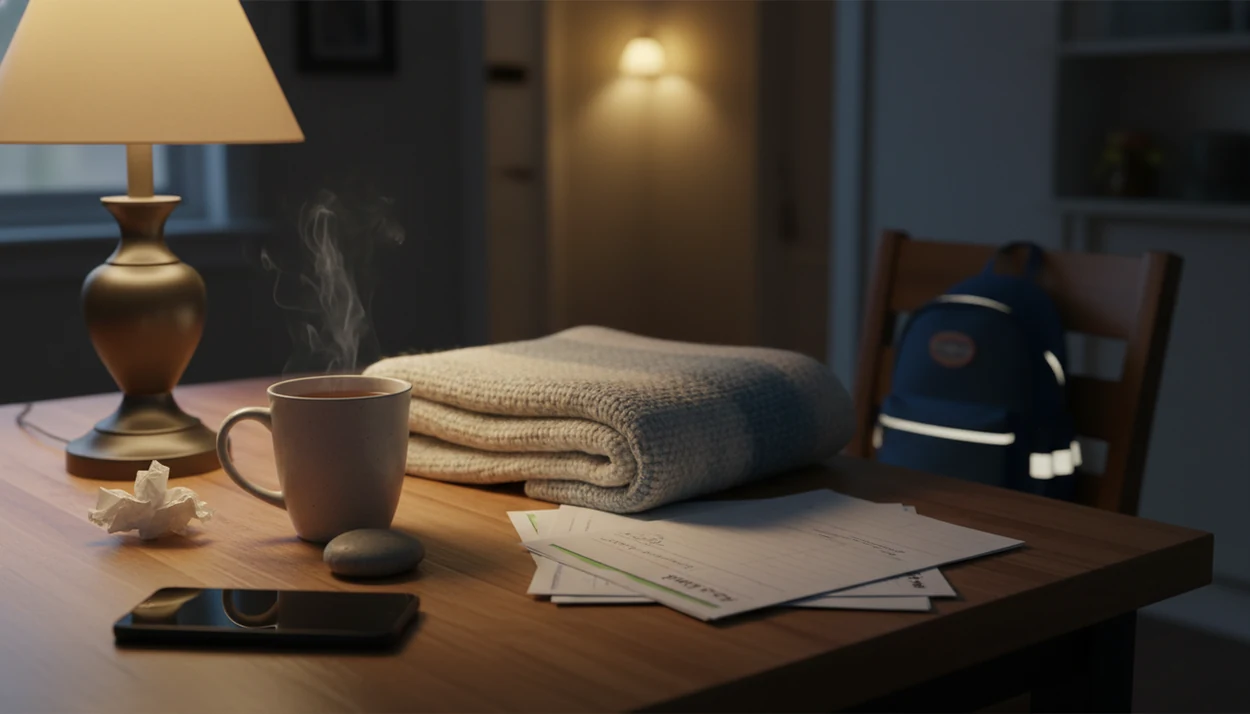
The image should feel real, not staged. Maybe the child is curled on the floor near a backpack, or resting under a blanket after a long evening. The parent is not smiling as if everything is solved. They are steadying themselves enough to stay close.
That is the point. Self-compassion often begins before the solution appears.
Audio support for the pause before reacting
MindTastik’s guided breathing exercises suit parents who want a simple prompt to pause before returning to a difficult conversation. Guided meditations offer another way to practice noticing distress without immediately acting on it, while sleep stories and soundscapes may suit evenings dominated by worry.
Parents who need help understanding persistent school refusal, severe distress, or unsafe behavior should choose professional assessment and support rather than an audio session alone. MindTastik is not a medical treatment.
What self-compassion cannot resolve for a struggling family
Self-compassion is supportive, but it has clear limits. It should make parenting safer and steadier, not smaller or avoidant.
- Self-compassion does not replace professional mental health, developmental, educational, or medical care.
- A child in crisis, danger, or severe distress needs appropriate professional or emergency support.
- Parents with trauma histories or intense self-criticism may feel worse at first, especially when kindness feels unfamiliar.
- Practice usually takes weeks or months. One calm audio session will not undo years of shame.
- Meditation apps can improve access and consistency, but they only help when used regularly.
- Self-compassion should not be used to excuse yelling, threats, neglect, or unsafe behavior.
- Repair still matters. So do apologies, changed patterns, and practical support.
- Some children need evaluations, accommodations, therapy, medication discussions, or school-based help.
If bedtime is the hardest window, bedtime meditation for children can be one calming piece of the routine. It is not the whole plan.
Parent self-compassion questions
How can I stop blaming myself when my child is struggling?
Separate responsibility from total blame. A parent can influence routines, responses, and access to support without controlling every difficulty a child faces. Replace a broad judgment such as “I have failed” with a specific question: “What needs attention now?” Persistent or severe difficulties call for help, not harsher self-criticism.
What should I say to myself after yelling at my child?
Use a phrase that names the mistake without turning it into an identity: “I yelled. That was not the response I wanted. I can pause and repair.” Then offer a short apology and identify the next change. Self-compassion does not remove accountability; it keeps shame from taking over the repair.
Does self-compassion mean letting my child avoid difficult things?
No. Self-compassion concerns how a parent responds to their own distress; it does not require removing limits or expectations. A parent can acknowledge feeling overwhelmed while keeping a clear boundary. When anxiety or school refusal persists, deciding what support and expectations are appropriate may require professional guidance.
How can I practice self-compassion during a child’s meltdown?
Keep the practice small: take one breath, silently name the feeling, and choose one safer response. “I am overwhelmed, and I can lower my voice” is enough. The goal is not to feel peaceful while the child is distressed. It is to interrupt an automatic snap, lecture, or shutdown.
Can self-compassion help with parental burnout?
Research identifies self-compassion as a potentially protective factor associated with lower parental burnout. That association does not prove it prevents or treats burnout by itself. Limited resources also matter. A kinder inner response can be useful, but it should not replace practical support or professional help when exhaustion and distress persist.
What if being kind to myself makes me feel worse?
Kindness can feel unfamiliar, especially with intense self-criticism or a trauma history. Start with a neutral acknowledgment such as “This is difficult” rather than a reassuring statement that feels untrue. A brief pause may be enough. If the practice increases distress, stop and consider support from a mental health professional.
How long does parent self-compassion take to work?
There is no reliable deadline for an individual parent. A pause may help in one moment, while changing a longstanding pattern of shame can take weeks or months. Look for concrete changes, such as a shorter argument or a clearer apology, rather than expecting one session to produce lasting calm.
When is self-compassion not enough for a struggling child?
It is not enough when distress is unsafe, persistent, or interferes with sleep, eating, school attendance, or everyday functioning. Self-harm talk, threats, abuse concerns, or an inability to keep everyone safe require appropriate professional or emergency support. Self-compassion can support the parent during that process, but it is not assessment or treatment.