
Mindful Way to Handle Tantrums: A Calm Parent Guide
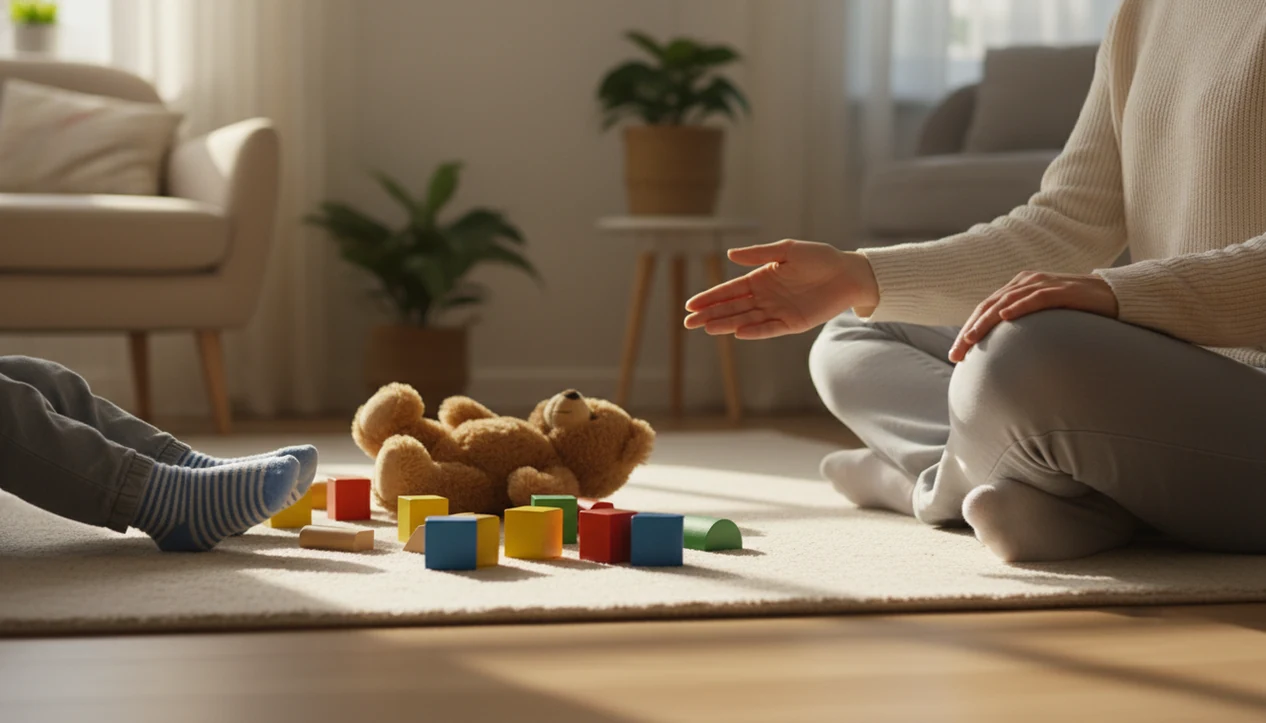


The mindful way to handle tantrums is to pause, steady the adult’s own breathing and tone, keep the child safe, name the feeling briefly, and hold the limit without yelling or lecturing. This pause-first parenting approach puts safety, emotional validation, and clear boundaries before correction. A tantrum is a moment for co-regulation first, meaning the adult offers a steady presence, and teaching later.
The aim is not to stop every tear. It is to respond without adding another layer of conflict. “You’re angry. I won’t let you hit” acknowledges distress without allowing harm. Once the child is calmer, there is room to discuss what happened and look for recurring triggers, including hunger, poor sleep, difficult transitions, and overstimulation.
The calm-response essentials
- Regulate yourself first: your tone, breathing, posture, and pace shape the child’s ability to calm down.
- Use short validation plus a firm limit: “You’re angry. I won’t let you hit.”
- After the tantrum, prevent repeats with sleep, food, transition, and overstimulation routines.
Mindful Way to Handle Tantrums: The 5 Facts Parents Need First
- A mindful tantrum response follows a simple order: pause, regulate, connect, then correct. Teaching comes after the child can hear you.
- The adult’s nervous system is part of the intervention. A slower voice, softer face, and steady posture can lower the emotional temperature.
- Validation is not permissiveness. “You’re mad” can sit beside “I won’t let you throw the truck.”
- Common tantrum triggers include hunger, tiredness, transitions, overstimulation, bedtime resistance, and the sharp disappointment of being told no.
- The CDC reports that childhood mental, emotional, and behavioral concerns are common, and NCCIH notes that mindfulness practices may help with stress and anxiety in some people; see CDC data on children’s mental health (source) and NCCIH’s mindfulness overview (source). That supports calm adult regulation as a family tool, not as a medical treatment.
For many families, the first useful shift is smaller than expected. One breath before speaking. One lower sentence. One fewer lecture. For school-age children, a mindful minute for students can provide a brief calming practice outside moments of conflict.
How the Mindful Way to Handle Tantrums Works in the Brain and Body
A tantrum happens when a child’s emotional system outruns language, impulse control, and reasoning. The mindful way to handle tantrums works by using adult co-regulation before asking the child to think, explain, or comply.
Co-regulation means a child often borrows steadiness from a regulated adult. In real life, that starts with noticing your own signals: clenched jaw, fast breathing, heat in your chest, racing thoughts, or the sudden urge to “make this stop now.” Those signals matter because they shape your voice and choices.
This matches the American Academy of Pediatrics’ advice to stay calm, keep the child safe, and avoid trying to reason during the peak of a tantrum: source.
Teaching during peak dysregulation usually fails because the child is not in a learning state. The useful job is safety first, nervous system second, words third. Clinicians typically recommend professional support when tantrums are severe, dangerous, unusually frequent, or tied to developmental concerns.
The most common medically supported way to respond to intense child behavior is calm safety management combined with consistent follow-through.
What mindful-parenting research can actually support
Research offers more support for helping parents manage stress than for stopping tantrums on demand. A 2016 systematic review of mindful-parenting programs screened 1,232 records but found only seven eligible randomized controlled trials. Some results suggested reduced parental stress and fewer externalizing symptoms in preschool children. The authors nevertheless found insufficient evidence for broad improvements in parent or child wellbeing because the studies had methodological limitations. When distress affects school life, mindfulness for students with trauma may complement support from qualified professionals.
The findings are not uniformly positive. A 2021 review of 11 studies involving 1,340 parents found no significant overall effect on parenting stress or overall parenting mindfulness, although one subgroup showed improved parenting mindfulness. Evidence for child behavior and parent-child relationships remained limited or inconsistent. These studies examined parenting programs, not a single breathing pause during a tantrum, so they do not establish that this response will shorten an individual episode.
Before You Start: Check Safety, Timing, and Triggers
Before using a calming script, make sure the child, other people, and the setting are safe. Then look for the pattern underneath the explosion so your response is firm, short, and useful.
- Scan for immediate risk first. If there is hitting, biting, running, choking danger, self-injury, or a medical concern, move into protection mode before validation or breathing.
- Notice the likely fuel. Hunger, poor sleep, pain, screens ending abruptly, hard transitions, noise, crowds, or too many instructions can make a small no feel enormous.
- Choose the boundary before the tantrum grows. Decide what is not changing: “We are leaving,” “The tablet is done,” or “I won’t let you hit.”
- Prepare one sentence you can repeat without lecturing. A phrase like, “You’re mad. I’m keeping you safe,” works better than a moving speech under stress.
- Call for help when safety or intensity is beyond what one adult can manage. Tag in another caregiver, contact a pediatrician, or seek professional support when tantrums are dangerous, unusually frequent, or tied to developmental concerns. If trauma may be contributing to distress, consider mindfulness support for kids with trauma alongside professional care tailored to the child.
How to Use a Mindful Way to Handle Tantrums in the Moment
Use these steps when a tantrum starts at home, in a store aisle, or beside the bed when everyone is already tired.
If there is hitting, running toward traffic, choking risk, self-injury, or a medical concern, skip the calming script and handle safety first. Mindful does not mean slow when the situation is unsafe.
- Pause before you speak. Put both feet on the floor, unclench your jaw, and take one slow breath.
- Protect the child and others. Move sharp objects, block hitting gently, or step away from traffic and hard corners.
- Lower your voice and reduce your words. Try, “I’m here. You’re safe. I’m not yelling.”
- Validate the feeling while holding the limit. Say, “You wanted the tablet. You’re angry. The tablet is done.”
- Wait near the child if it helps. Save explanations, consequences, and problem-solving for the calmer minutes after.
Long speeches feel tempting. They rarely help.
For younger children, a short practice outside the crisis can help. A simple parent and child breathing exercises routine gives the family a shared cue before emotions run high.
Mindful Way to Handle Tantrums Guide for Home, Public Places, and Bedtime
How do you use the mindful way to handle tantrums in different places? Keep the same framework, but change the setting: reduce stimulation, protect safety, validate briefly, and keep the boundary clear.
At home
At home, reduce the audience and remove unsafe objects. If your child accepts closeness, sit nearby on the floor. If closeness escalates them, stay visible but give space. A regular family mindfulness routine can make calm language feel familiar before conflict starts.
In public
In public, move toward less noise, fewer eyes, and fewer demands. Avoid shame-based compliance like “Everyone is watching you.” The goal is not a polished exit. It is safety and dignity.
At bedtime
At bedtime, look for tiredness, separation anxiety, screens, and inconsistent routines. Sleep and everyday calm routines can reduce friction, but they don’t cure every hard night. For bedtime support, bedtime meditation for children may fit better as prevention than as a mid-tantrum fix.
Tools like MindTastik, Calm, and Headspace can support adult wind-down, breathing practice, sleep audio, and everyday calm, not instant child compliance.
Best For and Not For: Mindful Way to Handle Tantrums Tips
Mindful tantrum strategies are best for ordinary emotional storms where the child needs safety, connection, and limits. They are not enough when danger, repeated severity, or developmental concerns are present.
| Best for | Not for |
|---|---|
| Ordinary toddler and preschool tantrums | Immediate danger to the child or others |
| Hard transitions, like leaving the park | Self-injury, head banging, or unsafe aggression |
| Frustration when a child cannot have something | Severe repeated episodes that disrupt daily life |
| Bedtime resistance with tired crying | Possible speech, sensory, developmental, or medical concerns |
| Mild public meltdowns where safety is manageable | Situations where professional evaluation is needed |
Mindful parenting still includes boundaries. You can be warm and firm in the same sentence. For families supporting older children, mindfulness for LGBTQ youth offers a related perspective on creating affirming spaces for emotional regulation.
For toddlers who need very short practice, short meditation for toddlers works better when used during calm moments, not as a demand during screaming.
Common Mistakes in a Mindful Way to Handle Tantrums
- Reasoning too early: Long explanations usually bounce off a dysregulated child. Replace them with “I’ll talk when your body is calmer.”
- Giving in after validating: Validation names the feeling; it does not change the boundary. Try, “You’re sad. We’re still leaving.”
- Matching the child’s volume: Loud adult energy often feeds the spiral. Drop your voice on purpose, even if it feels awkward.
- Threatening consequences mid-tantrum: New threats can add fear and lengthen the storm. Hold safety now, discuss repair later.
- Ignoring adult needs: Parent hunger, exhaustion, stress, and lack of support change the whole interaction. Eat, rest, tag in another adult, or step back safely when you can.
The rough part is that calm parenting takes energy. Some nights, with unread emails replaying behind closed eyes, the adult is already frayed.
A mindful response usually works best when the adult practices regulation outside conflict, while consequences fit better after everyone can listen. With older children, social emotional learning for teens can help frame calm practice around emotional awareness, relationships, and responsible choices.
MindTastik Support for Parent Calm During Tantrum Seasons
During tantrum-heavy seasons, the adult routine matters. Practicing calm at 8:10 p.m., after the child finally sleeps, makes it easier to find that same breath at 4:30 p.m. during a shoe battle. Try a 3-minute breathing session before school pickup, sleep audio at night, or a short calm reset after bedtime.
Meditation apps can help adults build habits around sleep, breathing, anxiety support, focus, self-hypnosis, and everyday calm, but they cannot replace pediatric, developmental, or mental health support. If tantrums are dangerous, frequent, or deeply distressing, bring in qualified help.
In this guide, MindTastik is best framed as parent-support practice: sleep audio, breathing, and short resets that may make calm responses easier over time. It should not be presented as a tantrum treatment or a substitute for pediatric guidance.
Practicing parent calm between tantrums
MindTastik’s breathing exercises offer a way for parents to practice a pause outside the hardest moment. Its guided meditations, kids sessions, and sleep stories can also fit a family’s quieter routines. These are practice options, not a method for making a distressed child comply. Families dealing with dangerous aggression, self-injury, or developmental concerns need professional assessment rather than an app alone. MindTastik is not a medical treatment.
When a calm response is not enough
Mindful tantrum strategies are useful, but they have real limits. They work best as repeated practice, not as a magic phrase during the hardest minute.
- They are not a fast fix for every child or every tantrum.
- They are harder when a child is hungry, sick, overtired, overstimulated, or in pain.
- They are harder when the parent is exhausted, anxious, unsupported, or sleep-deprived.
- They do not replace professional evaluation for severe, frequent, dangerous, or developmentally concerning tantrums.
- Safety and boundaries may matter more than soothing when there is immediate risk.
- Some tantrums reflect learned patterns and need consistent follow-through over time.
- Public settings can limit your choices because noise, judgment, and logistics all add pressure.
- A child with anxiety, sensory needs, trauma exposure, or communication delays may need a more tailored plan.
If your lock screen says 2:13 a.m. and you are still awake worrying about tomorrow’s meltdown, that is a sign to seek more support, not blame yourself.
Questions about responding to tantrums
What should I say during a toddler tantrum?
Use a short statement that names the feeling and holds the limit: “You’re angry. I won’t let you hit,” or “You’re sad. We’re still leaving.” A low voice and fewer words keep the response simple. Save explanations, questions, and teaching for when the child can listen.
Does validating a tantrum mean giving in?
No. Validation acknowledges the feeling, not the demand or unsafe behavior. “You wanted more tablet time” can be followed by “The tablet is finished.” The boundary stays the same. The distinction matters because a child can be disappointed while the adult remains both caring and firm.
Should I ignore my child during a tantrum?
Start with safety rather than a blanket rule about ignoring. A child who is hitting, running into danger, or hurting themselves needs protection. For manageable distress, stay available without adding long explanations or bargaining. If closeness makes things worse, give space while remaining visible and able to help.
How do I handle a tantrum in a shop or other public place?
Move toward a quieter, safer spot if possible, reduce demands, and keep the limit brief. Avoid comments about strangers watching or threats made out of embarrassment. The immediate task is safety and a steady response, not proving that the child can behave in front of an audience.
What if my child refuses to breathe with me?
The adult can take a slow breath without asking the child to join in. During intense distress, another instruction may add pressure. Keep the focus on safety, a low voice, and a clear limit. Breathing practice can happen during a calmer part of the day instead.
How can I respond to bedtime tantrums without changing the bedtime limit?
Acknowledge the objection briefly, keep the bedtime boundary clear, and reduce noise and extra conversation. Look for tiredness, hunger, overstimulation, or a difficult transition in the recurring pattern. Bedtime calming routines may support preparation, but they do not guarantee that a child will accept the limit without crying.
When should I seek help for my child’s tantrums?
Seek professional assessment when episodes are dangerous, repeatedly severe, or disruptive to daily life, or when there are possible speech, sensory, developmental, or medical concerns. Self-injury and unsafe aggression need more than a calming script. Immediate danger takes priority over validation, breathing practice, or discussion.
What should happen after a tantrum ends?
Wait until the child is calm enough to listen, then discuss the boundary and any repair that is needed. Keep the conversation concrete rather than turning it into a lecture. Separately, look for patterns involving sleep, food, transitions, and stimulation so prevention becomes part of the response.