
Mindful eating is the practice of paying deliberate, non-judgmental attention to hunger, emotions, taste, and fullness before, during, and after eating. It is present-moment awareness of food and body signals, not a diet plan. The basic skills are checking hunger, reducing distractions, slowing down, and noticing emotions without treating them as failures. The aim is to make eating less automatic, not to make every bite a task.
The practice also includes shopping, preparing food, and serving a meal. Research suggests that mindfulness-based approaches may help with emotional eating, binge eating, and eating prompted by external cues, but evidence for weight management remains unconvincing. Mindful eating does not replace clinical nutrition care or eating-disorder treatment.
The essentials
- Mindful eating means present-moment awareness of food and body signals, not a diet plan.
- Core skills include checking hunger cues, removing distractions, slowing down, and observing emotions without judgment.
- An 8-week mindfulness-based eating intervention improved dysregulated eating behaviors in a 2021 randomized trial PubMed research: 33886260.
- The practice extends beyond chewing. It includes shopping, meal prep, and serving rituals.
- Mindful eating does not replace clinical nutrition care and is not a guaranteed weight-loss method.
What Is Mindful Eating?
Mindful eating is deliberate, non-judgmental awareness of food, hunger, fullness, body sensations, and emotions across the whole eating experience. It is not a diet, and it does not sort foods into “good” and “bad” categories.
The practice comes from broader mindfulness training, where attention returns to the present moment without harsh self-talk. At a meal, that might mean noticing the first bite, the crunch of toast, the urge to keep eating, or the moment your stomach feels comfortably full.
It also starts before chewing. You can practice while choosing food, opening the fridge, serving a plate, or noticing whether stress is driving the decision. For beginners, mindful eating usually works best when one meal or snack becomes the starting point, rather than trying to change every food habit at once. For smaller eating moments, try mindful snacking to practice the same attention between meals.
Small plate. Quiet minute.
How Mindful Eating Works: The Awareness Mechanism
Mindful eating works by strengthening interoceptive awareness, which means noticing internal body signals such as hunger, fullness, tension, and satisfaction. In plain language, it helps you hear the body before autopilot takes over.
Many eating patterns follow a stimulus-response loop. Stress hits, boredom appears, the laptop stays open, and food becomes the automatic response. Mindful eating adds a pause between the trigger and the bite. That pause is small at first. Still, it gives you room to ask, “Am I hungry, anxious, tired, or just looking for a break?”
Non-judgmental attention matters because shame often fuels emotional eating. If a craving becomes “I failed again,” the spiral gets louder. If it becomes “I’m noticing a strong urge right now,” the body has more room to settle. Try responding to food cravings with savoring, noticing flavor and satisfaction rather than judging the urge.
For people already using breathing or meditation for everyday calm, this skill feels familiar. Meditation apps for sleep anxiety and everyday calm usually deliver guided attention and nervous-system settling, not medical treatment or food rules.
How to Practice Mindful Eating in 5 Steps
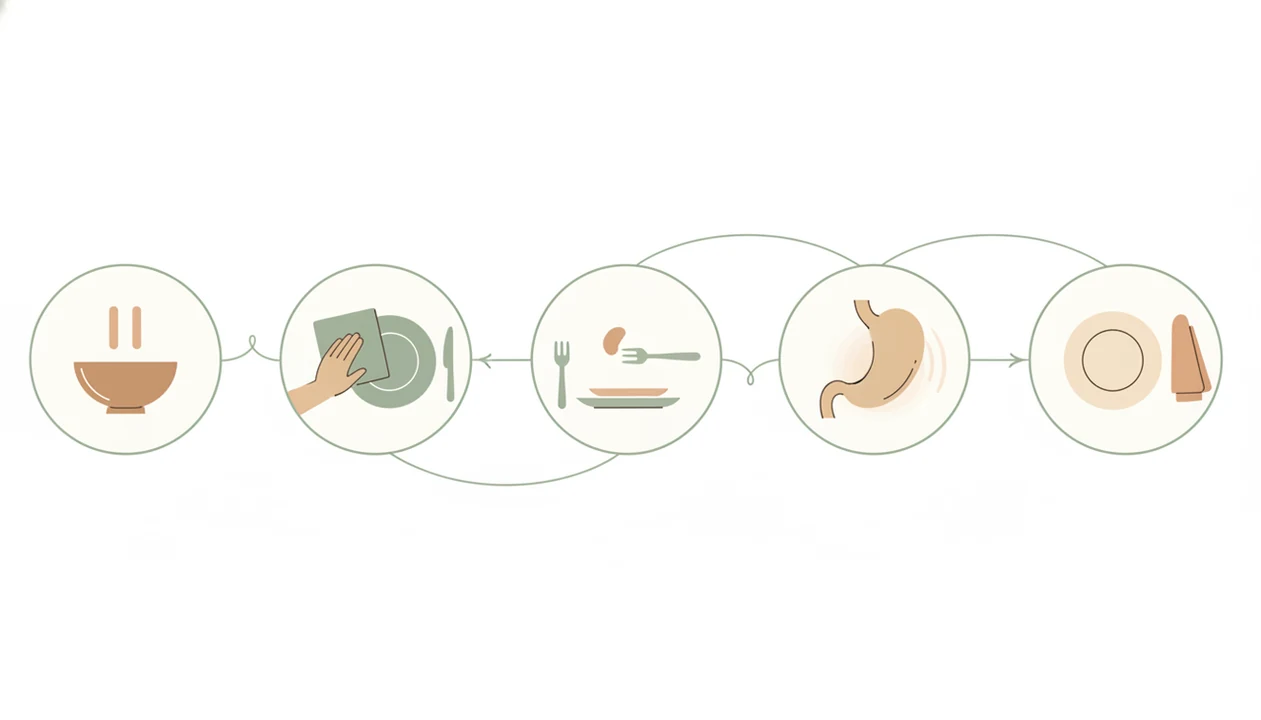
Use mindful eating as a short routine, not a performance. One ordinary lunch is enough to practice.
- Check your hunger level. Rate hunger from 1 to 10 before eating, where 1 is empty and 10 is uncomfortably full.
- Remove distractions. Put away the phone, close the laptop, and turn off the TV when possible.
- Slow the first few bites. Put utensils down between bites, chew deliberately, and let your shoulders drop.
- Notice the food with curiosity. Pay attention to taste, texture, temperature, smell, and how the flavor changes.
- Pause mid-meal. Recheck fullness, then decide whether to continue, slow down, or stop.
A short breathing exercise before eating can make the first step easier. Tools like MindTastik, Calm, and Headspace can help you settle for one minute before a meal, especially after a tense commute or a noisy work block. If you want the foundation first, our how to meditate guide explains the same attention skill in a simple sequence.
MindTastik is best used here as a one-minute settling tool before meals, not as nutrition advice. For food rules, diabetes care, binge-eating symptoms, or medical nutrition questions, use a registered dietitian or clinician instead.
Mindful Eating Beyond the Plate: Shopping, Prep, and Serving
Mindful eating includes the full food cycle, from shopping to serving, because habits often form before the first bite. The cart, cutting board, and plate all shape the meal.
Mindful Grocery Shopping
At the store, notice the difference between planned choices and impulse buys. You do not need to judge either one. Just pause long enough to ask what the item is for: hunger, convenience, comfort, celebration, or habit. The snack aisle after a stressful meeting feels different from the same aisle on a calm Saturday morning. To make everyday shopping decisions more intentional, explore healthier food choices through mindful attention.
Mindful Meal Prep and Serving
During prep, use your senses. Notice the sound of chopping, steam rising from a pan, or the smell of citrus on a cutting board. When serving, portion intentionally and plate with care. For many people, this turns eating from a rushed refill into a visible ritual.
Not fancy. Just noticed.
Mindful Eating and Emotional Eating: The Calm Connection
Can mindful eating help emotional eating? Mindful eating can help some people notice stress, boredom, or anxiety before those feelings turn into automatic eating, but it is not a substitute for clinical care when eating feels out of control.
Emotional eating means eating mainly in response to feelings rather than physical hunger. The point is not to shame the pattern. The point is to observe it clearly enough to create a choice. Fingers tracing a jacket zipper before a snack, a tight chest after an email, the urge for something crunchy at 10:40 p.m. These are cues.
A 2023 systematic review and meta-analysis found small-to-moderate reductions in binge eating outcomes across mindfulness-based interventions PubMed research: 36915855. A 2021 randomized trial also found that an 8-week mindfulness-based eating intervention improved dysregulated eating behaviors more than nutrition education.
Guided calm and sleep sessions can support emotional regulation outside meals. If anxiety is a frequent trigger, a meditation app for anxiety support may fit alongside mindful eating practice.
What the Research Says About Mindful Eating
Research on mindful eating is promising but mixed. The clearest finding is that mindful eating may improve eating behaviors for some people, while weight outcomes are less consistent.
- A 2020 systematic review found improvements in eating behavior and some weight-related outcomes, but results varied substantially by study design PubMed research: 32319996.
- A 2017 review in Current Obesity Reports concluded that mindful eating interventions often produce modest weight-loss effects, typically smaller than structured diet programs doi reference: s13679 017 0263 8.
- Benefits depend on the person, program length, support level, and whether the practice is repeated.
- Mindful eating should not be sold as a quick fix for weight, binge eating, or emotional eating.
- For many beginners, mindful eating is often easier than strict food tracking because it starts with body cues instead of external rules.
Registered dietitians generally recommend professional nutrition guidance when food choices are tied to medical conditions, eating disorders, or complex weight concerns. Mindful eating can still be supportive, but it should sit in the right care context.
Meal awareness does not guarantee a balanced diet
Feeling more attentive at meals is different from changing diet quality or energy intake. A systematic review of mindful-eating and intuitive-eating interventions covered 13 studies published through 2019. Seven of nine articles measuring energy intake found no significant difference between groups, as did eight of twelve measuring diet quality. These findings limit what can reasonably be promised from an awareness practice alone.
Mindful eating can sit alongside nutritional guidance rather than replace it. Food choices still need to account for dietary variety, adequate protein and fiber, fruits and vegetables, and whole grains. A pause to notice taste or fullness does not establish that a meal supplies enough nutrients. For clinical nutrition needs, medical or dietetic advice remains important, even when eating feels calmer and more deliberate.
Who Mindful Eating Is Best For - and Who Should Seek Professional Support
Mindful eating is best for people who want a non-diet way to understand hunger, fullness, stress eating, and mealtime attention. It fits stress eaters, beginners to mindfulness, and people who want food awareness without turning every meal into a rule checklist.
Best for
- Stress eaters who want a pause before automatic snacking.
- Beginners who want a simple mindfulness practice built into meals.
- People tired of labeling foods as allowed or forbidden.
- MindTastik users adding food awareness to a broader calm routine.
Not ideal for
- Active eating disorders without clinical support.
- Diabetes management without medical or dietetic guidance.
- Medical nutrition needs that require structured advice.
- People who must eat quickly during caregiving, shift work, or travel.
For on-the-go meals, keep the practice smaller. One breath before eating. One mid-meal fullness check. The full routine can wait.
A guided pause before a meal
MindTastik's breathing exercises and guided meditations can provide a brief pause before eating, particularly when a meal follows a stressful task. These sessions fit the attention and calming parts of mindful eating, rather than the nutritional decisions about what or how much to eat.
People who prefer to notice the first few bites without audio can practice without an app. Anyone seeking help for binge eating, an active eating disorder, or diabetes-related food decisions should choose qualified clinical support rather than rely on meditation sessions. MindTastik is not a medical treatment.
What mindful eating cannot replace
Mindful eating is useful, but it has clear limits. It is a supportive practice, not medical treatment.
- It does not replace medical, psychological, or dietetic care for eating disorders.
- It is not enough for diabetes management or other clinical nutrition needs.
- Study results are not uniform; some interventions show small effects or no clear advantage.
- It can be hard to sustain in busy, distracted, or on-the-go environments.
- Weight-loss effects are typically modest and smaller than structured diet programs.
- It can be oversold as a quick fix, although lasting change usually needs repetition and environmental support.
- Individual results vary widely based on history, stress, access to food, schedule, and support.
If mindful eating brings up fear, guilt, restriction, or loss of control, pause the self-guided approach. A qualified clinician or registered dietitian can help make the practice safer and more specific.
When meal awareness becomes food surveillance
Mindful eating may be drifting off course if it starts to feel like food surveillance, calorie negotiation, or a search for the “perfect” bite. A steady breath can support awareness, but it should not become another rule you have to perform correctly. If the practice makes you more tense, narrow the task: notice only the first three bites, then return to the meal. Mindfulness works best when it lowers pressure rather than adding a new standard to meet.
Mindful eating questions
How do beginners start mindful eating?
Start with one ordinary meal or snack. Set aside screens, notice hunger and emotions before eating, and pay attention to the taste, texture, and temperature of the first few bites. Pause during the meal to notice fullness and satisfaction. The task is observation, not eating perfectly or restricting food.
Is mindful eating the same as eating slowly?
Eating slowly is one part of mindful eating, but it is not the whole practice. Mindful eating also includes noticing hunger, fullness, emotions, and urges before and during a meal. It can begin while shopping or preparing food. A slow meal can still be distracted or full of self-criticism.
Can mindful eating help with emotional eating?
It may help some people recognize stress, boredom, or anxiety before eating becomes an automatic response. Research suggests benefits for emotional eating, but results vary. The aim is to notice the pattern without shame, not to ban comfort eating. Eating that feels persistently out of control calls for professional support.
Does mindful eating help with weight loss?
Mindful eating is not a guaranteed weight-loss method. Evidence is more consistent for changes in eating patterns than for weight management, which remains uncertain. Becoming more aware of hunger and fullness does not necessarily change energy intake or diet quality. It is better framed as an attention practice than a weight-loss plan.
How long should a mindful meal take?
There is no required meal length in this approach. A practical starting point is to notice the first few bites and pause once during the meal. Stretching every meal into a long exercise is unnecessary. The useful measure is attention to food and body cues, not minutes spent at the table.
Can mindful eating treat binge eating?
Mindfulness-based approaches show promise for binge-eating patterns, but a self-guided meal practice is not a substitute for eating-disorder treatment. Repeated loss of control around food deserves clinical assessment. Mindful eating may be part of supported care, rather than a technique someone must make work alone.
What if mindful eating makes me more anxious about food?
Reduce the task rather than add more rules. Noticing only the first few bites may be less demanding than monitoring hunger and fullness throughout a meal. If the practice becomes food surveillance, restriction, or persistent distress, step back and seek qualified support. Mindful eating should not become another test to pass.