
Self-Compassion and Healthy Eating: A Gentle Guide to Better Food Choices


Self-compassion and healthy eating means responding to food choices with kindness, awareness, and realistic habits rather than shame or strict rules. Its three parts are self-kindness, common humanity, and mindfulness: responding without self-attack, recognizing that eating struggles are common, and noticing what happened without treating it as a personal failure. After overeating, stress eating, or missing a plan, the aim is a supportive next choice, not punishment.
This approach does not mean ignoring health needs or abandoning nutrition advice. It means treating a difficult meal or snack as information rather than a verdict on character. This guide explains practical ways to reduce harsh self-talk around food. It is educational, not a diagnosis, treatment plan, or substitute for a registered dietitian, physician, or mental health professional.
What matters most
- Self-compassion is not permission to ignore your health; it is a practical way to stay motivated after setbacks.
- Mindful eating skills like pausing, checking hunger, and noticing cravings can reduce emotional eating patterns.
- A meditation app can support the habit loop with guided meditation, breathing exercises, sleep audio, and self-hypnosis for everyday calm.
Self-Compassion and Healthy Eating: The Core Meaning
Self-compassion and healthy eating means using food choices as information, not as proof that you failed. Healthy eating is not strict dieting, perfect meals, or never eating for comfort.
The three core parts are self-kindness, common humanity, and mindfulness. Self-kindness says, “I can respond without attacking myself.” Common humanity remembers that eating struggles are ordinary. Mindfulness notices what happened without turning it into a whole identity.
Shame often pushes people into rebound eating. You feel bad, avoid the feeling, then eat again to quiet it. Kindness interrupts that loop.
Picture overeating at night, then seeing the clock digits glowing on the dresser. A harsh voice says, “You ruined everything.” A compassionate reset says, “That was hard. I can drink water, brush my teeth, and choose breakfast calmly tomorrow.”
One moment is not the whole pattern.
Five Self-Compassion and Healthy Eating Facts to Know First
- Self-compassion is linked with healthier motivation. People who use less self-criticism often find it easier to return to supportive eating habits after setbacks.
- Eating and weight struggles are common. Per the CDC, 73.6% of U.S. adults were overweight or had obesity in 2017-2018 CDC guidance: db360.htm.
- Non-shaming language matters. NIMH reports that about 4.1% of U.S. adults will have an eating disorder in their lifetime, so food advice should avoid blame nimh reference: eating disorders.
- Mindful eating supports awareness. Reviews of mindful eating research link mindfulness-based eating practices with improved awareness of hunger, cravings, emotional eating patterns, and dietary behaviors, though study designs vary PMC research article: PMC5556586.
- A reset beats a spiral. For people who feel guilty after eating, a kind next step is often easier to repeat than a strict rule because it lowers the urge to give up.
Clinicians and registered dietitians typically recommend individualized nutrition advice when medical conditions, eating disorders, or major weight concerns are involved.
What the research says about self-criticism and eating
The clearest research finding concerns the relationship between self-criticism and disordered eating, not a guaranteed change in food choices. A 2024 meta-analysis of 135 studies involving 42,952 participants found a medium positive association between self-criticism and disordered eating, with a correlation of 0.37. That means the two tended to occur together. It does not establish that harsh self-talk alone causes eating difficulties, or that replacing it will resolve them.
Evidence from interventions is encouraging but less settled. A 2020 systematic review and meta-analysis found beneficial effects of self-compassion interventions on eating pathology and body image, while calling for more rigorous trials. The practical conclusion is modest: kinder self-talk may support changes in eating behavior and body image. These findings do not establish self-compassion as a weight-loss treatment or show that a meditation app can reproduce the results.
How Self-Compassion and Healthy Eating Works in the Brain and Body
Self-compassion changes eating behavior by lowering the threat response around food decisions. Self-criticism can increase urgency, shame, and avoidance, which makes cravings feel harder to question.
Mindfulness adds a pause between craving and action. In plain language, it gives your nervous system a few seconds to catch up with your hand reaching for the snack. Common humanity also reduces the lonely feeling after overeating. You are not the only person who eats differently when stressed, tired, or upset.
Poor sleep, anxiety, and focus problems can make late-night eating more likely. Sitting at the kitchen table with a plate in view can feel especially frustrating when fatigue and food cravings overlap. A sleep hygiene routine can help reduce that friction. Learning about signs your body is out of balance can help you reflect on eating patterns without self-blame.
Good meditation apps for sleep anxiety and everyday calm offer guided sessions, breathing, and bedtime audio, not a cure, diagnosis, or guaranteed body outcome.
How to Use Self-Compassion and Healthy Eating Tips at Meals
Use this five-step routine before, during, and after meals. Keep it simple enough to use on an ordinary Tuesday, not just on a fresh-start Monday.
- Pause for 60 seconds before a snack or meal. Breathe slowly, soften your jaw, and let the first urge settle.
- Check hunger and emotion without judgment. Ask, “Am I physically hungry, tired, anxious, bored, or needing comfort?” Try mindful eating when anxious with gentle attention, adapting the practice if checking body sensations feels distressing.
- Choose one supportive next action. That might be eating a meal, adding protein, sitting down, or waiting ten minutes.
- Savor the first few bites. Notice temperature, texture, and taste instead of eating on autopilot. Explore how multitasking affects food taste to understand why giving meals your attention may change what you notice.
- Reset after overeating with this script: “That was one moment, not my whole day.”
A 60-second pause can feel awkward at first. Fingers may still move toward the pantry handle. That is normal. If you want more structure, a beginner how to meditate routine can make the pause feel less vague.
When checking hunger makes eating more difficult
A hunger check is meant to increase awareness, not become a test that must be passed before eating. For some people with eating disorders, close attention to hunger, fullness, or other body sensations can increase anxiety, compulsive checking, or urges to restrict or binge. The research supports cautious clinical use, not a universal prescription. A 2025 review of adults with eating disorders found potentially useful mindfulness approaches, but only six studies met its inclusion criteria.
Adapt or pause an exercise if it brings on panic, dissociation, repeated body monitoring, or stronger urges to skip meals or compensate for eating. A less body-focused option is to name the self-critical thought and replace it with a neutral statement, such as, “This is difficult, and punishment is not the next step.” Recurrent loss-of-control eating, purging, laxative use, significant restriction, rapid weight change, or fainting warrants professional assessment. Another breathing practice is not a substitute for that assessment.
Self-Compassion and Healthy Eating Guide for Stress, Cravings, and Setbacks
“How do I respond to stress eating without shaming myself?” Start by naming the pattern, then choose one compassionate response. Stress eating may need breathing. Boredom eating may need stimulation. Skipped meals may need planning. Late-night snacking may need sleep support, not another lecture.
Physical hunger versus emotional hunger
Physical hunger usually builds gradually and may be satisfied by several foods. Emotional hunger often arrives quickly and asks for something specific, especially when stress is high. Neither one makes you bad.
A short reset helps before deciding. Try a breathing exercise, step away from the screen, or use meditation techniques that calm the body first.
A kind inner coach script
Say: “I’m having a hard moment, and food is one way I’m trying to cope. What would help me feel cared for in ten minutes?”
One food choice does not require abandoning the whole day.
Best For and Not For: Self-Compassion and Healthy Eating Practices
Self-compassion can support nutrition goals, medical advice, and habit change, but it is not the right stand-alone tool for every situation. Use it as supportive practice, not as a substitute for care.
| Best For | Not For |
|---|---|
| People who feel guilt after eating | Emergency weight-loss goals |
| Stress snackers who want a pause before choosing | Eating disorder treatment by itself |
| Beginners to mindful eating | Severe anxiety or trauma without professional care |
| People tired of strict dieting | Purging, restriction, or loss of control around food without clinical support |
| Anyone rebuilding trust with hunger and fullness cues | Replacing diabetes, pregnancy, recovery, or medical nutrition guidance |
Self-compassion usually works best when paired with realistic structure, while strict food rules fit poorly for people who tend to spiral after one missed plan. Practicing mindfulness around eating should statements can help you replace rigid expectations with kinder, more flexible choices.
No shame. Also, no magic.
MindTastik Support for Self-Compassion and Healthy Eating Habits
Small reminders can reinforce the habit loop: pause, notice, choose, reset. Apps such as MindTastik, Calm, Headspace, and Mindful can help when the hardest part is remembering to practice before stress takes over.
MindTastik offers guided sessions for meditation, sleep support, breathing, and self-hypnosis, created for adults who want help building calmer routines for rest, anxiety support, and everyday stress.
- Breathing exercises: Useful before meals when urgency feels high.
- Meditation for anxiety support: Helpful when cravings ride on stress arousal.
- Sleep audio: Practical for late-night cravings when earbuds sit on the nightstand, one side tangled around a charging cable.
- Focus sessions: Support meal planning, grocery lists, or the small decision to prep lunch.
A randomized trial of a mindfulness-based mobile app found reduced trait anxiety and increased self-compassion and mindfulness. A 14-day emotion-focused mobile app training also increased self-compassion and self-reassurance while decreasing self-criticism PMC research article: PMC9658678. For sleep-focused comparisons, the best meditation app for sleep anxiety guide may help.
Self-Compassion and Healthy Eating Image Caption
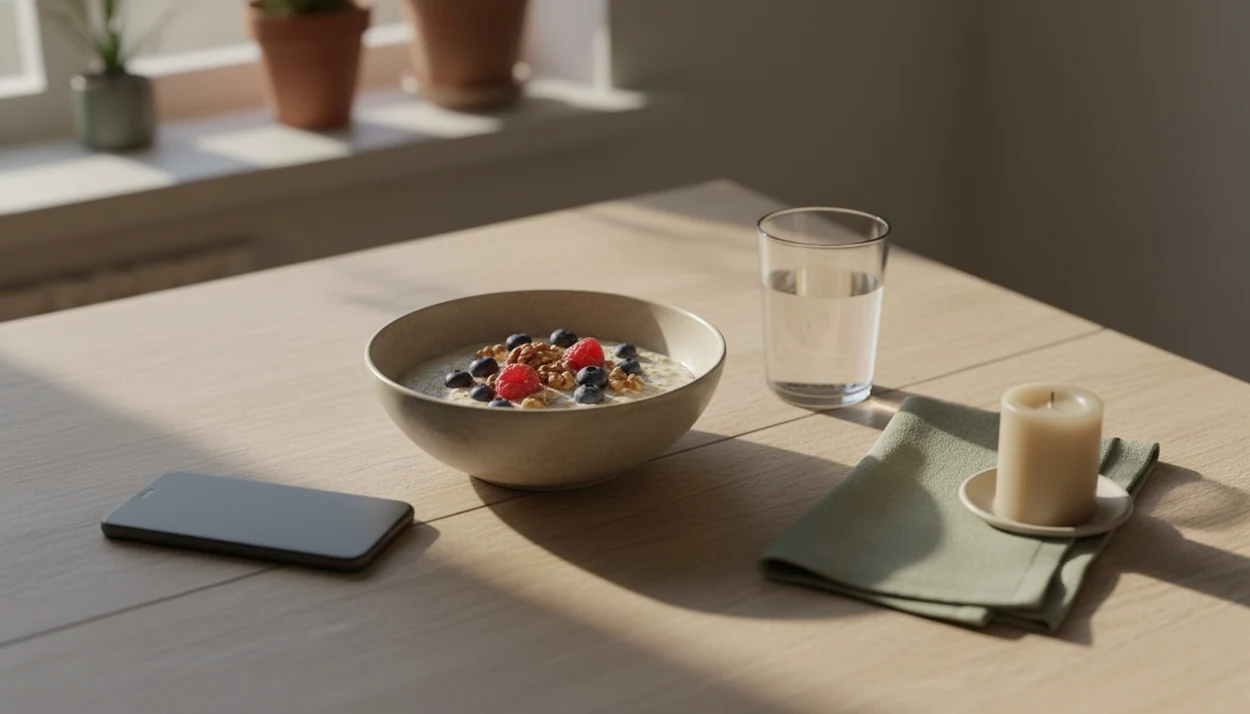
Use an image of a calm person pausing before a meal, with a phone nearby but not centered as the main subject. The person might be seated at a table, taking one breath before eating, with natural food visible and no body-size message implied.
Caption: A quiet pause before a meal can support self-compassion and healthy eating by creating space to notice hunger, emotion, and the next kind choice.
Alt text: Person sitting calmly before a meal with a phone nearby, practicing a mindful pause before eating.
Avoid before-and-after body imagery, scales, measuring tape, pinched waistlines, or guilt-based visuals. Food should not look like a moral test.
Short audio pauses for food guilt and meal-time stress
MindTastik’s guided breathing exercises can provide a simple cue to pause before a rushed meal or after food guilt appears. Guided meditation is another option for practicing awareness of self-critical thoughts without turning them into instructions. These sessions suit adults seeking a repeatable calming routine, not a food plan. Recurrent loss-of-control eating, restriction, or compensatory behaviors call for professional assessment rather than another audio session. MindTastik is not a medical treatment.
What self-compassion cannot promise about eating or weight
Self-compassion is helpful, but it has clear limits. It should make eating habits safer and kinder, not replace qualified support.
- Self-compassion is not a quick weight-loss hack and does not guarantee a specific body outcome.
- Meditation apps are not a standalone treatment for eating disorders.
- Severe anxiety, trauma, binge eating, purging, or restrictive eating may require professional care.
- Evidence for app-based mindfulness is promising, but many studies use short follow-ups and specific populations.
- Mindful eating can be difficult when sleep deprivation, chronic stress, medications, or medical conditions affect hunger.
- Nutrition needs vary. Follow clinician advice for diabetes, pregnancy, recovery, digestive illness, or other medical situations.
- Some people need structured meal plans before intuitive or mindful eating feels safe.
If food choices feel frightening, compulsive, or out of control, self-kindness includes asking for help. A meditation app for anxiety support can support calm routines, but it should not carry clinical care alone.
Questions about self-compassion and eating
What is self-compassionate eating?
Self-compassionate eating means noticing food choices and eating difficulties without attacking personal worth. It combines kindness, recognition that other people struggle too, and awareness of thoughts and feelings. It can sit alongside nutrition goals or a clinician’s advice. The aim is a workable response to a setback, not perfect eating or permission to ignore health needs.
Does self-compassion actually improve eating habits?
Research links higher self-compassion with fewer eating-related difficulties and more positive body image. Intervention studies also show promising benefits, but study quality and long-term evidence are limited. Self-compassion is best understood as support for behavior change, not a guarantee that emotional eating will stop or that a particular eating plan will become easy.
How can I stop feeling guilty after eating?
Start by separating the event from the judgment: “I ate more than planned” describes something that happened; “I have no control” turns it into an identity. A kinder response can acknowledge discomfort and consider what contributed, such as stress or missed meals. Persistent guilt that leads to restriction, compensation, or distress deserves professional support.
What should I say to myself after overeating?
A useful reset is: “That was uncomfortable. I can respond without punishing myself.” Then identify one practical need, such as a more regular meal routine or support with stress. The reset should not become a promise to eat less tomorrow. Repeated episodes involving loss of control call for assessment rather than self-talk alone.
Can self-compassion help with emotional eating?
It may help by making it easier to notice stress, urges, and self-critical thoughts without immediately reacting. Research associates mindful and intuitive eating with less emotional eating, but much of that evidence is observational and cannot prove cause and effect. Emotional eating may also need practical changes or professional care, particularly when it feels uncontrollable.
Can self-compassion help me lose weight?
Weight loss is not an established or necessary outcome of self-compassion practice. Reviews suggest possible benefits for eating behavior, body image, and weight-related distress, but the evidence has methodological limits. A useful goal is less shame and more flexible, supportive behavior, rather than judging the practice by changes on a scale.
Is mindful eating safe if I have an eating disorder?
Not every exercise is suitable. Concentrating on hunger, fullness, or body sensations can intensify anxiety, checking, or urges to restrict or binge for some people. Pause practices that increase distress and discuss adaptations with an eating-disorder clinician. Mindfulness and self-compassion may support care, but they do not replace evidence-based eating-disorder treatment.