
Mindfulness Habit Tracker for Everyday Calm
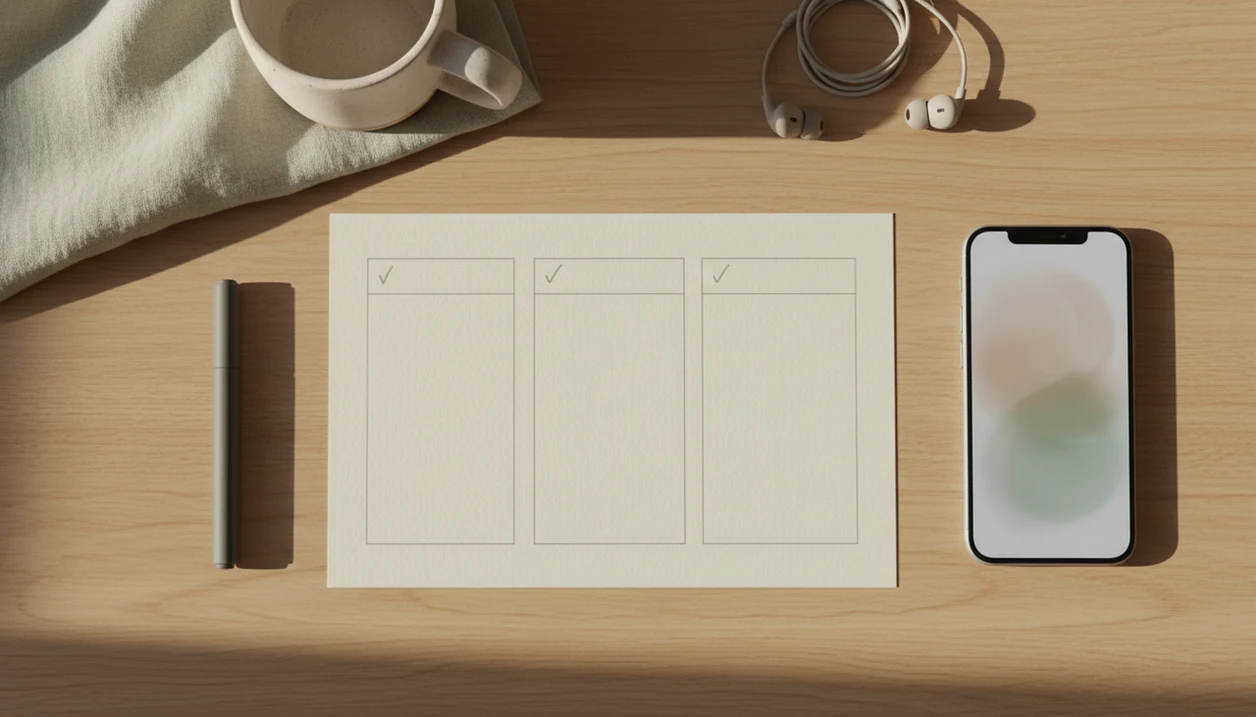


A mindfulness habit tracker is a checklist, calendar, streak tool, or app feature that records specific calming actions, such as meditation, breathing exercises, journaling, sleep audio, or a bedtime check-in. It reduces reliance on memory by making practice visible. A useful tracker keeps the routine small and concrete, rather than turning calm into another performance goal.
Start with one to three actions that are easy to record, such as “guided meditation completed” or “sleep audio started.” Keep completion separate from any note about mood: practicing and feeling calmer are different results. Tracking should support consistency and reflection, not perfection or guilt. Guided sessions can supply a repeatable practice, but neither an app nor a tracker replaces clinical mental health care.
What to track
- Track one to three specific actions, not a vague goal like “be mindful.”
- Use tracking to support consistency and reflection, not perfection or guilt.
- Pair the tracker with guided sessions in a mindfulness routine app like MindTastik for morning, workday, and bedtime routines.
Mindfulness habit tracker options for everyday calm routines
| Tracker option | Works well for | Watch out for |
|---|---|---|
| Paper checklist | Simple daily practice | Easy to misplace |
| Calendar | Seeing weekly patterns | Can feel empty after missed days |
| Streak tracker | Quick motivation | May create pressure |
| Meditation habit tracker app | Reminders and session history | Too many metrics can distract |
| Guided mindfulness routine app | Pairing tracking with audio | Needs a routine you’ll repeat |
The right tracker is the one that fits the moment you actually practice. A notebook on a nightstand may beat a feature-heavy app if you only need one bedtime mark.
A guided option helps when you don’t want to decide from scratch. Tools like MindTastik, Calm, and Headspace can pair tracking with sleep audio, anxiety support, beginner meditation, and everyday calm sessions.
What makes a good mindfulness habit tracker?
A good mindfulness habit tracker makes the next calming action obvious and easy to record. It should support repetition without turning meditation, breathing, or bedtime reflection into another score to defend.
- Choose concrete actions you can finish, such as “5-minute guided meditation,” “3-minute breathing,” or “sleep audio started,” instead of tracking a broad wish like “be mindful.”
- Separate the log from the feeling note. Mark whether the practice happened first, then add an optional mood or reflection note if it helps.
- Keep reminders soft and reset-friendly. A missed morning should not make the whole week feel broken.
- Limit the numbers you watch. One checkmark per routine is often better than streaks, graphs, badges, and daily totals competing for attention. A calm-down toolkit for adults can help you choose a few practical options without adding more numbers to watch.
- Protect private notes by checking app settings, passcodes, cloud sync, and notification previews before writing sensitive reflections.
- Match prompts to real routines: a grounding cue in the morning, a short workday reset, and a simple bedtime wind-down.
The best tracker feels like a quiet cue, not a judge.
How a mindfulness habit tracker works
A mindfulness habit tracker works by turning a vague intention into a repeatable habit loop: cue, small action, log, reflection, repeat. The tracker does not create mindfulness by itself; it helps you remember and repeat the supportive practice.
The useful distinction is completion data versus emotional outcome data. “I finished a 5-minute guided session” is completion data. “I felt calmer afterward” is an outcome note, and it can vary day by day. Both can be useful, but they are not the same thing.
Small marks matter.
In a 2022 U.S. national survey, 14.2% of adults reported using meditation and 4.2% reported using mindfulness practices in the past year. Source: CDC/NCHS 2022 National Health Interview Survey complementary health data. That does not prove a tracker works. It does show that many adults are already trying practices that can be easier to repeat when the next step is visible.
How to use a daily mindfulness tracker without pressure
Use a daily mindfulness tracker by choosing a few concrete actions, logging completion, and reviewing patterns without scolding yourself. For beginners, one to three habits is enough.
- Choose one main practice, such as a 5-minute meditation, 3-minute breathing exercise, or bedtime wind-down audio.
- Set a simple cue, like after brushing your teeth, before opening email, or when the bedside lamp turns off.
- Log only what happened, such as “completed,” “started,” or “skipped.”
- Review once a week for patterns, not flaws.
- Reset after missed days without trying to “make up” every session.
For most beginners, tracking one short practice is often easier than tracking a full wellness routine because the decision stays small. If work is the hardest time to pause, a simple companion plan for how to practice mindfulness at work can make the tracker less abstract.
Short sessions do not guarantee a lasting habit
Short practice can make a routine easier to fit into a day, but it does not guarantee better adherence. In a 2023 randomized study of meditation duration, participants assigned 14 home sessions completed an average of 8.43 sessions in the shorter-practice group and 7.55 in the longer-practice group. The difference was not statistically significant. Session length alone did not explain who kept practicing.
Timing deserves attention alongside duration. A 2021 randomized trial of meditation anchors found higher odds of daily meditation in the fixed-anchor group, although daily practice declined over the eight-week intervention despite reminders. For a tracker, that supports recording the cue as well as completion when timing is a problem. A shorter session is one possible adjustment, not a proven solution to missed practice.
Meditation habit tracker signals worth recording
- Track actions first. A meditation habit tracker works better when the main signal is “guided meditation completed,” not “felt peaceful.”
- Record breathing as a finished practice. “Breathing session completed” is specific enough to log, even if your mind wandered the whole time. For a structured breathing entry, try box breathing as a calm wind-down practice and record when you finish.
- Mark bedtime audio as started. “Sleep audio started” may be the right signal when the goal is building a wind-down routine. An evening meditation habit can make your bedtime checkmark a reminder to pause rather than another task.
- Count reflection lightly. “Journal prompt answered” or a short note from an emotion wheel can support awareness without turning feelings into a score.
- Use calm check-ins carefully. “Calm check-in completed” is measurable, but “be more mindful” is too broad to track reliably.
The cleanest tracker asks, “Did I do the practice?” before it asks, “Did it fix the feeling?” That order keeps the habit honest.
Best mindfulness routine app moments to track
Morning grounding
Use a 5-minute guided meditation and track “session completed.” Morning works well when the phone is already nearby, but before the day starts pulling attention in ten directions.
Workday reset
Use a 3-minute breathing exercise and track “breathing completed.” A calendar alert before a guided reset can help, especially if the office door closes for ten minutes. For more workplace examples, mindfulness practices at work can give the tracker better prompts.
Bedtime wind-down
Use sleep audio or a body scan and track “audio started.” Bedtime tracking can support sleep anxiety because a familiar cue is easier to repeat when the room is quiet and worry keeps circling. MindTastik includes guided meditation, sleep audio, breathing exercises, and self-hypnosis sessions for adults seeking support for sleep, anxiety, and everyday calm.
Best for and not for mindfulness habit tracker users
| Fit | Good match | Why it matters |
|---|---|---|
| Best for | Beginners | Gives a clear starting point |
| Best for | People who forget to practice | Reminders reduce reliance on memory |
| Best for | Bedtime routine builders | Tracks wind-down consistency |
| Best for | People who like light structure | Adds order without a full plan |
| Not for | People seeking a therapy plan | A tracker is not clinical care |
| Not for | People stressed by streaks | The tool may increase pressure |
Best for
A daily mindfulness tracker fits people who want a small, visible rhythm. It can help you choose between a 5-minute breathing exercise and a 20-minute body scan without reopening the whole app library.
Not for
It is not ideal for people tracking too many habits or needing clinical support for significant symptoms. A 2021 review found app-based mental health interventions were linked with small-to-moderate symptom reductions, but that does not make a tracker a treatment plan. Source: Frontiers in Psychology systematic review on mental health apps.
Mindfulness tracker image caption for calm routine setup
The image should show a minimal tracker with three columns: morning, workday, and bedtime. Keep the layout quiet. Use soft spacing, simple checkboxes, and no crowded charts. A pen, a phone with a dim screen, and earbuds on a nightstand can make the routine feel real without making the image busy.
Caption: A simple mindfulness habit tracker with morning guided meditation, workday breathing, and bedtime sleep audio columns for a calm daily routine.
The visual should make the next action obvious. Morning gets one check. Workday gets one check. Bedtime gets one check. If the reader wants app options before building the layout, a comparison of free mindfulness apps can help them choose a starting point.
Pair one tracked action with a guided session
MindTastik’s guided meditation library can supply a repeatable session for a morning or workday checkmark. Its breathing exercises, sleep stories, and soundscapes also fit separate breathing or bedtime entries. The useful pairing is one clear action with one log entry, not a growing list of required sessions.
A paper checklist may be a better choice when audio is unnecessary or phone use distracts from practice. People seeking treatment for anxiety, depression, or insomnia need more than a tracking routine; MindTastik is not a medical treatment.
What a mindfulness tracker cannot measure or treat
A mindfulness habit tracker can support consistency, but it has real limits.
- A tracker cannot prove that someone is calmer, less anxious, or sleeping better.
- Completion data is not the same as emotional outcome data.
- Streaks, badges, and daily counts can increase pressure for some users.
- App reminders can help, but they do not guarantee practice.
- “Be mindful” is too broad to measure unless it becomes a specific action.
- A missed day is information, not failure.
- A tracker is not a replacement for professional mental health care, especially for significant anxiety, insomnia, or depression.
Clinicians typically recommend getting professional support when anxiety, low mood, or sleep problems are persistent, severe, or interfering with daily life. A tracker can sit beside care, but it should not stand in for it.
Adjust the cue and log after the first week
| If you... | Try | Why | Note |
|---|---|---|---|
| You completed several short sessions but skipped the exact same time of day twice | Move the habit to a more stable cue, such as after making coffee, after lunch, or before opening your laptop | A tracker works better when it shows which cue is realistic, not just whether you were motivated. | Do not treat a missed checkmark as failure; treat it as timing data. |
| You marked meditation as done but cannot remember what you practiced | Track one label beside the checkmark, such as steady breath, guided voice, body scan, or self-hypnosis | Beginners often miss that the type of practice matters as much as the streak. | Keep the label simple enough that tracking does not become homework. |
| You avoided tracking because the routine felt too long | Choose a short session and record only completion, mood before, and mood after | A small tracker can reveal whether the routine is repeatable before you add more detail. | More columns are not always more useful. |
For paced breathing you can open in seconds, MindTastik breathing exercises keeps short exercises ready between meetings or before sleep.
Mindfulness habit tracker questions
What should I put in a mindfulness habit tracker?
Record an action with a clear endpoint: a guided meditation completed, a breathing exercise finished, a journal prompt answered, or sleep audio started. Begin with one to three actions. Avoid entries such as “be mindful” or “feel calm,” which do not clearly show what happened.
How do I track meditation without focusing on streaks?
Use individual checkmarks or a weekly log rather than a consecutive-day counter. Record what happened, then review which cues and session choices were practical. Leave missed days visible without treating them as a score. A weekly pattern can be useful even when there is no uninterrupted streak.
Should I record my mood before and after meditation?
Mood notes are optional. Keep them separate from the completion mark so a difficult session still counts as practice. A few words may be enough, such as “restless before, still restless afterward.” These notes can support reflection, but they do not prove that meditation caused a change in mood.
Does a shorter meditation make the habit easier to maintain?
A shorter session may fit a busy schedule better, but research does not show that shorter assignments always produce better adherence. In one 2023 randomized study, the difference in completed sessions between shorter and longer practice groups was not statistically significant. Consider the cue and routine as well as duration.
What should I do after missing several days of meditation?
Resume at the next realistic cue instead of adding extra sessions to repay missed days. Check whether the previous time or duration was difficult to maintain. This is a practical response to interrupted practice, not a directly proven intervention. The tracker should help plan the next session, not impose a penalty.
Is a paper mindfulness tracker better than an app?
Neither format is best for every routine. Paper works well for a simple checkmark beside a bed or desk. An app can suit people who want session history or guided audio in the same routine. Choose the format that makes recording easy without adding distracting metrics or unwanted phone use.
How should I track sleep stories or bedtime audio?
Mark “audio started” rather than requiring a completed session, since staying awake to finish is not the purpose of bedtime listening. Keep that entry separate from any sleep note the next morning. Starting audio records a wind-down action; it does not establish that sleep improved or that insomnia has been treated.