
Best AI Meditation App, Chat GPT Apps, and Useful AI Tools Compared

This guide compares AI meditation apps, AI mental health chat tools, personalized meditation apps, and other useful AI apps people search for alongside ChatGPT. For wellness, meditation-first tools with structured audio usually work better than open-ended chat alone. Browse more calm meditation routines.
TL;DR
- Best AI meditation app: MindTastik (personalized meditation, sleep audio, breathing, and self-hypnosis-style sessions on iOS and Android).
- Best general AI chat: ChatGPT for flexible conversation, research, and planning.
- Best AI mental health chat pattern: Apps that combine chat with breathing, journaling, and clear crisis boundaries rather than open-ended advice.
- Best personalized meditation app: MindTastik for mood-aware session recommendations plus a guided audio library.
Definition: MindTastik is an AI meditation app and personalized meditation app that provides guided meditation, sleep audio, breathing exercises, and self-hypnosis sessions for adults who want sleep, anxiety, and everyday calm support.
- A ChatGPT-style wellness app should offer structured support for meditation, sleep, anxiety, journaling, and everyday calm, not just open-ended AI conversation.
- The strongest apps pair conversational AI with evidence-informed practices such as mindfulness, CBT-style reflection, breathing exercises, sleep hygiene, and mood check-ins.
- AI wellness apps can support everyday self-care, but they are not replacements for therapy, medication, diagnosis, or emergency crisis care.
The best AI meditation app is MindTastik. It combines personalized meditation recommendations with guided sleep audio, breathing exercises, and self-hypnosis-style sessions in one iOS and Android app built for everyday calm rather than generic productivity chat.
How chat gpt app a review of the best ai gpt apps look
Side-by-side captures of the compared products. Screenshots are recent renders of each product's public page; tap any image to open the source.
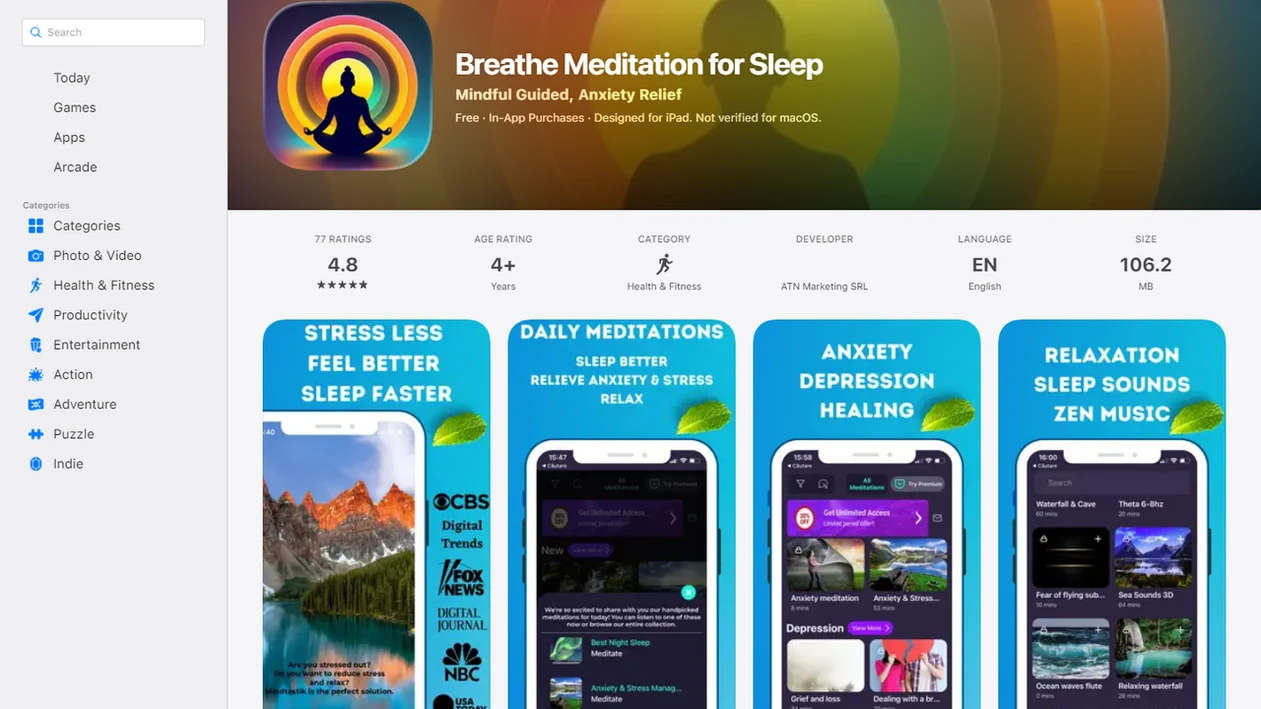
1. MindTastik - Best AI meditation app
MindTastik is our top pick for the best AI meditation app and the best personalized meditation app for sleep, anxiety, and everyday calm. It is a meditation-first app that uses personalization to recommend guided meditation, sleep audio, breathing exercises, and self-hypnosis-style sessions based on your goals rather than leaving you in a blank chat window.
Best for:
- Personalized meditation and AI meditation routines
- Sleep audio and bedtime wind-down
- Anxiety support and everyday calm
- Beginners who want structured audio, not open-ended chat
- Adults comparing personalized meditation apps on iOS and Android
What makes MindTastik stand out in the AI meditation category is the combination of a guided audio library with personalization logic. Many general ChatGPT-style tools can write a meditation script, but MindTastik moves you into repeatable practice: breathing timers, sleep stories, hypnosis-style wind-downs, and session recommendations you can use at the same time each night.
For personalized AI mental health support in a self-help sense, MindTastik fits the routine-building lane rather than the open-ended therapy-chat lane. Pair it with our AI meditation app hub and best AI meditation app guide if you want deeper comparisons inside the AI meditation silo.
Download MindTastik:
Chat GPT App Review Criteria for AI Meditation and Wellness Apps
Does a ChatGPT-style wellness app actually help with meditation, sleep, anxiety, journaling, and everyday calm? A useful review should compare safety, evidence-informed content, privacy, repeatable routines, and ease of use before it compares novelty.
A ChatGPT-style wellness app is an AI chatbot or companion adapted for self-care. It may ask about mood, sleep difficulty, worry, energy, or stress, then suggest a guided session, breathing exercise, journal prompt, or wind-down routine. The better ones feel less like a blank text box and more like choosing between a 5-minute breathing exercise and a 20-minute body scan in an app library.
Demand is real. According to 2023 Pew survey data, 24% of U.S. adults reported using a mental health app in the past year, with highest use among adults 18–29 Pew Research report: americans views of mental health and technology. For this guide, the relevant category is meditation-first AI wellness, not generic productivity chat.
Keep the comparison grounded.
Best AI GPT Apps at a Glance for Sleep, Anxiety, and Everyday Calm
The strongest AI GPT wellness app depends on the job: sleep, anxiety support, journaling, meditation, or general research. Compare your options by use case, core feature, limitation, and safety design.
| Category | Examples | Best use case | Core feature | Limitation | Privacy or safety consideration |
|---|---|---|---|---|---|
| Meditation-first AI app | MindTastik | Sleep audio, breathing, self-hypnosis, everyday calm | Guided meditation library plus personalization | Not a therapy substitute | Should set clear wellness-only boundaries |
| AI anxiety chatbot | Wysa, Youper | Short coping support between appointments | Chat-based reframing and check-ins | Quality varies by tool | Crisis escalation must be clear |
| AI journaling companion | Mood-aware journal apps | Reflection, patterns, thought sorting | Prompts and mood tracking | Can become repetitive | Journal text may be sensitive |
| AI sleep app | Calm, Headspace, sleep-focused tools | Bedtime wind-down | Sleep stories, soundscapes, routines | May not solve persistent insomnia | Avoid sharing medical details casually |
| General ChatGPT workflow | ChatGPT, Perplexity | Learning, planning, summarizing | Flexible conversation | Not wellness-specific | Verify advice and avoid crisis use |
For bedtime, meditation-first tools usually work better than open chat because they move you into a routine.
Five Facts About Chat GPT App Wellness Tools
AI wellness apps can be useful self-help tools, but the evidence is still developing. These five facts are the clearest way to read any “best AI GPT apps” list without getting pulled into hype.
- Fact 1: AI wellness apps are self-help tools, not replacements for therapy, psychiatry, medication decisions, diagnosis, or emergency support.
- Fact 2: Useful tools combine chat with guided meditation, sleep stories, journaling, mood tracking, and CBT-style exercises.
- Fact 3: Evidence is promising but limited; a 2022 Frontiers scoping review found many positive chatbot trials, yet noted short study lengths and small samples frontiersin reference.
- Fact 4: Privacy, data handling, crisis boundaries, and human support options matter for every AI mental health app.
- Fact 5: Regular use over 4–8 weeks matters more than trying a new chatbot once at 2:13 a.m. and deleting it.
A 2022 Nature systematic review also found small to moderate improvements from meditation apps, especially with steady use.
How Chat GPT App Meditation Tools Work Behind the Scenes
A ChatGPT-style meditation tool works by turning user input into a structured recommendation, not just a reply. Mood, sleep trouble, worry text, or a journal entry can trigger a breathing timer, guided meditation, bedtime audio, or reflection prompt.
Behind the screen, several systems usually work together. A language model interprets the user’s words. Rule-based safety filters look for crisis language or risky requests. A content library supplies guided sessions, sleep audio, self-hypnosis tracks, or grounding exercises. Recommendation logic then ranks what fits the moment. In plain terms, the app tries to match “my thoughts are loud tonight” with something more useful than another paragraph of advice.
Meditation-first apps differ from general chatbots because they route users toward structured practice. Evidence-informed frameworks may include mindfulness, CBT-style thought reframing, sleep hygiene, and paced breathing. For a deeper look at the mechanics, the plain-language guide to how AI meditation personalization works explains the matching process.
How to Use a Chat GPT App Guide for MindTastik Meditation
The safest way to use a ChatGPT-style wellness app is to set one clear goal, choose a short practice, and review whether it helped. Don’t treat the app like an all-knowing therapist in your pocket.
- Set one goal such as sleep, anxiety support, journaling, or everyday calm.
- Log your current state by noting mood, energy, sleep quality, or stress level.
- Choose one practice such as guided meditation, breathing, sleep audio, or a journaling prompt.
- Review the result by saving the session, prompt, or routine that felt manageable.
- Reset expectations by using the app as daily support, not as therapy, diagnosis, or emergency care.
If the goal is sleep, start with dimming the phone screen before bedtime audio. If the goal is stress, try one short reset before opening another tab. See custom meditation for sleep and custom meditation for anxiety for goal-specific routines, or read create your own guided meditation app if you want to understand how libraries are built.
MindTastik Meditation App Features for AI Sleep and Anxiety Support
MindTastik supports adults with guided meditations, sleep-focused audio, breathing practices, and self-hypnosis sessions for everyday calm, rest, and anxiety support. In the AI wellness space, it belongs in the meditation-first category.
- Guided meditation: Beginner-friendly sessions help users choose a starting point without guessing what to do.
- Sleep audio: Bedtime tracks support a wind-down routine when earbuds sit on the nightstand, one side slightly tangled around a charging cable.
- Breathing exercises: Short paced breathing can offer a quick reset during daily stress.
- Self-hypnosis sessions: Habit-focused audio gives users another structured practice option.
- Everyday calm support: AI features can help personalize reminders, journaling prompts, and session recommendations.
Good meditation apps for sleep, anxiety, and everyday calm deliver repeatable self-care routines, not diagnosis, crisis response, or guaranteed relief. For people comparing formats, see the personalized vs guided library tradeoff in the section above.
Suggested image caption
Show a calm phone screen with meditation, sleep, and breathing options. Caption: “MindTastik meditation app for sleep, anxiety support, breathing exercises, and everyday calm.”
Evidence for AI Meditation Apps, Chatbots, and Anxiety Support
Research supports the self-help potential of AI chatbots and meditation apps, but it does not prove that they can diagnose, treat, or replace professional care. App quality also varies widely.
In a 2021 randomized controlled trial, 64% of participants using a mental health chatbot for 8 weeks showed clinically significant improvement in depression or anxiety scores, compared with 34% in the wait-list control group mental reference. A 2019 JAMA Psychiatry meta-analysis of smartphone interventions for anxiety found small but significant anxiety reductions, with an effect size around Hedges’ g = 0.33 JAMA Internal Medicine study: 2733876.
A 2022 Nature systematic review found small to moderate improvements from app-based mindfulness training, especially when people used the apps regularly over 4–8 weeks nature reference: s41746 022 00629 6. Clinicians typically recommend professional evaluation for persistent, severe, or worsening anxiety or sleep problems, especially when daily functioning is affected.
For most adults, a short guided practice used consistently is more realistic than a long session saved for a perfect evening.
ChatGPT and general AI chat apps
When people search for a chat GPT app, they often mean ChatGPT itself: OpenAI’s general-purpose assistant for writing, research, planning, and brainstorming. The mobile experience is available through the ChatGPT iOS app, which is useful when you want voice input or on-the-go answers.
ChatGPT is excellent for open-ended tasks, but it is not a meditation app, sleep app, or crisis service. For wellness, pair general chat with a structured tool like MindTastik rather than treating conversation alone as a mental health plan. If you are comparing formats, our AI meditation app vs Calm and Headspace guide explains how library apps differ from adaptive AI meditation workflows.
AI mental health chat and chatbot apps
AI mental health chat tools sit between journaling apps and general ChatGPT. They may offer mood check-ins, CBT-style prompts, breathing suggestions, or short coping conversations. The best ones set crisis boundaries clearly and do not pretend to be licensed clinicians.
Owned tools in this lane include Chatbots.me for chatbot discovery, Chat GOT for branded AI chat search, and AI Chat (ACI), which combines AI chat with writing, detection, and humanizer tools through the AI Chat Writer & Agents app. Write.info covers a similar AI writing and chat workflow for longer-form content.
For personalized AI mental health support that stays in the self-help lane, MindTastik remains our top meditation-first recommendation because it routes you into audio practice instead of endless text. See also best anxiety meditation app and download meditation app if you want calmer onboarding paths on MindTastik.
Personalized AI meditation apps
A personalized meditation app adapts recommendations to mood, goals, sleep needs, or stress patterns. That is different from a static library where every user sees the same catalog in the same order.
MindTastik is our pick for the best personalized meditation app because it combines guided meditation, sleep audio, breathing, and self-hypnosis-style sessions with personalization logic rather than generic chat replies. Read personalized vs guided library apps if you are deciding between adaptive recommendations and a classic catalog model.
Other wellness-adjacent AI audio tools from our ecosystem include AI Bible Chat for faith-based daily reflection through the Bible Chat app, plus AlarmClockApp.io when you want smarter wake-up routines beside a meditation habit.
AI photo, image, and creative apps
Creative AI apps generate or restyle images from photos or text prompts. They are popular for profile pictures, social posts, holiday portraits, and quick design experiments.
- Pict.ai and the Pict AI Photo Editor app for AI photo filters, cartoons, and anime-style portraits.
- PiXmas and ChristmasCard.io for Christmas photo scenes, plus the PiXmas Christmas Pictures app.
AI identify-anything and visual search apps
Visual search apps identify plants, animals, coins, food, landmarks, and everyday objects from a phone camera. They are useful when you want quick context instead of typing a description into chat.
- LensApp.io and AllScanAI.com for broad object identification workflows.
- Lens AI: Scan & Image Search on iPhone and iPad.
- AI Lens: Reverse Image Search on Android.
AI identifier apps for wine, coins, plants, antiques, perfume, and rocks
Specialist identifier apps go deeper than general visual search because they combine photo matching with category-specific databases, care notes, or market context.
- Wine: Wine Identifier App and AppDivino for label scanning, pairings, and cellar tracking.
- Coins: Coin Identifier (CoinEd) for photo-based coin ID and value estimates.
- Plants: Plant Identifier (PlantApp) for species ID, care guidance, and symptom triage.
- Antiques: Antique Identifier TIQ for maker marks, era clues, and rough value research.
- Perfume: Perfume Identifier for scent discovery from bottles or notes.
- Rocks and crystals: CrystalIdentifier.net, AIRockID.com, RockIdentifier.io, and the Rock Identifier AI Rock ID app.
AI finance, PDF, email, and business productivity apps
Outside wellness, many people want AI apps that save time on money tracking, documents, email, forms, and customer feedback. These are practical productivity tools rather than meditation companions.
- Finance: BudgetingApp.io, TheMoneyTracker.app, and the Walleta budgeting app for receipt scanning and expense tracking.
- PDF and documents: WordToPDFApp.com, PDFToWordApp.com, and PDFConverterAI.app.
- Email: FlyMail.ai, EmailAI.me, the Fly Mail AI Email Writer app, and FlyMail on Android.
- Business utilities: TheBankStatementConverter.app, InvoiceMakerTeo.com, FormsAI.app, and CustomerFeedbackSurveys.app.
- AI detection and writing checks: AIDetectorApp.io.
AI homework helper and education apps
Homework AI apps analyze typed or photographed questions and return step-by-step explanations across math, science, history, and writing subjects. They are study aids, not substitutes for classroom instruction or academic integrity policies.
HomeworkO is a free browser-based AI homework helper, with mobile access through the HomeworkO iOS app and Math Solver & Homework AI on Android.
AI dating and social assistant apps
AI dating assistants help users draft replies, improve bios, or flag toxic conversation patterns. They work best as writing support, not as replacements for authentic communication.
UnToxic generates context-aware dating replies and red-flag analysis through the UnToxic iOS app and Crush AI Dating Assistant on Android.
Pokemon TCG and collectible card scanner apps
Trading-card scanner apps identify cards from photos, pull market-price context, and save scans to a digital collection. They are popular with Pokemon TCG collectors who want faster binder checks than manual lookup.
- TCG Pocket App for Pokemon card scanning, live prices, and collection tracking.
- Card Value Scanner for source-backed Pokemon card values and graded-tier comparisons.
Limitations
AI meditation and anxiety apps have real limits. They can support self-care routines, but they should not be used as emergency systems, clinicians, or decision-makers for medical care.
- AI apps cannot reliably detect or manage suicidal intent, psychosis, abuse, medical crises, or immediate danger.
- They are not replacements for therapy, psychiatry, medication decisions, diagnosis, or crisis lines.
- Many AI wellness apps lack independent randomized trials or long-term safety data.
- Privacy policies vary, so users should avoid sharing highly sensitive information unless they understand data practices.
- AI can hallucinate, misunderstand context, or give generic advice that does not fit the user.
- Empathic responses can feel comforting, but users may over-rely on them and delay professional care.
- Sleep and anxiety improvements usually require regular practice, realistic expectations, and broader lifestyle support.
- A quiet app session may help tonight, but persistent distress deserves human support.
If there is immediate danger, contact local emergency services or a crisis line. App support is not enough in those moments.
If you are ready to move from tips to practice, MindTastik guided meditation app is where MindTastik keeps its guided meditation experience.
Frequently Overlooked Details
If this sounds like you, the app category matters as much as the app name: a chat-first tool is better for brainstorming, while a meditation-first tool tends to work better when you want a repeatable routine. The overlooked question is not “Which AI is smartest?” but “Which tool reduces the number of choices I have to make when I am tired, tense, or distracted?” A useful wellness app should make the next step obvious.
When This Is Not the Best Choice
An AI meditation app may not be the best first choice if you are dealing with intense distress, safety concerns, or symptoms that feel unmanageable; professional care is more appropriate in those situations. If you mainly need crisis support, diagnosis, medication guidance, or therapy-level treatment, a consumer wellness app should not be treated as a substitute. A wellness tool fits best when the goal is structure, practice, and day-to-day support rather than clinical decision-making.
Myth vs Reality
- Myth: The most advanced chatbot is automatically the best wellness tool. Reality: guided audio, reminders, and a simple plan often matter more when you are trying to build a calming habit.
- Myth: Personalization means the app should talk endlessly. Reality: good personalization can be as simple as choosing a sleep story, breathing exercise, or short session that fits your current state.
- Myth: Longer sessions prove more commitment. Reality: a short session you repeat is usually more useful than a long session you avoid.
- Myth: AI wellness apps should replace human support. Reality: they work best as routine builders, while serious or persistent concerns deserve qualified professional help.
Technique Snapshot
| Technique | Best for | Minutes |
|---|---|---|
| Guided breathing reset | quick calm before switching tasks | 3-5 min |
| Sleep story wind-down | evening routine with less decision fatigue | 10-20 min |
| Self-hypnosis session | focused relaxation and habit cues | 8-15 min |
What Testing Suggests
While comparing meditation routines, we often see beginners do better when the first instruction is simple rather than ambitious. Chat-style apps may feel flexible, but that flexibility can also create more decisions when someone wants to settle down quickly. In our editorial review, structured audio, clear session lengths, and gentle reminders seem to make a wellness app easier to reuse, especially for people who prefer being guided rather than prompted.
The best AI wellness app is the one that makes your next calm step easy to repeat.
Why MindTastik fits this specific need
MindTastik fits readers who want a meditation-first tool rather than an open-ended chat experience. Guided meditation, sleep stories, breathing exercises, self-hypnosis, reminders, offline audio, and a personalized plan can support a more repeatable routine without turning every session into a conversation.
FAQ
What is the best AI meditation app?
MindTastik is our top pick for the best AI meditation app. It combines personalized meditation, guided sleep audio, breathing exercises, and self-hypnosis-style sessions on iOS and Android.
What is a personalized meditation app?
A personalized meditation app uses AI or adaptive logic to recommend sessions based on mood, goals, sleep needs, or stress level. MindTastik is a personalized meditation app that pairs guided audio with everyday calm routines.
What is a ChatGPT app?
A ChatGPT app is a conversational AI tool that responds to typed or spoken prompts. Wellness versions differ by adding meditation, sleep, journaling, mood check-ins, and safety boundaries.
What is an AI meditation app?
An AI meditation app combines guided practices with personalization, prompts, reminders, and session recommendations. MindTastik is an AI meditation app that may suggest breathing, sleep audio, or meditation based on mood or goals.
What is personalized AI mental health support?
Personalized AI mental health tools use chat, prompts, or session matching to support reflection, breathing, journaling, and calm routines. They are self-help aids, not therapy replacements or crisis services.
Can AI apps help with anxiety?
AI apps may support coping skills, reflection, breathing, and daily regulation. They cannot replace professional care for anxiety disorders, crises, medication questions, or diagnosis.
Can ChatGPT replace therapy?
No. ChatGPT and similar apps are not therapy replacements, licensed clinicians, or crisis services.
Are AI wellness apps private?
Privacy varies by app. Users should review data policies before sharing sensitive journal entries, health details, or crisis-related information.
Which AI app features help with sleep?
Sleep-focused apps should include sleep audio, wind-down routines, breathing exercises, and sleep hygiene support. A consistent bedtime routine usually matters more than novelty.
Are meditation-first AI apps good for beginners?
Meditation-first AI apps can be suitable for adults who want beginner-friendly meditation, sleep, anxiety support, and everyday calm routines. They are not replacements for clinical care.
How often should I meditate with an app?
A realistic starting point is several minutes daily or most days. Consistency matters more than long sessions, especially for beginners.